
Quick Summary
Preventing window screen damage during cleaning means using a soft-bristle brush or microfiber cloth, rinsing with a garden hose on a shower or flat setting held at least 12 inches away, and never using a stiff brush, wire brush, or jet spray. Clean screens flat and padded after removal, and avoid carrying them by the mesh or pulling on the frame.
- Use a soft-bristle brush or microfiber cloth instead of a stiff brush or scouring pad.
- Keep the nozzle at least 12 inches from the mesh and spray at a 45-degree angle.
- Avoid jet or cone nozzle settings, since straight-on force can push the mesh out of plane.
- Carry screens flat with the mesh facing up and never by the mesh or a single corner.
- Test any new brush on an inconspicuous corner before cleaning the full screen.
Table of Contents
- Why Window Screens Get Damaged During Cleaning
- Choosing Window Screen Cleaning Tools That Won’t Tear the Mesh
- How to Clean Window Screens Without Removing Them
- Safe Removal, Handling, and Reinstallation Steps
- How to Clean Screens Without Stretching the Mesh
- How Often to Clean Window Screens to Prevent Damage
- What to Do If a Window Screen Is Already Damaged
- Book a Professional Screen and Window Cleaning Quote
- Frequently Asked Questions
Preventing window screen damage during cleaning comes down to using gentle tools, low water pressure, and careful handling. Screens are thin, and a single bent corner or torn mesh section can mean a replacement. This guide walks through what usually goes wrong, which tools to choose, and how to clean screens without stretching or tearing them.
Most people reach for a stiff brush or a strong hose when a screen gets dusty. That habit causes most of the damage we see. Fiberglass and aluminum mesh both look sturdy, but they bend and tear under the wrong pressure.
Why Window Screens Get Damaged During Cleaning
Damage usually happens in three ways: pressure, pulling, and rough tools. A pressure washer can push the mesh out of its frame. Pulling a screen out of its track with bare fingers can bend the frame. A stiff brush can snag and tear the mesh.
Understanding these risks makes the rest of the process easier. Each step below is designed to avoid one of them.
Watch out: pressing hard with a brush on a dirty screen grinds grit into the mesh and can permanently stretch it.
Choosing Window Screen Cleaning Tools That Won’t Tear the Mesh
The right tools do most of the protecting, but “soft brush” and “gentle spray” are not specific enough to prevent damage. The tool choices below are matched to the two mesh types most homes have and to the pressure levels that keep frames square and mesh taut. For a closer look at gentle methods for hard water residue on screens and windows, see gentle cleaning methods for hard water residue.
Brushes and cloths. Use a soft-bristle brush with nylon filaments no stiffer than a toothbrush, or a microfiber cloth. Natural-bristle brushes and microfiber lift grit without snagging the weave. Avoid wire brushes, scouring pads, and stiff deck brushes, they catch individual strands and pull them out of the weave. A handheld vacuum with a soft brush attachment is the safest first pass because it removes loose dust before any liquid turns it into abrasive slurry.
Nozzle settings and spray distance. A garden hose with an adjustable nozzle is the right rinsing tool, but the setting matters as much as the tool. Use the “shower” or “flat” setting, never “jet” or “cone.” Keep the nozzle at least 12 inches from the mesh and spray at a 45-degree angle rather than straight on. A straight-on jet at close range is the single most common cause of mesh deformation, because the force pushes the weave out of plane while the frame holds the edges fixed.
Soap and water. A few drops of mild dish soap in a bucket of water is enough. Avoid degreasers, bleach solutions, and abrasive cleansers, they can dull aluminum frames and degrade fiberglass mesh over time. Mix only what you need; a bucket of soapy water left standing is not a cleaning advantage.
Material-specific tool notes.
- Fiberglass mesh: the most forgiving, but it stretches permanently under a hard brush. Stick to microfiber and low pressure.
- Aluminum mesh: stiffer and more dent-resistant, but the weave can crease if bent. A soft brush is fine; never use a scraper to remove stuck debris.
- Solar screens: the denser weave traps grit, so vacuum first and rinse longer at low pressure. Do not scrub, the tighter weave concentrates brush force.
- Pet-resistant mesh: the heavier gauge tolerates more contact, but the frame and spline are the weak points. Keep pressure low and avoid pulling on the mesh to test its strength.
Test any new brush on an inconspicuous corner of the screen before using it across the full mesh. A brush that feels soft on your hand can still snag a loose weave.
How to Clean Window Screens Without Removing Them
Cleaning a screen in place is often safer than taking it out. Start by vacuuming loose dust and debris with the soft brush attachment. Work from the top down so dirt does not fall onto clean areas.
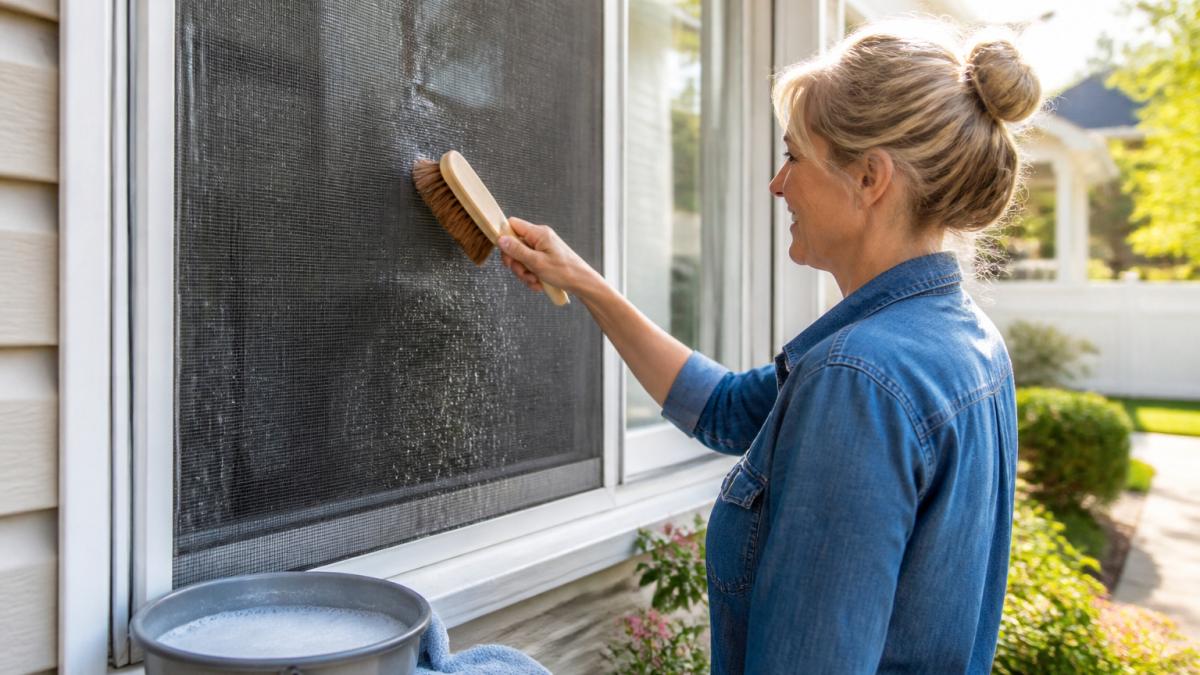
Next, mix a small amount of mild soap in a bucket of water. Dip a soft cloth, wring it well, and wipe the mesh gently in one direction. Then rinse the screen with a garden hose at low pressure, spraying from the outside in. Clean both sides of the screen so grime does not get trapped.
Let the screen air dry fully before closing the window. A damp screen can stick to the frame and warp.
Safe Removal, Handling, and Reinstallation Steps
Most screen damage happens during removal and reinstallation, not during washing. A frame that is twisted on the way to the cleaning area will not sit square in its track again, and a spline that is pulled loose during removal is hard to reseat without a new spline. The workflow below is built to keep the frame square and the mesh under even tension from the moment you touch the screen.
Before you remove the screen. Note which way the screen sits in its track, most screens have a top and bottom, and some have a slight bevel that only fits one way. Take a photo with your phone if the orientation is not obvious. Check the tabs or spring clips for cracks; a brittle tab can snap during removal and leave the screen loose in the track.
Removal. Lift the screen straight up or press the tabs as the window design requires. Do not pry with a screwdriver or putty knife, the blade concentrates force on one corner and bends the frame. Hold the screen by its frame, never by the mesh, and keep both hands on opposite sides so the frame stays square as it comes out.
Transport. Carry the screen flat, with the mesh facing up, to your cleaning area. Do not carry it on edge or let it flex, a frame carried by one corner will twist under its own weight. If you must set it down, place it on a padded surface such as a moving blanket or a folded tarp, not directly on concrete or grass.
Cleaning surface. Clean the screen on a flat, padded surface. A flat surface supports the frame evenly; cleaning a screen propped against a wall or draped over a sawhorse puts bending stress on the frame and lets the mesh sag under the weight of water.
Reinstallation. Reinstall the screen in the same orientation, pressing the tabs back into place until they click or seat fully. Check that the frame sits flush in the track on all four sides before you close the window. A frame that rocks or sits proud of the track is not seated and will bend the next time the window is operated.
Spline and tab care. If the spline (the rubber cord that holds the mesh in the frame groove) is loose or cracked, reseat it with a spline roller rather than pushing it in with a screwdriver. A screwdriver stretches the spline and can tear the mesh at the groove edge. Replace cracked tabs rather than forcing them; a replacement tab is inexpensive and prevents the screen from falling out.
Never carry a screen by the mesh or by a single corner. The frame is the structural part; the mesh is not designed to bear any load.
When to skip removal. If the screen is large, stuck, or already slightly bent, cleaning it in place is often safer than forcing it out of the track. Removal is only the better choice when the screen comes out easily and the frame is sound.
How to Clean Screens Without Stretching the Mesh
Stretching usually comes from scrubbing too hard or spraying too close. Keep the nozzle at least a foot from the mesh, use light, even strokes, and never pull the screen tight while wiping. If you see a slight sag after cleaning, let it dry and check again. Most minor sagging corrects itself once the mesh is dry and back in its frame.
A common mistake is cleaning a screen with the window still closed behind it. Water can run into the window track and push dirt back toward the mesh. Open the window or remove the screen first.
How Often to Clean Window Screens to Prevent Damage
Many homes do well with a light cleaning every few months and a deeper cleaning once or twice a year. Homes near dusty roads, pollen-heavy trees, or the coast may need more frequent attention. Regular light cleaning keeps grime from building up, which means you rarely need to scrub hard.
| Cleaning Type | Frequency | Method |
|---|---|---|
| Light dusting | Every 1-3 months | Soft brush or handheld vacuum |
| Gentle wash | Every 3-6 months | Mild soap, cloth, low-pressure rinse |
| Full removal and clean | Once or twice a year | Remove, clean flat, air dry |
What to Do If a Window Screen Is Already Damaged
Small tears can often be patched with a screen repair kit, which uses adhesive patches or a thin strip of new mesh. For larger tears, bent frames, or mesh that will not lie flat, replacing the screen is usually the better choice. Measure the frame before buying a replacement so the fit is right.
Damaged screens also let in bugs and debris, so repairing them promptly protects your window as well.
Book a Professional Screen and Window Cleaning Quote
If you would rather not risk cleaning screens yourself, Professional window cleaning services can handle screen and window cleaning for you. You can request a quote for professional window cleaning to see what the service covers. Many homeowners also ask whether professional window cleaning is worth the cost before booking, which is a fair question to weigh against the cost of a replacement screen.
Pricing depends on the size of the property, the number of screens and windows, and how often you want service. Visit the Simply Superior Window Cleaning website for current prices or to request a free quote.
Frequently Asked Questions
What is the safest way to clean window screens without damaging them?
The safest method uses a soft-bristle brush or soft cloth, a few drops of mild dish soap in lukewarm water, and a garden hose on a low-pressure setting. Work gently in the direction of the mesh, avoid scrubbing hard, and rinse both sides. Pressure washers and stiff brushes are the most common causes of bent frames, torn mesh and stretched fiberglass. Let the screen air dry fully before reinstalling it in the window.
Can you clean window screens without removing them?
Yes. Most screens can be cleaned in place if you first vacuum or brush off loose dust and debris from both sides. Then use a soft brush and mild soapy water from the inside and outside, followed by a light rinse with a garden hose on low pressure. Cleaning in place is gentler on the frame and avoids the risk of bending or dropping the screen. Remove the screen only if it is heavily soiled or needs repair.
How often should window screens be cleaned?
Most homeowners benefit from cleaning window screens at least twice a year, typically in spring and fall. Homes near dusty roads, pollen-heavy trees or the coast may need cleaning more often, since salt and grime build up faster. Light dusting with a soft brush between deep cleanings helps keep mesh clear and reduces the amount of scrubbing needed later, which lowers the risk of damage.
When should a damaged window screen be repaired or replaced?
Repair a screen when the damage is limited to a small tear, a loose corner or a single bent section of frame that can be straightened. Replace the screen when the mesh is torn across a large area, the frame is badly warped, or the mesh sags and no longer holds its shape after cleaning. Damaged screens let insects in and can be pulled out of place by wind, so address problems promptly. Contact Simply Superior Window Cleaning for current pricing or a quote on exterior window service.