
Table of Contents
- What a Professional Window Cleaning Service Actually Covers
- A Standard Window Cleaning Service Description, Step by Step
- The Tools and Techniques Behind a Streak-Free Finish
- Your Residential Window Cleaning Checklist: What Gets Cleaned
- How Long Does Professional Window Cleaning Take?
- What Is Not Included and How Scope Varies
- Residential vs. Commercial Window Cleaning: Key Differences
- Frequently Asked Questions
Last Updated: October 15, 2026
What a Professional Window Cleaning Service Actually Covers
Homeowners want to know what they’re paying for before anyone shows up.
A standard visit covers more than you’d expect, and less than some ads imply. Below: the full scope, the process, and what’s usually an add-on.
A standard professional window cleaning typically includes:
- Interior and exterior glass on all reachable windows
- Frames, sills, and ledges wiped down
- Screens removed, washed, and reinstalled
Most companies quote per pane or per window. What changes the price is access, not effort: a ground-floor and a third-story window take very different equipment.
Scope is the real difference between quotes. Two bids for the same house can differ by hundreds of dollars because one includes tracks and screens and the other charges extra for them.
A Standard Window Cleaning Service Description, Step by Step
A professional window cleaning service description should read like a checklist, not a slogan. Here’s a standard residential visit.
From Arrival to Final Walkthrough
- Walkthrough and scope check. We confirm which windows, note any damaged glass or stuck panes, and flag anything that needs a different approach.
- Drop cloths and floor protection. Furniture gets moved aside, and floors get covered before any water comes out.
- Screens and tracks first. Screens come out and get washed. Tracks get vacuumed, then wiped.
- Exterior glass. We scrub with a soapy applicator, then squeegee the glass clean, working top to bottom.
- Interior glass. Same method inside, with extra care around sills and blinds.
- Detailing. Frames, sills, and edges get hand-wiped. This is where streaks usually hide.
- Final walkthrough. We check the glass in daylight and fix anything we missed before packing up.
That last step matters: streaks show up in angled light, so every pane is checked from an angle before finishing.
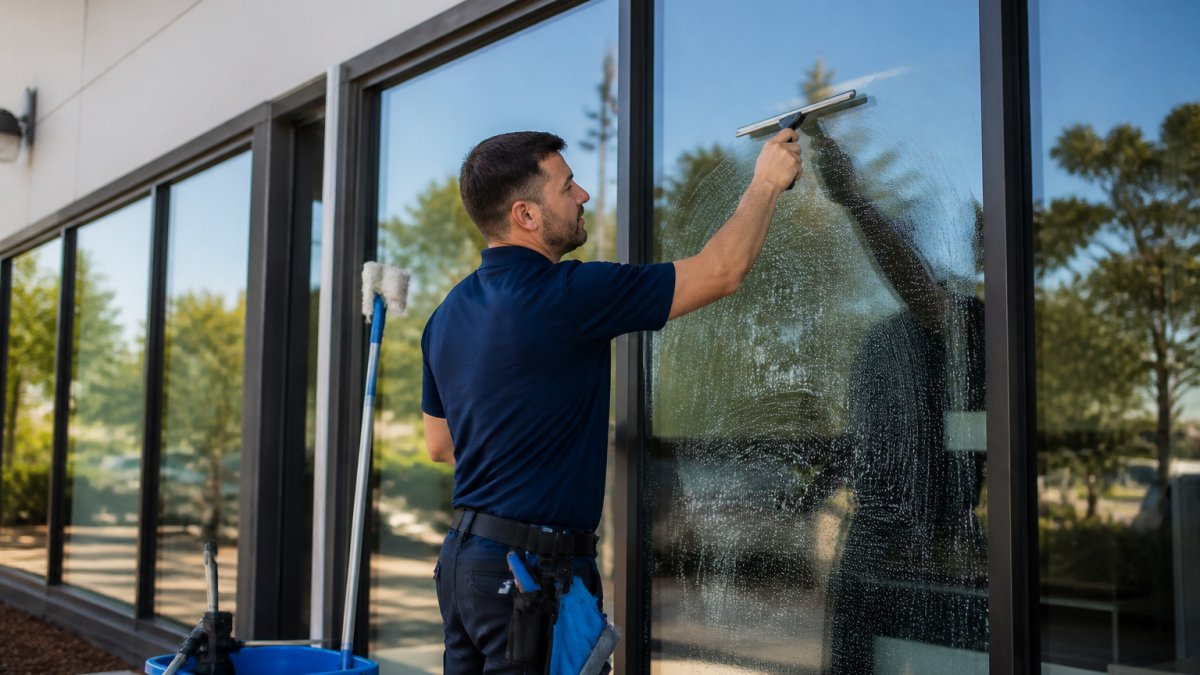
The Tools and Techniques Behind a Streak-Free Finish
Streak-free glass comes down to three things: the right tools, clean water, and technique.
Squeegees. A sharp rubber blade pulls water off in one pass.
Buckets. One for soapy water, one for rinse water.
Scrapers. A razor blade in a holder removes paint, stickers, and construction debris.
Extension poles and water-fed poles. These reach second and third stories from the ground.
Microfiber cloths and towels. For edges, sills, and detailing.
Purified water is the quiet hero here. Tap water leaves mineral spots as it dries. Water-fed poles use filtered water that dries spot-free, which is why upper-story glass often looks better than glass cleaned by hand.
Your Residential Window Cleaning Checklist: What Gets Cleaned
A residential window cleaning checklist covers more than glass. A full visit includes:
- Exterior glass on all accessible windows
- Interior glass on all accessible windows
- Window frames wiped top to bottom
Not every home needs every line: a house with no screens skips that step, and hard-water buildup needs extra time.
Window Screen Cleaning Service and Track Detailing
Screen cleaning and track detailing are the two steps most DIY attempts skip, and they make the biggest visible difference.
Screens trap pollen, dust, and bug debris, and a dirty screen makes clean glass look dull.
Tracks collect everything that falls off the glass and frame; left alone, that grit jams the window and stains the sill.
Never pressure wash window tracks or frames. High pressure forces water behind the frame and into the wall cavity, which can lead to rot and mold. Tracks need a vacuum and a cloth, not a hose.
How Long Does Professional Window Cleaning Take?
Professional window cleaning takes about 1 to 3 hours for a typical single-family home. Larger homes, heavy buildup, and upper-story access push that higher. The breakdown:
| Home Size | Typical Time | Main Time Driver |
|---|---|---|
| Small home, 1 story | 1-1.5 hours | Window count |
| Medium home, 1-2 stories | 1.5-2.5 hours | Ladder and pole setup |
| Large home, 2-3 stories | 2.5-3.5 hours | Access and safety setup |
| Home with heavy buildup | Add 1+ hour | Scraping and spot removal |
Two cleanings of the same house can take different times: a home cleaned last season moves fast, while one untouched for three years needs scraping and extra passes. Weather matters too, wind and direct sun dry glass too fast and cause streaks, so on hot days we work shaded sections first.
What Is Not Included and How Scope Varies
The fastest way to be disappointed by a window cleaning is to assume something is included when it isn’t. Standard window cleaning has a defined edge, and everything past it is an add-on or a different trade. Knowing where the line sits before you book is the difference between a fair price and a surprise invoice.
What a standard visit does not include
These fall outside a standard residential or commercial window cleaning, usually because they need different equipment, chemicals, or a license:
- Pressure washing. Siding, driveways, patios, and decks need a pressure washer and surface cleaner, not a squeegee. Some companies bundle it; it’s still a separate line item.
- Gutter cleaning and downspout clearing. Roof and ladder work with debris hauling, frequently sold alongside window cleaning but never part of the base price.
- Solar panel cleaning. Panels require deionized water and a soft brush to avoid micro-scratches and voiding a warranty. It’s a specialty service.
Why the line moves between companies
Two quotes for the same house can differ by hundreds of dollars because one company treats screens and tracks as standard and the other as add-ons. Neither is wrong, but the pricing model changes what you’re comparing.
The all-inclusive model bakes screens, tracks, and sills into a per-pane or per-window rate. The base-plus-add-on model prices glass as the base and itemizes everything else.
When you compare bids, compare the scope, not the headline number. Ask each company to put in writing whether screens, tracks, sills, and hard-water spot treatment are included or extra. That single question exposes the real price difference.
How to confirm scope before you book
A short, specific conversation before the visit prevents almost every dispute. Ask these questions and get the answers in writing:
- Which surfaces are included? Glass only, or glass plus frames, sills, tracks, and screens?
- How are screens handled? Removed and washed, or wiped in place?
- Are tracks vacuumed, or just wiped? Vacuuming is the step that actually clears grit.
- What counts as an add-on? Get the list and the price for each.
- How is hard-water spotting handled? Is light spotting included, and at what point does it become a specialty treatment?
- What happens if a pane can’t be reached? Is it skipped, or is there a charge either way?
- Is there a minimum charge or trip fee? Small jobs often carry one.
How scope varies with frequency and condition
Scope also scales with how often the property is cleaned and the condition of the glass on arrival.
A home on a recurring schedule, once or twice a year for residential, monthly or quarterly for storefronts, stays ahead of mineral buildup and pollen film.
That’s why a reputable company often quotes a first-time deep clean higher than the recurring rate: the scope of work is genuinely larger on visit one.
Residential vs. Commercial Window Cleaning: Key Differences
Residential and commercial window cleaning share the same core method, scrub, squeegee, detail, but diverge sharply on access, frequency, scheduling, safety, and insurance. Knowing the differences helps a homeowner know what to expect and a property manager choose the right provider.
Scope of work
Residential work is usually a whole-house job: every reachable pane inside and out, plus frames, sills, tracks, and screens. The scope is defined by the building, and the customer lives there. Commercial work is defined by the contract, not the building: a storefront contract might cover only street-facing glass and entry doors, while a full-building contract might cover every exterior pane plus lobby glass, tenant partitions, and atrium panels.
Access methods
Most single-family homes are cleaned from the ground with extension and water-fed poles, with a ladder only for low second-story work, fast, and lower fall risk.
Commercial buildings change the equation. Ground-floor storefronts are still pole-and-squeegee work, but anything above pole reach needs a tank-fed water-fed pole system, a ladder, or, for taller buildings, a lift, boom truck, or rope access.
Frequency and scheduling
Residential customers typically book once or twice a year, often spring and fall, driven by pollen season, rainy season, and how visible the glass is from inside.
Commercial frequency is driven by appearance standards and foot traffic. A restaurant or retail storefront may need weekly or biweekly service for fingerprints, exhaust film, and street grime; an office building may run monthly or quarterly.
Scheduling differs too. Residential work happens during business hours, often with the customer home.
Safety and fall protection
Working at height is the biggest difference in risk profile. Residential work above the first floor is usually handled from the ground with poles, keeping technicians off ladders for most of the job.
Commercial work above pole reach brings in fall protection: safety belts, harnesses, anchor points, and sometimes rope descent systems. Federal workplace safety rules require employers to provide fall protection and training at height, and equipment must be inspected and maintained, one of the main reasons commercial work costs more per pane than residential work of the same size.
Insurance and training
This is where the two markets diverge most for the customer.
Residential customers rarely ask about insurance; commercial clients almost always do. A crew working above a sidewalk, parked car, or storefront window carries liability a homeowner’s policy won’t cover if the contractor is uninsured. Confirm these before signing a commercial contract:
- General liability insurance. Ask for a certificate of insurance and confirm the coverage is current. A legitimate commercial provider will send it without hesitation.
- Workers’ compensation. If a technician is injured on your property and the company does not carry workers’ comp, the claim can come back to the property owner in some situations.
- Training. Ask how technicians are trained, classroom, on-the-job, or both, and whether the company runs ongoing safety meetings. A provider that cannot describe its training program is a risk.
- Equipment maintenance. Squeegee blades, poles, harnesses, and anchor points all wear out. A company that tracks replacement intervals takes the work seriously.
Do not hire an uninsured crew for high-access work, even at a lower price. If a technician falls or a pane is dropped, the cost of an uninsured incident can far exceed the savings on the job.
How to tell which service you need
If you own or live in a single-family home, townhouse, or small multi-unit building, you need residential service: whole-property scope, seasonal frequency, mostly ground-level access.
If you manage a storefront, office, restaurant, medical building, or multi-tenant property, you need commercial service: contract-defined scope, frequency set by appearance standards, and higher access and insurance requirements.
Some providers do both.
Frequently Asked Questions
Do professional window cleaners clean window screens and tracks?
Most full-service window cleaning companies include screen removal, gentle washing, and reinstallation in a standard visit. Track cleaning is often included as well, though heavy buildup may be treated as an add-on. If screens or tracks matter to you, confirm during your quote so the crew arrives prepared with the right brushes and cleaning solutions for the job.
How long does professional window cleaning take for an average home?
A single-story home with 15 to 20 windows usually takes one to two hours for a two-person crew. Two-story homes, heavy debris, or added services like screen cleaning and track detailing can push the visit to three or four hours. Commercial storefronts and buildings can take longer depending on glass count and access needs.
What should I expect during a window cleaning appointment?
Expect the crew to walk the property first, identify problem areas, and lay drop cloths or protect landscaping. They will scrub, squeegee, and detail both interior and exterior glass, then handle screens and tracks if included. A final walkthrough lets you check the results before they pack up. Most visits are quiet, efficient, and require no work on your end beyond unlocking interior access.
Does professional window cleaning include pressure washing or gutter cleaning?
No, those are separate services in most cases. Pressure washing, gutter cleaning, and solar panel cleaning are typically add-ons or standalone visits because they require different equipment and safety planning. If you want them bundled, mention it when requesting your quote so the company can schedule enough time and bring the right gear for every task.