
Last Updated: October 22, 2026
Quick Summary
A seasonal exterior cleaning checklist for businesses assigns every exterior task to a season, an owner, and a deadline so nothing gets skipped between weather events. Spring removes winter salt and debris, summer protects curb appeal, fall prepares for freeze, and winter focuses on inspection and storm response.
- Inspect before you clean in spring, since washing first can make a small crack worse.
- Most commercial properties need full window cleaning four times per year, with entry glass cleaned more often.
- Pressure wash surfaces in order from sidewalks to building walls, testing a small patch first.
- Winter gutter checks pass if water flows freely at the downspout outlet with no sagging or separation.
- Budget by season, not by emergency, setting aside a fixed quarterly amount for exterior cleaning.
Table of Contents
- Why a Seasonal Exterior Cleaning Checklist Matters for Commercial Property
- Spring Cleaning Checklist for Commercial Buildings
- Summer Exterior Upkeep and Curb Appeal Tasks
- Fall Exterior Maintenance Checklist for Businesses
- Commercial Window Cleaning Schedule by Season
- Commercial Pressure Washing Checklist for Hard Surfaces
- Winter Weather Response, Gutter Care, and Roof Inspection
- Assigning Tasks, Setting Frequency, and Budgeting for Exterior Cleaning
- Frequently Asked Questions
Why a Seasonal Exterior Cleaning Checklist Matters for Commercial Property
A seasonal exterior cleaning checklist for businesses assigns every exterior task to a season, an owner, and a deadline so nothing gets skipped between weather events. Cleaning only when something looks bad always costs more.
Exterior upkeep slips quietly: nobody notices the first few leaves in a gutter until a storm arrives, water backs up, and you pay for repairs instead of cleaning.
What Happens When Exterior Upkeep Slips
Small misses compound fast: a clogged downspout sends water against the foundation, and dirty entry glass signals neglect to every customer.
The costs stack up in predictable ways:
- Water damage from blocked drainage and overflowing gutters
- Staining on concrete, siding, and entryways that sets in over months
- Curb appeal loss that quietly hurts sales and leasing interest
A written checklist turns all of this into routine work.
Spring Cleaning Checklist for Commercial Buildings
Spring is recovery season. Winter leaves salt residue, storm debris, and grit packed into every corner, so your spring cleaning checklist for commercial buildings should undo that damage before summer traffic arrives.
Work through these tasks in order:
- Walk the full perimeter and photograph every issue you find
- Clear winter debris from gutters, downspouts, and roof edges
- Wash salt residue and grit off sidewalks, parking areas, and entryways
- Clean all exterior glass, including entry doors and storefront windows
- Inspect siding, trim, and paint for cracks or peeling
- Rinse patios, decks, and other hard surfaces
- Check exterior lighting and signage for winter damage
Post-Winter Exterior Inspection Points
Inspect before you clean. Damage hides under dirt, and washing first can make a small crack worse.
Check these points every spring:
- Roof surface and flashing for lifted shingles or cracks
- Gutters and downspouts for sagging, separation, or clogs
- Foundation edges for pooling water or staining
Photograph every inspection point each season from the same angle. Year-over-year photos make it obvious when a crack is growing or a gutter is pulling loose, which turns guesswork into evidence for your maintenance budget.
Summer Exterior Upkeep and Curb Appeal Tasks
Summer is your highest-visibility season, so exterior upkeep in summer is really brand maintenance. Below: business-type priorities, pass/fail checks, and a simple ownership model.
Summer Priorities by Business Type
Different businesses expose different surfaces to summer wear. Use the table below to set the first three tasks for each property type, then fill in the rest from the general checklist.
| Business type | Highest-priority summer tasks | Why it matters |
|---|---|---|
| Office | Entry glass and lobby doors; parking lot sweeping; signage wipe-down | First impressions and tenant satisfaction |
| Retail | Storefront windows; sidewalk and entry pressure washing; awning cleaning | Curb appeal drives foot traffic |
| Restaurant | Dumpster pad degreasing; patio and hard-surface washing; entry glass | Odor, grease, and slip hazards |
| Warehouse | Loading dock sweeping; roof drain checks; exterior wall rinsing | Dust, debris, and drainage |
| Multi-tenant | Common-area glass; walkway pressure washing; shared dumpster pads | Fair cost allocation and consistent appearance |
Measurable Summer Inspection Criteria
A summer walkthrough should produce a pass/fail result, not a vague impression. Use these indicators:
- Entry glass: No visible film, fingerprints, or hard-water spots at eye level; pass if a clean squeegee streak shows no haze.
- Sidewalks and entryways: No standing water, gum, or visible staining; pass if a 10-foot section looks uniform after rinsing.
- Parking areas: No oil sheen or ponding after rain; pass if water drains within 24 hours.
Summer Scheduling and Ownership
Summer tasks fall into three cadences. Assign each one an owner so the work does not drift.
| Task | Frequency | Typical owner |
|---|---|---|
| Entry glass cleaning | Weekly or biweekly | In-house staff |
| Full window cleaning | Monthly to quarterly | Contractor |
| Sidewalk and entry pressure washing | Monthly | Contractor |
| Parking lot sweeping | Weekly | Contractor or staff |
| Dumpster pad degreasing | Monthly | Contractor |
| Signage and fixture wipe-down | Monthly | In-house staff |
| Weed removal from cracks | Monthly | In-house staff |
Summer Safety and Weather Response
Summer heat and afternoon storms create two risks. Wet surfaces after rain become slip hazards, so place wet-floor signs and schedule pressure washing for dry windows. Work at height should follow a written safety procedure: inspect equipment, use a spotter, and avoid metal ladders near power lines. If staff are not trained for height work, assign it to a qualified contractor.
Photograph each summer inspection point from the same angle every month. A side-by-side comparison makes it obvious when pollen film, gum, or staining is accumulating faster than your cleaning cycle can handle, which is your signal to adjust frequency rather than add an emergency call.
Summer upkeep is about doing the right tasks on a schedule with a named owner and a pass/fail check, keeping curb appeal consistent through the highest-traffic months.
Fall Exterior Maintenance Checklist for Businesses
Fall is preparation season: everything you skip now becomes a winter problem.
Complete these tasks before the first freeze:
- Clear leaves and debris from gutters and downspouts
- Trim tree branches away from the roof and siding
- Inspect the roof for loose or damaged material
- Wash the building exterior before temperatures drop
- Seal cracks in parking areas and walkways
- Drain and store exterior hoses and equipment
- Schedule a final window cleaning before winter
Leaves are the biggest fall risk: a handful in a downspout can block an entire drainage run once they pack down and freeze.
Never let fall leaves sit in gutters through winter. Trapped water freezes, expands, and can pull gutters loose from the fascia or force moisture into the roof edge. By the time you see the stain indoors, the damage is already done.
Commercial Window Cleaning Schedule by Season
A commercial window cleaning schedule should follow a predictable rhythm: quarterly for most storefronts, monthly for high-traffic entry glass, and after any major weather event. Glass is the first thing customers judge and shows dirt fastest.
How Often Should Commercial Windows Be Cleaned?
Most commercial properties need full window cleaning four times per year, with entry glass cleaned more often. High-traffic retail entries often need weekly or biweekly attention on the doors alone.
Build your schedule around these factors:
- Traffic level at each entrance
- Local pollen and dust patterns
- Proximity to parking areas and road spray
A simple seasonal split works well: a deep clean in spring, touch-ups through summer, a full clean in fall, and spot work in winter between storms.
Commercial Pressure Washing Checklist for Hard Surfaces
A commercial pressure washing checklist should cover every hard surface, from sidewalks to dumpster pads, while protecting anything pressure washing can damage.
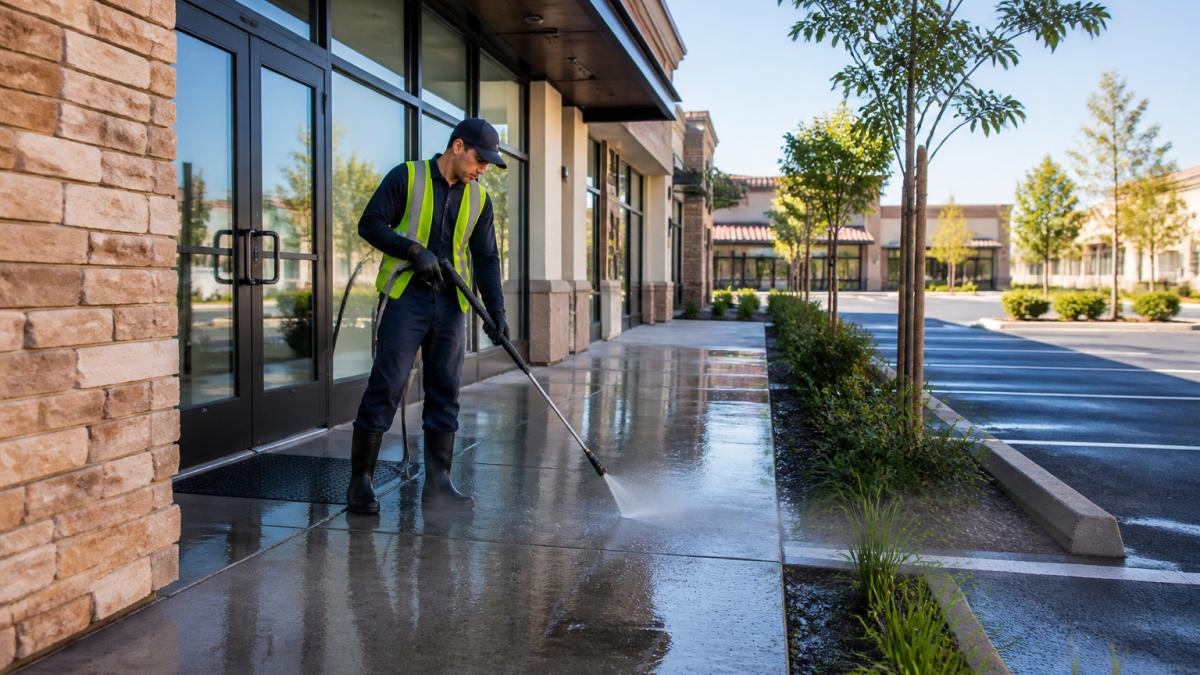
Work through surfaces in this order:
- Sidewalks and walkways
- Entryways and entry glass surrounds
- Parking areas and parking lots
- Dumpster pads and service areas
- Patios and decks
- Building exterior walls, tested on a small patch first
Surfaces to Include and Surfaces to Protect
Not everything should meet full pressure. Match the method to the material.
| Surface | Method | Watch For |
|---|---|---|
| Concrete sidewalks | High pressure, wide tip | Chipping at cracks |
| Parking areas | High pressure, degreaser | Oil stains needing pretreatment |
| Entry glass | Low pressure, squeegee finish | Hard water spots |
| Painted siding | Low pressure, soft wash | Paint lifting or peeling |
| Wood decks | Low pressure, fan tip | Splintering and grain damage |
| Awnings and fabric | Soft wash only | Tearing and color fade |
The most common pressure washing mistake is using full pressure on painted siding or older wood. It strips paint, gouges the surface, and forces water behind the cladding. Always test a small hidden patch first and drop the pressure before you commit.
Winter Weather Response, Gutter Care, and Roof Inspection
Winter is response season: you are protecting the building between storms, not deep cleaning. Gutter care and roof inspection become the priority because that is where winter damage starts. A winter checklist only works if it says what to inspect, what failure looks like, who does the work, and when to call a professional.
Winter Inspection Criteria: Pass/Fail Checks
Use these indicators after every major weather event. A failed check is your trigger for action.
- Gutters and downspouts: Pass if water flows freely at the downspout outlet and no sagging or separation is visible. Fail if you see ice dams, standing water in the gutter, or water staining the fascia.
- Roof surface: Pass if shingles are flat and flashing is sealed. Fail if you see lifted shingles, granules in the gutter, or daylight through the roof deck.
- Ice dams: Pass if the roof edge is clear of ice buildup. Fail if ice is backing up under shingles or water is dripping inside.
Winter Task Ownership and Frequency
Winter work splits cleanly between in-house response and contractor inspections. Assign each task a name and a cadence.
| Task | Frequency | Typical owner |
|---|---|---|
| Post-storm walkthrough | After each event | Property manager |
| Gutter and downspout check | After heavy rain or snow | Contractor |
| Roof inspection | Monthly and after storms | Contractor |
| Salt and grit cleanup | Daily during snow events | In-house staff |
| Drainage check | Weekly | In-house staff |
| Ice dam monitoring | After freeze-thaw cycles | Contractor |
Winter Safety Procedures
Winter exterior work carries specific hazards. Follow these procedures:
- Work at height: Roof and gutter inspections should be done by trained contractors using fall protection. Do not send staff onto roofs or ladders in icy conditions.
- Wet and icy surfaces: Use ice melt and wet-floor signs at entries. Keep walkways clear and schedule pressure washing only when temperatures are above freezing.
- Chemical handling: Store ice melt in sealed containers and follow label instructions for application rates to avoid damage to concrete and landscaping.
When to Call a Professional
Call a qualified contractor if you see any of the following:
- Water staining on interior ceilings or walls
- Ice dams that recur in the same location
- Gutters pulling away from the fascia
Winter is a season to inspect, document, and respond. A pass/fail checklist with named owners turns it from a series of emergencies into a manageable routine.
Assigning Tasks, Setting Frequency, and Budgeting for Exterior Cleaning
A checklist only works when each task has a name and a date next to it. Assign ownership, set frequency, and budget by season so exterior cleaning never becomes an emergency expense.
Use this simple ownership model:
| Task | Frequency | Owner |
|---|---|---|
| Entry glass cleaning | Weekly | In-house staff |
| Full window cleaning | Quarterly | Contractor |
| Gutter cleaning | Spring and fall | Contractor |
| Roof inspection | Spring and fall | Contractor |
| Pressure washing | Spring and summer | Contractor |
| Post-storm walkthrough | After each event | Property manager |
Budget by season, not by emergency: set aside a fixed quarterly amount so a surprise storm does not blow up your numbers.
The businesses that spend the least on exterior maintenance are the ones that schedule it. Preventive work is predictable and budgetable. Emergency repairs are neither.
Simply Superior Window Cleaning handles window cleaning, pressure washing, gutter maintenance, and solar panel cleaning for commercial properties up to four stories, with flexible maintenance schedules and virtual quotes so you can plan without a site visit. Our technicians go through rigorous classroom and on-the-job training, and we hold monthly safety meetings to keep every job safe and consistent. If you want a calendar you can actually keep, start with a free quote and we will build the schedule around your property.
Frequently Asked Questions
What should be included in a commercial exterior cleaning checklist?
A workable checklist covers windows and entry glass, gutters and downspouts, roof debris and surface inspection, building exterior walls, sidewalks, parking areas, entryways, and any patios or decks. Add hard-surface pressure washing and stain checks for mold or salt residue. Each line should note frequency, who owns the task, and what a passing result looks like. Group items by season so nothing gets skipped between spring cleanup and winter weather response.
How often should a business schedule exterior cleaning?
Most commercial properties need windows cleaned every four to eight weeks, gutter cleaning at least twice a year with a third pass after heavy leaf fall, and pressure washing of sidewalks and entryways two to four times a year. Roof inspections belong on a spring and fall schedule. High-traffic storefronts and buildings near trees need more frequent visits. The right commercial window cleaning schedule depends on foot traffic, tree cover, and local weather, so review it each year.
What exterior cleaning tasks should businesses do each season?
Spring covers post-winter inspection, debris removal, gutter cleaning, and washing away salt residue. Summer focuses on entry glass, windows, and curb appeal for peak visitor traffic. Fall preparation means clearing leaves from gutters and downspouts, checking drainage, and trimming back vegetation. Winter brings weather response: inspecting for roof damage and leaks, clearing walkways, and watching for ice damming. A maintenance calendar that lists each task by month keeps the cycle from breaking down.
Which exterior cleaning tasks should be handled by professionals?
Anything above ground level, anything involving a roof, and anything requiring pressure washing near siding deserves a trained crew. High windows, gutter and downspout clearing, roof inspection, and hard-surface pressure washing all carry fall or damage risk when done by staff. Professional teams also carry the equipment to adjust pressure and avoid stripping paint or forcing water behind siding. Routine tasks like sweeping entryways and picking up litter can stay in-house.