
Table of Contents
- Why Window Cleaning Safety Matters More Than Ever
- 1. Master Ladder Stabilization and Fall Protection
- 3. Build Your Commercial Window Cleaning Equipment List
- 4. Use the Right Cleaning Agents and Protect Glass Integrity
- 5. Follow a Window Cleaning Safety Training Checklist
- 6. Weather Protocols and Environmental Safety
- 7. Equipment Maintenance and Daily Inspection Routines
- Frequently Asked Questions
Last Updated: October 3, 2026
Why Window Cleaning Safety Matters More Than Ever
Our technicians undergo rigorous classroom and on-the-job training, and we hold monthly safety meetings to keep protocols sharp. This guide distills what we’ve learned into 10 essential tips.
The stakes are higher than most building owners realize. According to the Occupational Safety and Health Administration, falls remain the leading cause of work-related fatalities in the United States.
Below, we’ll walk through ladder stabilization, OSHA requirements, equipment lists, cleaning agents, training checklists, weather protocols, and maintenance routines, each with something you can act on today.
1. Master Ladder Stabilization and Fall Protection
Ladder stabilization is the foundation of any window cleaning safety program. A properly stabilized ladder eliminates the most common cause of falls: the ladder shifting sideways or sliding out from under the worker.
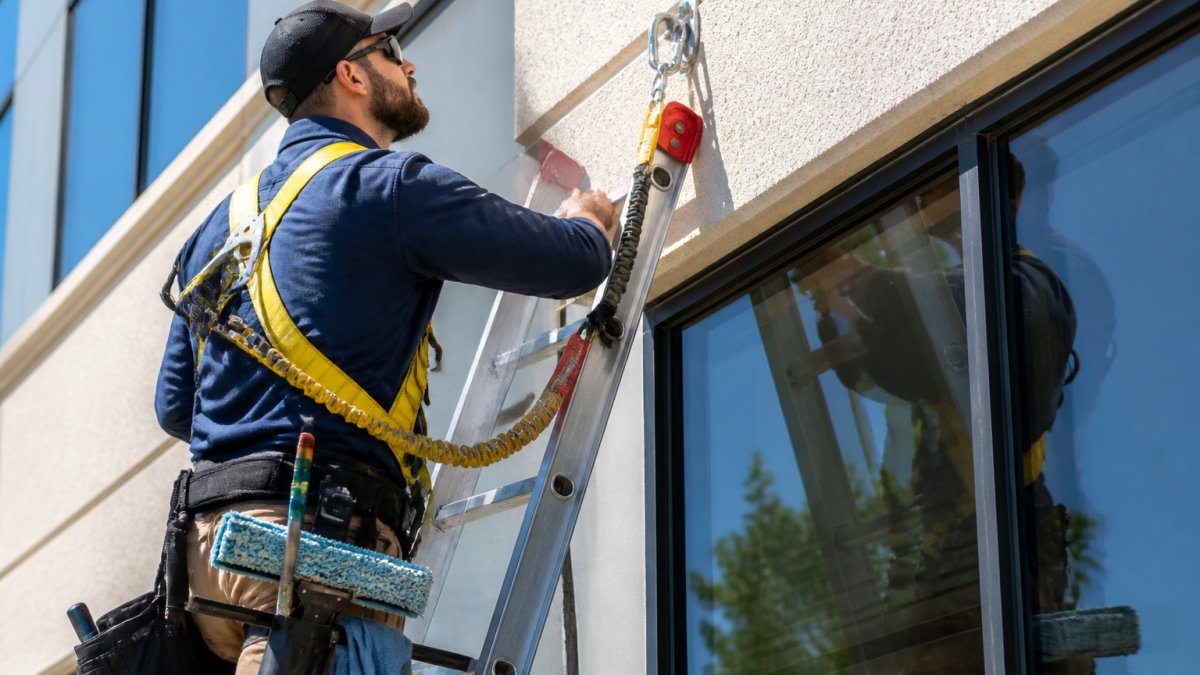
Here’s how to stabilize a ladder correctly:
- Place the ladder on firm, level ground. Never set feet on mud, gravel, or uneven pavement.
- Use the 4-to-1 rule: base one foot out for every four feet of working height.
- Secure the top to the building using ladder stabilizers or a standoff bracket.
- Attach non-slip ladder shoes to prevent sliding on smooth surfaces.
- Have a second person foot the ladder during any work above 10 feet.
(/tag/window-cleaning-maintenance-schedule/) safety requirements fall primarily under 29 CFR 1910 and 29 CFR 1926, covering general industry and construction standards for work at height. Compliance protects both your workers and your business from liability.
Key OSHA Standards for Work at Height
The core requirements are:
- Fall protection is required at heights of 6 feet or more in construction work.
- Ladders must be inspected before each use and removed from service if damaged.
- Workers must be trained on fall hazards, equipment use, and rescue procedures.
The OSHA fall protection standards provide the full regulatory text. Building owners and contractors should review them annually, since citations and penalties are updated regularly.
Document every inspection and training session. If an incident occurs, your written records are your strongest defense, and OSHA compliance officers ask for them first.
3. Build Your Commercial Window Cleaning Equipment List
A commercial window cleaning equipment list should cover three categories: access equipment, cleaning tools, and personal protective equipment. Missing any category creates gaps in your safety program.
Essential Tools for Safe High-Rise Cleaning
- Water-fed extension poles with deionized filtration (keeps workers on the ground)
- Squeegees with ergonomic handles to reduce repetitive strain
- Microfiber cloths and synthetic sponges for streak-free results
| Category | Essential Item | Purpose | Inspection Frequency |
|---|---|---|---|
| Access | Ladder stabilizers, harness, lanyard | Prevent falls | Before each use |
| Cleaning | Squeegee, extension pole, microfiber | Streak-free results | Weekly |
| PPE | Gloves, safety glasses, non-slip shoes | Protect from chemicals and slips | Daily |
| Chemical | Detergent, deionized water | Safe, non-abrasive cleaning | Per job |
Manufacturers like IPC Eagle professional window cleaning systems build equipment specifically for high-reach work, which reduces ladder dependency and improves safety.
4. Use the Right Cleaning Agents and Protect Glass Integrity
Choosing the right cleaning agent protects both the worker and the glass. The wrong product can etch glass, damage window film, or create hazardous fumes in enclosed spaces.
A common mistake is using ammonia-based cleaners on tinted or filmed glass; ammonia breaks down window film over time. Use pH-neutral detergents instead, diluted per the manufacturer’s instructions.
For environmentally sensitive sites, biodegradable, non-abrasive formulas reduce chemical safety risks for technicians and building occupants.
Match the cleaner to the surface. What works on plain glass can ruin window film, etched glass, or coated low-E panes. When in doubt, test a small area first.
5. Follow a Window Cleaning Safety Training Checklist
A window cleaning safety training checklist ensures every technician covers the same ground before working at height. Adapt this starting point to your site.
- Review the site survey and identify all fall hazards
- Confirm the risk assessment is current and signed
- Inspect harness, lanyard, and anchor points
Training certification should be renewed on a schedule. Our team holds monthly safety meetings to review incidents, new equipment, and regulatory updates.
6. Weather Protocols and Environmental Safety
Weather is the variable most window cleaners underestimate. Wind, rain, and temperature swings change the risk profile of every job, and thresholds differ by access method: a 20 mph wind that’s uncomfortable on a ladder is a stop-work condition on a suspended platform, where the stage can swing and rigging loads shift.
Establish clear thresholds before work begins, and tie each one to the equipment in use:
- Ladder work: Suspend when sustained winds exceed 20 mph, or when gusts make the ladder vibrate or shift. Wind is worse on the leeward side of a building, where it eddies unpredictably.
- Suspended platforms and bosun’s chairs: Most manufacturers publish a maximum operating wind speed, commonly 20 to 25 mph, and that limit is a hard stop, not a guideline. Gusts count. If the platform swings more than a few inches, come down.
- Aerial lifts: Follow the manufacturer’s wind rating, which is often lower than crews expect. Boom lifts become unstable in gusty conditions even at moderate sustained speeds.
A written weather protocol removes guesswork and gives crews clear authority to stop work without fear of pushback.
Monitoring and Documentation
A weather protocol only works if someone is watching conditions. Practical habits:
- Check the forecast the night before and again at the morning tailgate meeting.
- Use a handheld anemometer at the work location, rooftop wind is often stronger than the ground-level forecast.
- Assign one person to monitor conditions during the shift and to call a stop when thresholds are hit.
Environmental Safety and Runoff
Environmental safety extends to runoff: capture wastewater where required and never let detergent flow into storm drains. Many jurisdictions treat window cleaning runoff as an illicit discharge when it carries surfactants, dirt, or glass particles into the storm system. Practical controls:
- Using deionized water and low-residue detergents that break down without leaving a film.
- Blocking or berming drains near the work area when washing above grade.
- Collecting runoff from ground-level work with a wet vacuum or containment mat when the site requires it.
- Storing and disposing of chemical containers per the safety data sheet and local rules.
Weather thresholds belong in writing, tied to the access method, and monitored on site, not eyeballed from the ground. The crew that can point to a number and a log is the crew that stays safe when conditions turn.
7. Equipment Maintenance and Daily Inspection Routines
Equipment maintenance is where safety programs quietly succeed or fail. Gear that looks fine can hide frayed webbing, cracked plastic, or worn squeegee blades.
Daily inspection routines should cover:
- Harnesses and lanyards: check stitching, webbing, and hardware for damage.
- Ladders: inspect rails, rungs, feet, and spreaders.
- Squeegees and blades: replace worn rubber to prevent streaks and glass damage.
- Poles and extensions: check locks, couplings, and hose connections.
- Chemical containers: verify labels, lids, and storage conditions.
Retire any component that fails inspection. A replacement costs far less than an injury. Providers like Window Hero safety accessories supply non-slip ladder shoes, tool lanyards, and high-grip gloves that directly address fall and drop hazards.
Frequently Asked Questions
What is the number one hazard faced by professional window cleaners?
Falls from height are the leading cause of serious injury and death in the window cleaning industry. According to OSHA, falls remain the top cause of fatalities in construction and related fields, and window cleaning carries similar risks. Proper fall protection, including harnesses, lanyards, and anchor points, is critical for any work above ground level. Ladder stabilization and regular equipment inspection also reduce fall risk significantly.
What PPE is required for commercial window cleaning?
OSHA requires employers to provide personal protective equipment (PPE) at no cost to workers. For commercial window cleaning, essential PPE includes a full-body harness with lanyard for fall arrest, non-slip gloves for grip and chemical protection, safety glasses to guard against splashes, and non-slip footwear. When using cleaning agents, chemical-resistant gloves and eye protection are mandatory. All PPE must be inspected before each use and replaced when worn or damaged.
How does OSHA regulate commercial window cleaning safety?
OSHA regulates commercial window cleaning under several standards, including 29 CFR 1910 for general industry and 29 CFR 1926 for construction. Key requirements cover fall protection systems for work at height above 4 feet in general industry, ladder safety, PPE, and hazard communication for cleaning chemicals. Employers must conduct risk assessments, provide training, and maintain records of safety compliance. State plans may impose additional requirements.
What should be included in a window cleaning safety training checklist?
A thorough window cleaning safety training checklist covers fall protection equipment inspection, ladder setup and stabilization, proper use of harnesses and anchor points, chemical handling and dilution, PPE requirements, emergency response procedures, and weather-related stop-work criteria. Training should include both classroom instruction and hands-on practice, with refresher courses at least annually. Documenting each training session ensures OSHA compliance and keeps safety standards consistent across your crew.
How do professionals ensure safety when cleaning windows above ground level?
Professionals use a combination of fall protection systems, including full-body harnesses anchored to certified anchor points, guardrails, and safety nets. For buildings up to four stories, water-fed extension poles allow cleaning from the ground, eliminating ladder work entirely. A site survey before each job identifies hazards, and a written safe system of work ensures every crew member knows their role. Regular equipment inspections and monthly safety meetings reinforce these practices.
Commercial window cleaning safety comes down to discipline: stable ladders, rated anchor points, the right equipment, and a training routine that never slips. If managing all of that in-house feels like a stretch, that’s where we come in. Simply Superior Window Cleaning handles buildings up to four stories with trained technicians, 24/7 maintenance services, and virtual quote options that minimize contact. Schedule a free quote and let our team keep your glass pristine and your property safe.