
Last Updated: November 10, 2026
Quick Summary
To fix sagging gutters, first find the cause by checking for standing water, clogs, failed spikes or hangers, and incorrect pitch. Then reattach or replace the failed parts, and adjust the slope so water drains toward the downspout.
- Standing water that stays in the gutter for more than a few minutes signals a clog or pitch problem.
- Drive a new 2-inch exterior screw into solid wood if the old spike hole has stripped out.
- Space replacement hangers about 24 to 36 inches apart.
- Aim for about 1/4 inch of fall for every 10 feet, sloping toward the downspout.
- Adjust slope by moving the hangers, not by bending the gutter itself.
Table of Contents
- Diagnosing Why Your Gutters Are Sagging
- Safety Steps Before You Climb a Ladder
- How to Fix a Gutter That Is Falling Off
- Gutter Hanger Replacement: Choosing and Installing New Hangers
- Gutter Pitch Adjustment: Measuring and Correcting Slope
- Sagging Gutter Repair Cost and When to Call a Professional
- Booking a Gutter Inspection With Simply Superior Window Cleaning
- Frequently Asked Questions
Diagnosing Why Your Gutters Are Sagging
Fixing sagging gutters usually starts with a clear cause, and finding it first saves you from repairing the same problem twice. Most sagging comes from failed hangers, bent or pulled-out spikes, clogged debris that adds weight, or a gutter that was never pitched correctly.
Start with a walk around the house. Look for gutters that dip between brackets, pull away from the fascia, or hold water instead of draining. If you live where freezing winters are common, learn how to prevent ice dams that can weigh gutters down. Those three signs point to different fixes, so note which ones you see.
Checking for standing water and clogs
Standing water is the fastest clue. After a rain, look for pools that stay in the gutter for more than a few minutes. The water collects in low spots, and that extra weight pulls the section down further.
Clogs cause the same problem. Leaves, shingle grit and roof debris pack into the trough, and the wet mass can add a lot of weight over a long run. Clear the debris by hand with gloves, then flush the gutter with a hose to check that water moves toward the downspout. For the full procedure, see step-by-step downspout clearing.
If water still sits after clearing, the gutter pitch is likely off. That is covered in the pitch section below.
Spotting failed spikes and hangers
Spikes and hangers are the parts that hold the gutter to the fascia. Look for spikes that have pulled loose or bent, hangers that have rusted through, and brackets that have torn away from the board.
Check each bracket by pulling gently on the gutter. Any section that moves more than a little needs attention. Pay special attention to the spots under the heaviest debris, such as near trees.
Safety Steps Before You Climb a Ladder
Working at height is where most gutter repairs go wrong. Before you climb, set up the ladder on firm, level ground and check that it reaches at least three feet above the gutter line.
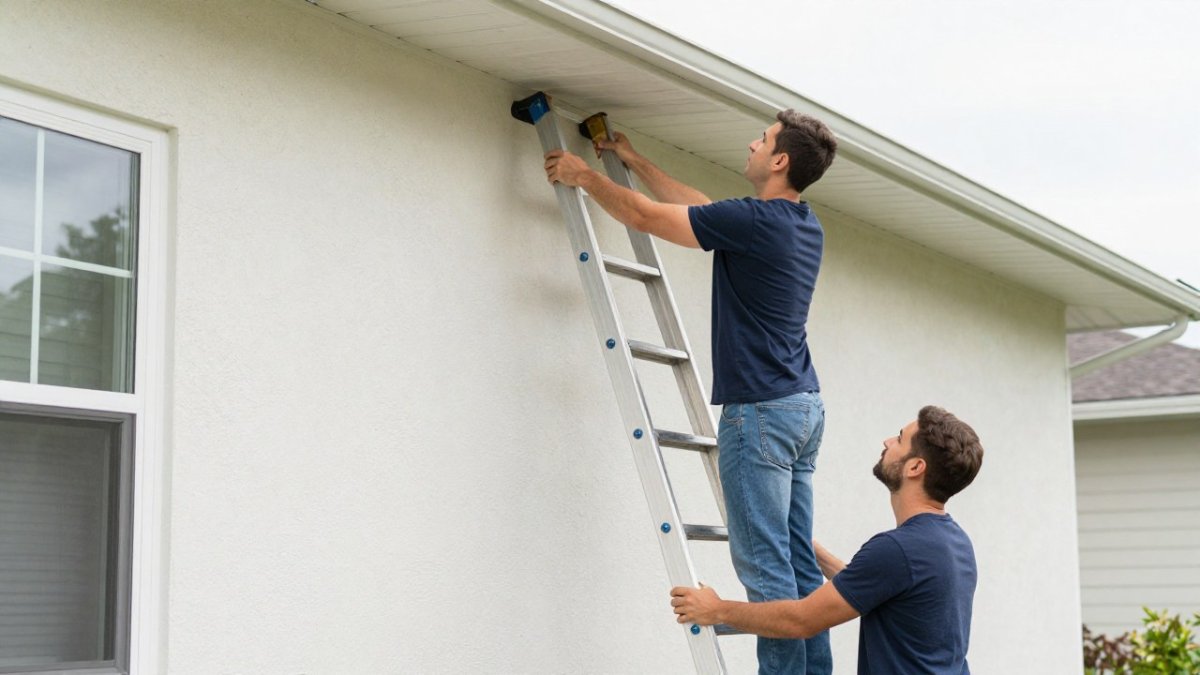
Keep both feet on the rungs, never reach so far to one side that your belt leaves the ladder, and have a helper steady the base if you can. Do not work in wet or windy weather, and never use a metal ladder near power lines.
If the gutter is more than one story up, or the roof is steep, hire a professional. A fall from a second story can cause serious injury.
How to Fix a Gutter That Is Falling Off
When a gutter section is falling away from the house, it usually needs to be reattached rather than replaced. Start by removing the loose section from the bracket, cleaning out the old spike hole, and checking whether the fascia board itself is solid.
- Clear all debris from the gutter section.
- Remove the old spike or screw from the fascia.
- Drive a new 2-inch exterior screw into solid wood, not the existing hole if it has stripped out.
- Reattach the gutter and check that it sits level against the hanger.
- Run water through the section to confirm it drains.
If the fascia is soft or rotted, the screw will not hold. Fix the wood first, or the repair will fail again within months.
Gutter Hanger Replacement: Choosing and Installing New Hangers
Replacing a hanger is one way to fix sagging gutters in a single section. Hidden hangers attach under the gutter lip and are the most common replacement, while spike-and-ferrule systems are older and harder to adjust.
Choose hangers made for your gutter size and material, and space them about 24 to 36 inches apart. Drive the fastener into the fascia at the same height as the original, and angle it slightly up toward the roof so the gutter sits with a slight slope.
Reusing existing holes is fine if the wood is solid. Drill new holes a few inches away if the old ones have stripped or split the board.
Gutter Pitch Adjustment: Measuring and Correcting Slope
Gutters need a consistent slope toward the downspout so that rainwater moves rather than sitting. The common target is about 1/4 inch of fall for every 10 feet of run, though some installers aim for a slightly steeper pitch on long runs. Too little slope leaves water standing and adds weight to the trough. Too much slope concentrates water at the low end, where it can overshoot the outlet or wash over the front lip.
To measure, start at the downspout end of the section. Snap a chalk line or pull a taut string from the high point of the run down to the outlet. Use a level on the string, or a line level, to confirm it is straight. Then measure the vertical gap between the string and the top inside edge of the gutter at several points: near the high end, at the midpoint, and near the low end. The gap should shrink steadily toward the downspout. If one bracket shows a gap that is clearly larger or smaller than its neighbors, that hanger is the one to adjust.
For long runs, measure each section separately rather than trying to set a single line for the whole house. Most gutters are joined at seams or fed by a single outlet at one end, so a run that is level at one end and sloped at the other will almost always collect water in the middle.
To adjust, loosen the fastener at the affected hanger, raise or lower the bracket on the fascia by a small amount, and retighten. Make one change at a time. Recheck the string gap after each adjustment instead of making several corrections at once.
Test the result with water. Use a garden hose at the high end or pour a measured bucket of water into the trough, and watch the flow. Water should move steadily toward the downspout and clear the section within a few seconds. Any spot where water pools, stalls, or runs back toward the high end needs another adjustment. Repeat the test after each change until the flow is consistent.
Watch out: Do not adjust the slope by bending the gutter itself. Bent seams and cracked joints leak, and the correction usually fails within a season. Move the hangers instead.
The article’s key pitch figures and steps are summarised below for quick reference.
| Item | Value | Note |
|---|---|---|
| Target slope | 1/4 inch per 10 feet | Fall toward the downspout |
| Hanger spacing | 24 to 36 inches | Spacing used when replacing hangers |
| Measuring tool | Taut string and level | Check the gap at high, mid and low points |
| Adjustment method | Move the hanger | Loosen, shift bracket, retighten |
| Testing | Water flow | Water should clear the section in seconds |
Sagging Gutter Repair Cost and When to Call a Professional
Many small repairs, like replacing a few hangers or reattaching a section, are manageable for a careful homeowner with a ladder and basic tools. Costs depend on how many sections need work, the gutter material and whether the fascia needs repair.
Call a professional if the fascia is rotted, if the gutter has pulled far from the house, if the roof is steep or high, or if water is getting behind the gutter and into the walls. Those jobs carry higher risk and often need carpentry as well as gutter work.
For current pricing, request a quote from Simply Superior Window Cleaning’s website before work starts. To compare DIY repair with hiring help, see what professional gutter maintenance services include.
Booking a Gutter Inspection With Simply Superior Window Cleaning
If you would rather not climb the ladder yourself, Simply Superior Window Cleaning can inspect your gutters, clear the debris, and tell you exactly which hangers or sections need repair. Our technicians undergo rigorous classroom and on-the-job training, and we offer virtual quotes so you can get a clear estimate without a long wait.
Sagging gutters left alone can allow water to collect and cause damage over time, so an inspection can help you address the problem early. Schedule your gutter inspection with Simply Superior Window Cleaning today and get a free quote. Our guide explains how to schedule gutter cleaning or maintenance service step by step.
Frequently Asked Questions
How do you fix sagging gutters properly?
Start by clearing debris and checking for standing water, since clogs add weight that pulls gutters down. Next, inspect the hangers and spikes. Replace any that are bent, pulled loose, or rusted, and use hidden hangers or screw-in brackets anchored into the fascia or rafter tails rather than reusing old nail holes. Finally, re-establish the slope so water drains toward the downspout, which usually means a fall of about 1/4 inch per 10 feet. Work in sections and recheck the pitch with a level after each adjustment.
How much does sagging gutter repair cost?
Costs depend on the length of gutter affected, how many hangers need replacing, the type of gutter and roof edge, and whether the fascia needs repair. Simply Superior Window Cleaning does not publish gutter repair prices, so the most accurate figure comes from a quote for your specific property. DIY repairs mainly cost the price of hangers, screws, and sealant, but factor in ladder access and the time needed for careful slope correction.
When should sagging gutters be replaced instead of repaired?
Repair is usually enough when the gutter sections are straight and sound but the hangers or slope have failed. Replacement makes more sense when the metal is cracked, separated at seams in several places, heavily rusted, or bowed in a way that will not hold a true pitch even after new hangers are installed. If the fascia board behind the gutter is soft or rotted, address that first, because new gutters will not stay attached to damaged wood.
Can you fix sagging gutters without taking them down?
In many cases, yes. You can clear the gutter, add new hangers alongside or in place of failing ones, and adjust the slope while the gutter remains attached. Taking sections down becomes necessary when a hanger is so damaged that the section cannot be secured in place, or when the entire run needs to be re-pitched across a long span. Working from a stable ladder and having a second person present makes in-place repairs safer.