
Last Updated: November 9, 2026
Quick Summary
Window cleaners need liability insurance to pay for legal defense and settlements when a client or passerby is injured or their property is damaged during the job. Without it, one claim can threaten the business owner’s savings and equipment. Most commercial clients also will not sign a contract without proof of coverage.
- General liability covers third-party bodily injury and property damage, not the cleaner’s own tools or employees.
- Commercial clients often require a certificate of insurance naming them as an additional insured.
- Verify coverage by checking active policy dates and confirming the named insured matches the business you hire.
- Premiums are rated on factors like revenue, payroll, work height, and claims history, so get a written quote.
Table of Contents
- What Liability Insurance Means for a Window Cleaning Business
- What Does General Liability Insurance Cover for Window Cleaners?
- What Does Window Cleaning Insurance Not Cover?
- Commercial vs Residential Window Cleaning Requirements
- High-Rise vs Residential Risk: Why Height and Property Type Change Your Coverage
- How Much Window Cleaning Insurance Costs and What Affects the Price
- How to Verify a Window Cleaner’s Insurance Before You Hire Them
- Booking a Fully Insured Window Cleaning Service in Ventura and North LA Counties
- Frequently Asked Questions
Window cleaning looks simple from the ground, but one slipped ladder, one shattered pane, or one water-damaged wall can cost a property owner far more than the job itself. That is why liability insurance matters so much for window cleaners in Ventura and North LA Counties. Property owners and managers often ask the same question before hiring any cleaner: what happens if something goes wrong? Below, we explain what liability coverage does, what it leaves out, and how to check a cleaner’s paperwork before you sign anything.
What Liability Insurance Means for a Window Cleaning Business
Liability insurance protects a business when it is held responsible for injury or property damage to someone else (Get business insurance). For a window cleaner, that might mean a customer’s patio furniture breaking after a bucket of water spills, or a passerby being hit by falling debris from a ladder. The policy pays for legal defense and any settlement or judgment, up to the policy limits. Without it, a single claim can threaten the business owner’s savings and equipment. Most commercial clients will not sign a service contract without proof of coverage.
What Does General Liability Insurance Cover for Window Cleaners?
General liability (GL) is the baseline policy nearly every window cleaning business carries, and it responds to third-party claims, meaning claims brought by someone other than the business owner or its employees. For a window cleaner, the two core coverages are third-party bodily injury and third-party property damage, plus the legal defense costs associated with either.
Bodily injury in practice. A ladder shifts while a technician is working above a storefront, a bucket tips off a scaffold, or a squeegee slips from a rope-access rig and strikes a pedestrian below.
Property damage in practice. A technician drags a hose across a customer’s new landscaping and kills a row of shrubs, cracks a window frame while removing a screen, or leaves a water trail that warps hardwood flooring. GL responds to the cost of repairing or replacing that third-party property.
How limits work. Commercial general liability policies are usually written with two numbers: a per-occurrence limit (the most the insurer pays for any one claim) and a general aggregate limit (the most it pays across the policy term). Limits are a negotiated choice, and property managers and general contractors frequently require higher limits or an umbrella policy on top. When a claim exceeds the per-occurrence limit, the business owner is personally exposed for the difference, which is why the limit selection matters as much as the premium.
Additional insured status and the COI. This is where most new window cleaners get tripped up. A certificate of insurance (COI) is a one-page summary, usually an ACORD 25 form, that lists the named insured, policy numbers, effective dates, and limits.
Watch out: A COI is evidence of coverage, not a guarantee, if the policy is canceled for nonpayment the day after the certificate is issued, the COI still looks valid on its face.
What GL does not do. It does not cover injury to the cleaner’s own employees (that is workers’ compensation), damage to the cleaner’s own tools or vehicle (tool floater or commercial auto), or professional errors such as a client claiming a missed spot cost them a sale (errors and omissions). Those gaps are covered in the next section.
The table below summarises what general liability covers for a window cleaner and what falls outside it.
| Coverage area | Example from the article | Where it is handled |
|---|---|---|
| Third-party bodily injury | Pedestrian hit by a dropped squeegee | General liability |
| Third-party property damage | Shrubs killed by a dragged hose | General liability |
| Damage to cleaner’s own tools | Dropped pole or broken squeegee | Tool floater or inland marine |
| Injury to cleaner’s employees | Technician hurt on the job | Workers’ compensation |
| Missed-spot sale dispute | Client claims a streak cost a sale | Errors and omissions |
What Does Window Cleaning Insurance Not Cover?
Liability policies have exclusions, and window cleaners should know them before a claim arises. General liability generally does not cover damage to the cleaner’s own tools or vehicles, which requires a tool floater or commercial auto policy. It also does not cover injury to the cleaner’s own employees, which falls under workers’ compensation. Professional mistakes, such as a missed streak that the client says cost them a sale, may fall under errors and omissions coverage rather than general liability. Policy exclusions vary, so read the actual wording with your agent instead of assuming.
Commercial vs Residential Window Cleaning Requirements
Residential jobs and commercial jobs carry different risk levels, and the paperwork usually reflects that. Our article on residential vs commercial window cleaning breaks down these differences in detail. A homeowner may accept a verbal agreement and a basic liability certificate, while a commercial property manager often requires a COI naming them as an additional insured, higher coverage limits, and proof of workers’ compensation. Commercial contracts can also include indemnification clauses that shift liability to the cleaner. Before signing, confirm which requirements apply and whether your current limits meet them.
High-Rise vs Residential Risk: Why Height and Property Type Change Your Coverage
Height changes the risk profile considerably. Residential work on a two-story home involves ladders and short rope access, while buildings up to four stories bring longer reach, more exposure to wind, and greater consequences if equipment fails. A dropped squeegee from the third floor can injure someone on the sidewalk, which is why commercial clients often ask about rope access training, fall protection and ladder safety protocols. Some insurers rate high-work exposure differently, so tell your agent exactly what kinds of buildings you clean.
How Much Window Cleaning Insurance Costs and What Affects the Price
Pricing for window cleaning insurance is individually rated, so no honest guide can quote you an exact figure without knowing your revenue, payroll, and scope of work. What a useful guide can do is explain the rating factors and the ranges most small operators see, so you can sanity-check a quote instead of accepting the first number that lands in your inbox.
The factors that move your premium.
- Annual revenue and payroll. Premium is typically rated per $1,000 of revenue or per $100 of payroll. A solo operator grossing $60,000 a year pays far less than a five-crew company grossing $600,000, even at identical coverage limits.
- Height and access method. Ground-level and ladder work on one- and two-story homes is rated more favorably than rope access, suspended scaffolds, or work above roughly three to four stories. Insurers want to know the maximum height you service and the equipment you use to get there.
- Residential vs. commercial mix. Commercial work, especially retail storefronts, office buildings, and properties with heavy foot traffic, generally carries higher rates than single-family residential because the third-party exposure is larger.
- Claims history. A single paid GL claim can raise premiums for several years. Many carriers surcharge or non-renew after a large loss, so loss runs matter when you shop.
- Coverage limits and endorsements. Raising the per-occurrence limit from $1 million to $2 million, adding an umbrella, or adding additional-insured endorsements all increase premium. Workers’ compensation is priced separately and is driven by payroll classification and experience modification.
- Subcontractor use. If you hire 1099 helpers, insurers will ask whether those subs carry their own GL and workers’ comp. If they do not, the carrier may charge you premium on their payroll or exclude claims arising from their work, a detail many new cleaners discover only after a loss.
Adding workers’ compensation for employees, or a commercial auto policy for a company vehicle, adds to the total. The only reliable number comes from a licensed agent who has seen your operations. For a broader look at pricing, see cost factors for commercial building exterior cleaning.
How to get a usable quote. Gather four things before you call: your estimated annual revenue, your payroll (including any 1099 labor), the maximum height you work at, and your claims history for the past five years. Ask each agent for the same limits so you are comparing apples to apples, and ask specifically whether the quote includes additional-insured endorsements and subcontractor coverage. A cheap quote that excludes the work you actually do is worse than a slightly higher one that covers it.
Watch out: The lowest premium is often the policy with the most exclusions. Read the exclusions page before you sign, and ask the agent to confirm in writing that high-rise or rope-access work is covered if you do it, a standard GL form may exclude or sublimit that exposure unless it is specifically endorsed.
Simply Superior Window Cleaning can walk clients through how our safety practices, monthly safety meetings and classroom plus on-the-job technician training, relate to their coverage questions.
How to Verify a Window Cleaner’s Insurance Before You Hire Them
Never accept a verbal claim of coverage. Our guide on how to choose a reliable commercial window cleaner explains what to look for before you hire. Ask for a current certificate of insurance, check that the policy dates are active, and confirm that the named insured matches the business you are hiring. Verify the liability limits against your property’s requirements, and ask whether the cleaner uses subcontractors and whether those subcontractors carry their own coverage. Uninsured subcontractors can expose the property owner to claims. You can also contact the insurer directly to confirm the policy is in force.
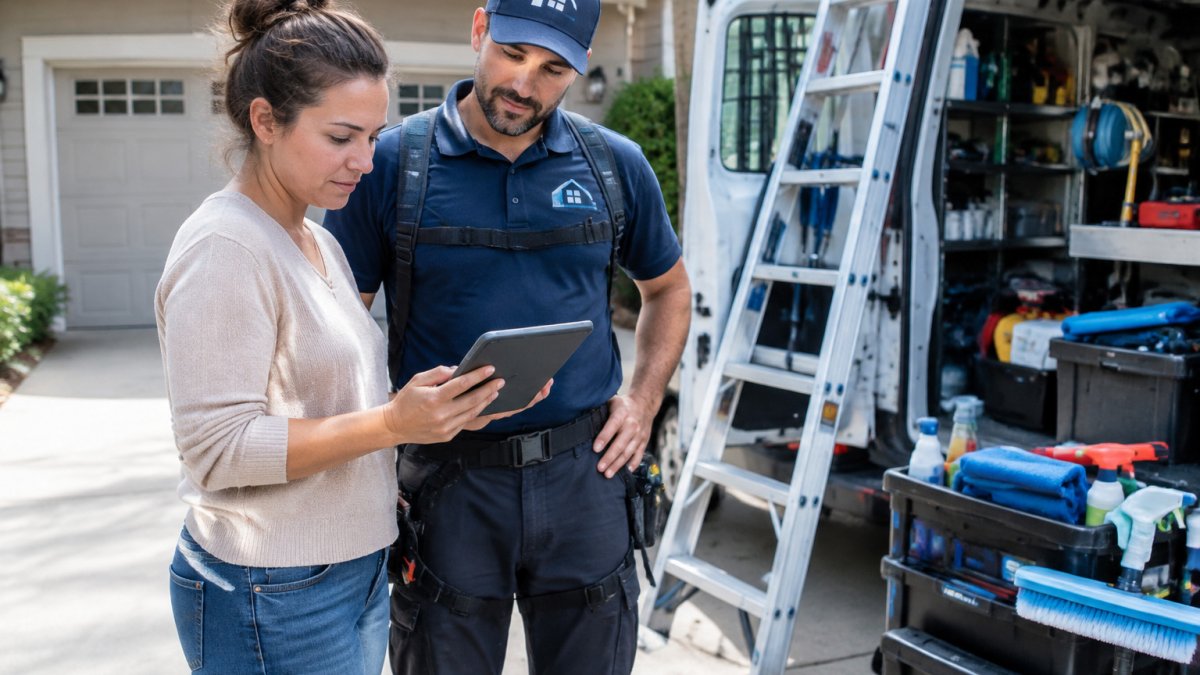
!Homeowner reviewing a certificate of insurance on a tablet in a driveway while a uniformed window cleaner stands beside a ladder and equipment van
Booking a Fully Insured Window Cleaning Service in Ventura and North LA Counties
If you are ready to hire, Simply Superior Window Cleaning can discuss your insurance questions before any work begins. Our technicians complete classroom and on-the-job training, and our team holds monthly safety meetings. We offer virtual quotes so you can review pricing without multiple visits, and we handle everything from residential windows to commercial buildings up to four stories. Contact us to request a free quote.
Frequently Asked Questions
What type of insurance do window cleaners need?
Most window cleaners need general liability insurance, which covers third-party bodily injury and property damage caused during work. Many commercial clients also require workers’ compensation if the business has employees, and commercial auto insurance for company vehicles. Simply Superior Window Cleaning can explain which coverage applies to a specific property during a free quote. Ask any cleaner for a certificate of insurance listing current limits before work begins.
Is it mandatory for window cleaners to carry general liability insurance?
Requirements vary by location and by client. Many property managers, commercial landlords and homeowner associations require proof of general liability insurance before allowing a contractor on site, even when state law does not mandate it. Workers’ compensation rules also depend on whether a business has employees. Checking local requirements and client contracts is the most reliable way to know what applies to your situation.
What happens if a window cleaner damages my property and has no insurance?
Without insurance, you may need to pursue the cleaner directly for repairs, which can be slow and costly if the business lacks funds. Damage such as a broken window, scratched glass or a cracked frame can run into hundreds or thousands of dollars depending on the repair. A cleaner carrying general liability insurance typically has the claim handled by the insurer, so you avoid chasing payment yourself.
Why should I verify a window cleaner’s insurance before hiring them?
Verification confirms that the coverage is active, that the limits are adequate for your property, and that the policy names your property if required. Request a current certificate of insurance directly from the insurer or broker, not just a copy the cleaner sends you. Check the policy dates and make sure the coverage matches the type of work, including any height or commercial services you need.