
Table of Contents
- How Dirty Panels Quietly Cut Your Energy Output
- When Natural Rain and Wind Are Not Enough
- Real Damage: Micro-Cracks, Mineral Buildup, and Warranty Risks
- Solar Panel Cleaning Frequency: A Climate-Based Schedule
- How to Clean Solar Panels Safely (and What to Avoid)
- Why Homeowners Choose Residential Solar Panel Cleaning Services
- The Cost-Benefit Math: Cleaning vs. Lost Production
- Frequently Asked Questions
Last Updated: September 23, 2026
How Dirty Panels Quietly Cut Your Energy Output
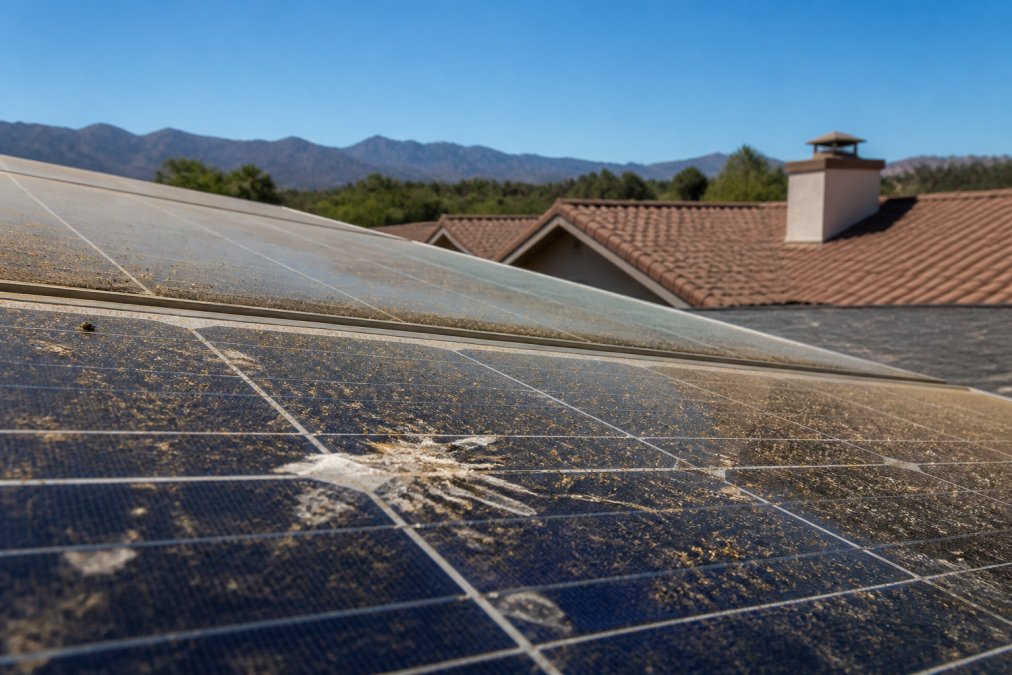
Left alone, a dirty solar array does not fail loudly. It simply produces less each day, and the loss compounds. What happens if you don’t clean solar panels is a slow decline in energy output that most homeowners never notice until a utility bill or a monitoring app forces the issue. Dust, pollen, and coastal salt build up faster than most owners expect.
How Soiling Loss Adds Up Month After Month
A thin film of dust might trim output by a small margin on any given day. Stack that across weeks without rain, and the kilowatt-hour yield drops steadily. Because photovoltaic efficiency is measured against full sun exposure, even partial shading from grime reduces the whole string’s performance. Many installers recommend monitoring inverter data monthly to catch the trend early.
Common Types of Soiling: Pollen, Dust, Bird Droppings, and Salt
Not all dirt behaves the same way. Each type affects the glass differently.
- Pollen buildup: Sticky and widespread in spring, it clings even after light rain.
- Dust and environmental pollutants: Fine particles create an even film that dulls output.
- Bird droppings: Small but highly opaque, they can shade a cell entirely.
- Salt: Coastal air leaves a residue that attracts more dust over time.
When Natural Rain and Wind Are Not Enough
Rain helps, but it is unreliable as a cleaning method. A light shower often just smears dust into streaks, and wind can deposit more debris than it removes. Natural precipitation only clears panels effectively when it is heavy and frequent, which few regions can count on year-round.
How Tilt Angle Changes Debris Accumulation
Tilt angle determines how well a panel sheds debris on its own. Steeper arrays let rain and gravity carry dirt away more efficiently, while shallow or flat-mounted panels hold water, pollen, and dust in place. Systems with self-cleaning properties, such as certain glass coatings, reduce buildup but do not eliminate the need for occasional manual attention.
Check your array’s tilt before assuming rain will handle it. If your panels sit at a shallow angle, expect debris to linger longer and plan your maintenance schedule accordingly.
Real Damage: Micro-Cracks, Mineral Buildup, and Warranty Risks
Most guides stop at “you’ll lose some output.” The more expensive outcome is permanent hardware damage, and the warranty fight that follows. Cleaning incorrectly can cost more than never cleaning at all.
Micro-Cracks: Invisible Fractures That Never Heal
Micro-cracks are hairline fractures in the silicon cells, usually a few microns wide. They form when a panel flexes under uneven pressure, a pressure washer jet, a knee pressed on the glass, a scrub brush pushed hard across a hot surface, or when hot glass meets cold water and the cell expands faster than its frame. Because the crack runs across the cell’s busbars, it severs the conductive path that carries current.
Hard Water and Mineral Buildup: The Slow Etch
Tap water in much of the Southwest and in many municipal supplies carries dissolved calcium and magnesium. When that water evaporates off hot glass, it leaves behind calcium carbonate, the same scale that coats a showerhead. On a showerhead you can scrub it off. On solar glass, the deposit bonds to the anti-reflective coating and, over repeated wet-dry cycles, begins to etch the surface.
Abrasive Tools and Detergents
Rough sponges, scouring pads, steel wool, and gritty brushes scratch the anti-reflective coating. Once that coating is compromised, the glass scatters light instead of transmitting it, and the panel’s efficiency drops for good. Harsh detergents and dish soaps can leave a residue that attracts dust or, worse, attack the frame’s anodized finish and the sealant around the junction box.
What This Means for Your Warranty
Most manufacturer warranties, the 25-year product and performance warranties that come with a typical residential array, cover defects in materials and workmanship, not damage from improper maintenance. The fine print usually excludes “damage caused by customer abuse, negligence, or unauthorized cleaning methods.” In practice, that means:
- Scratched glass from abrasives is almost always denied as customer-caused damage.
- Micro-cracks from pressure washing are typically denied unless the homeowner can show the damage predates installation.
- Mineral etching from hard water is usually classified as a maintenance issue, not a defect.
- Water intrusion into the junction box from a high-pressure spray can void the product warranty on the module.
Never use a pressure washer directly on panels, never scrub with abrasive pads, and never let hard water air-dry on hot glass. Any of the three can produce permanent damage that a manufacturer will classify as customer-caused and decline to cover.
Solar module manufacturer warranty terms and exclusions
Solar Panel Cleaning Frequency: A Climate-Based Schedule
“It depends” is the answer every competitor gives. Here is the version that actually helps: match your schedule to your climate zone, then let your inverter data tell you when to pull the trigger early.
Start With Your Climate Zone
| Climate Condition | Recommended Frequency | Main Soiling Risk | Early-Trigger Signal |
|---|---|---|---|
| Arid / dusty, low rainfall (desert Southwest, high plains) | Every 4-8 weeks during dry season | Fine dust film, windblown soil | Output down 5%+ vs. a clean-day baseline |
| Coastal salt air | Every 8-12 weeks | Salt residue that attracts and holds dust | Visible white haze on glass after a dry spell |
| Seasonal pollen heavy (spring tree pollen, fall ragweed) | Once after peak pollen, plus mid-season check | Sticky pollen that resists light rain | Yellow-green film visible at a low viewing angle |
| Humid / frequent rainfall | Every 6-12 months, plus spot checks | Bird droppings, mold at frame edges | Dark streaks or spotting that rain does not clear |
| Agricultural / construction nearby | Every 4-8 weeks during active season | Coarse dust, chaff, cement dust | Uniform dulling across the whole array |
| Snow-belt | Once after final snowmelt | Road salt spray, grit | Streaking along the bottom edge of modules |
Why Arid and Coastal Climates Need Different Rules
In an arid climate, the enemy is a uniform film of fine dust. It builds fast, it is easy to miss, and it does not wash off in a light sprinkle, it smears. The practical rule is to clean on a fixed interval during the dry season and to treat any rain event under about a quarter inch as a non-event.
Why Humid and Rainy Climates Still Need Attention
Frequent rain does most of the work, but it does not solve everything. Bird droppings, tree sap, and mold spores at the frame edges survive rain because they bond to the glass. In humid climates, the bigger risk is biological, algae and lichen can establish along the lower edge of a module where water pools, and once established they are difficult to remove without scratching.
Let Your Inverter Data Set the Real Schedule
Every modern string inverter and most microinverter systems log daily production. The most reliable cleaning trigger is not the calendar, it is a comparison. Pick a clear, cool day shortly after a rain or a cleaning, note the peak production, and use that as your baseline. When a comparable clear day shows a sustained drop of roughly 5% or more, it is time to clean, regardless of what the schedule says.
Set a recurring reminder to check your monitoring portal on the first of each month. If you see a clear-day output drop of 5% or more against your baseline, schedule a cleaning, do not wait for the calendar.
The right frequency is the one your climate and your inverter data agree on. Use the table as a starting point, then let production numbers override it.
How to Clean Solar Panels Safely (and What to Avoid)
Learning how to clean solar panels safely protects both your system and your warranty. The process is straightforward, but the details matter.
- Shut down the system if your inverter manual recommends it before cleaning.
- Work early morning or evening to avoid thermal stress on hot glass.
- Use deionized water and a soft brush or microfiber tool.
- Rinse from the top down to avoid streaking.
- Never stand on the panels or use roof access points that risk a fall.
- Skip pressure washers, abrasive materials, and harsh soaps entirely.
The safest cleaning method uses soft tools, clean water, and cooler temperatures. Anything abrasive risks permanent damage that no warranty will cover.
Why Homeowners Choose Residential Solar Panel Cleaning Services
DIY cleaning carries real safety hazards, from roof access falls to accidental panel damage. Professional residential solar panel cleaning services remove that risk and handle water quality, tooling, and timing correctly. Simply Superior Window Cleaning provides cost-effective solar panel cleaning. Our technicians are trained through rigorous classroom and on-the-job instruction, and we hold monthly safety meetings. Virtual quotes make scheduling simple, and flexible maintenance plans fit any property.
The Cost-Benefit Math: Cleaning vs. Lost Production
The cost-benefit ratio favors cleaning in almost every case. Production degradation from soiling reduces your return on investment every month it continues, while professional maintenance restores output and protects system longevity. For homeowners weighing the decision, the math is simple: a modest recurring cost versus steadily shrinking energy output and potential warranty issues.
Homeowners with dusty, pollen-heavy, or coastal conditions who want to protect both output and warranty coverage without climbing on the roof themselves.
Frequently Asked Questions
Is it really necessary to clean your solar panels?
Yes, if you want to protect your energy output and system longevity. Dust, pollen, bird droppings, and other environmental pollutants block sunlight and reduce photovoltaic efficiency. In dry or dusty areas, soiling loss can add up quickly. Rain helps, but it rarely removes baked-on debris or sticky deposits. A regular maintenance schedule keeps production consistent and helps you spot small problems before they become expensive repairs.
How much energy efficiency is lost due to dirty solar panels?
Soiling loss varies by location and weather. In dusty or agricultural areas, production degradation can be noticeable within weeks. Bird droppings and pollen buildup create shading that affects entire panel strings, not just the dirty spot. The exact percentage depends on your tilt angle, local climate, and how long debris sits. Monitoring inverter data is the most reliable way to see whether your kilowatt-hour yield has dropped compared to previous months.
How often should residential solar panels be cleaned?
Solar panel cleaning frequency depends on your environment. Homes near the coast deal with salt spray. Properties surrounded by trees face pollen and bird droppings. Dusty inland areas accumulate grit faster. A common baseline is once or twice a year, but many homeowners in Ventura and North LA Counties need quarterly service. Check your panels monthly and schedule cleaning when you see visible buildup or a drop in energy output.
Will dirty solar panels void my warranty?
Neglect itself does not usually void a warranty, but improper cleaning can. Abrasive materials, harsh chemicals, and high-pressure water can scratch the glass coating or cause micro-cracks. Many manufacturers require reasonable maintenance and may deny claims if damage traces back to careless cleaning. Using deionized water, soft brushes, and trained technicians keeps you in warranty compliance. Check your specific warranty terms before you or anyone else touches the panels.
Dirty panels cost you money quietly, every single day, and the damage from improper DIY cleaning can last the life of the system. Simply Superior Window Cleaning offers trained technicians, virtual quote options, and flexible maintenance schedules designed for homes and commercial properties up to four stories. Get started with Simply Superior Window Cleaning and schedule a free quote to keep your solar investment producing at full capacity.