Table of Contents
- Why Dirty Solar Panels Cost You More Than You Think
- How Often to Clean Solar Panels: A Seasonal Schedule
- Solar Panel Cleaning Cost: What Drives the Price
- DIY Solar Panel Cleaning Tips (And Their Limits)
- Professional Solar Panel Cleaning Services: What to Expect
- Warranty Implications and Environmental Considerations
- How to Choose a Residential Solar Panel Cleaning Service
- Conclusion
Last Updated: August 11, 2026
Dirty solar panels are quietly draining money from homeowners every month, and most people don’t realize it until they check their utility bills. Soiling loss, the reduction in photovoltaic efficiency caused by accumulated dirt, bird droppings, pollen, and debris, is one of the most common and preventable causes of underperforming solar arrays. At Simply Superior Window Cleaning, we’ve helped homeowners across Ventura and North LA Counties recover meaningful energy output through professional residential solar panel cleaning services, and the difference is often visible within the first billing cycle. Below, we break down exactly what drives panel degradation, what cleaning costs, and how to choose a service that protects both your investment and your warranty.
Why Dirty Solar Panels Cost You More Than You Think
Soiling loss is the silent tax on every solar installation. When a layer of dust, pollen accumulation, bird droppings, or mineral deposits settles on your panels, it blocks sunlight from reaching the photovoltaic cells beneath. Less sunlight means less energy output, which means your system produces less electricity than it was designed to deliver.
The effect compounds over time. A single rain shower won’t restore full efficiency because rainwater often leaves behind mineral deposits, especially in areas with hard water. Those deposits bake onto the glass surface and become increasingly difficult to remove without the right tools.
According to guidance published by the U.S. Department of Energy’s Office of Scientific and Technical Information, soiling is recognized as one of the primary factors affecting real-world solar system performance, particularly in dry climates with infrequent rainfall. For homeowners in Southern California, where rainfall is seasonal and dust is constant, the impact is more pronounced than in wetter regions.
Panel degradation from neglected maintenance also compounds with inverter performance. When panels underperform, inverters may not operate at their optimal load, which creates inefficiencies across the entire system. Preventative care isn’t just about clean glass. It’s about protecting every component downstream.
Hard water from a standard garden hose can leave behind calcium and mineral deposits that are harder to remove than the original dirt. Always use deionized water or purified water for solar panel cleaning, or hire a professional who does.
How Often to Clean Solar Panels: A Seasonal Schedule
Most residential solar arrays benefit from cleaning two to four times per year. The right service frequency depends on your local environment, roof pitch, and what’s growing or flying nearby.
A practical seasonal schedule for most homeowners looks like this:
| Season | Primary Soiling Source | Recommended Action |
|---|---|---|
| Spring | Pollen accumulation, tree debris | Professional cleaning after bloom season |
| Summer | Dust, bird droppings, wildfire ash | Inspect monthly; clean if output drops |
| Fall | Leaf debris, early rains with mineral deposits | One-time cleaning before rainy season |
| Winter | Minimal soiling in dry climates | Monitor inverter performance data |
For homeowners in areas with heavy tree cover or near agricultural land, quarterly cleaning is worth the investment. For those with minimal shade and moderate rainfall, twice-yearly service may be sufficient.
Energy production monitoring is the most reliable guide. If your inverter app shows output declining month over month without a weather explanation, that’s a signal your panels need attention, not a new quote on additional panels.
Signs Your Panels Need Cleaning Now
Solar panel cleaning shouldn’t be scheduled on a calendar alone. Watch for these specific indicators:
- Visible streaks, gray film, or white mineral deposits on the panel surface
- Bird droppings concentrated on one or more panels
- A measurable drop in kilowatt-hour output compared to the same period last year
- Pollen or ash visible from ground level
- Your monitoring system flags underperforming strings
If you see any of these, don’t wait for the next scheduled service. Baked-on grime takes longer to remove and may require more aggressive (though still non-abrasive) cleaning methods.
Solar Panel Cleaning Cost: What Drives the Price
Solar panel cleaning cost varies based on several factors, and any provider that quotes a flat rate without knowing your setup should raise a flag. Pricing depends on the number of panels in your solar array, roof pitch and accessibility, single-story versus multi-story installation, the degree of soiling, and whether deionized water equipment is required.
For a general sense of the market, other providers offer one-time residential cleaning starting around $195 for basic setups on accessible, single-story roofs with up to 40 panels, though pricing for more complex installations requires a custom quote. Simply Superior Window Cleaning provides virtual on-site quote capability so you get an accurate price without waiting for an in-person visit.
The real question isn’t what cleaning costs. It’s what not cleaning costs. A system operating at reduced efficiency due to soiling loss is losing you money every month. Recurring maintenance plans typically cost less per visit than repeated one-time cleanings, and they keep your system performing consistently year-round.
Ask any provider whether their quote includes a visual inspection report with before-and-after documentation. Reputable services include this as standard, and it gives you a record for warranty purposes.
One-Time Cleaning vs. Recurring Maintenance Plans
One-time cleaning makes sense for homeowners who want to restore output before selling a property, or who are testing a provider before committing. It addresses immediate soiling but leaves the system unprotected between visits.
Recurring maintenance plans deliver better return on investment for most homeowners. Scheduled visits prevent heavy buildup, reduce the labor time per visit, and often come at a lower per-visit rate. They also create a documented maintenance history, which matters for warranty compliance and resale value.
| Option | Best For | Key Benefit | Trade-off |
|---|---|---|---|
| One-time cleaning | Pre-sale prep, first-time users | No commitment required | Higher per-visit cost |
| Recurring maintenance | Long-term system owners | Consistent efficiency, lower cost per visit | Requires scheduling commitment |
DIY Solar Panel Cleaning Tips (And Their Limits)
DIY solar panel cleaning is viable for ground-mounted systems and accessible single-story roofs with a shallow pitch. For anything higher or steeper, the risks outweigh the savings.
If you’re going the DIY route, the process is straightforward:
- Clean in the early morning or late evening to avoid thermal shock from cold water hitting hot panels
- Rinse panels with purified or deionized water to loosen surface debris
- Use a soft-bristle brush or water-fed pole to gently scrub the surface
- Rinse thoroughly to remove all residue
- Allow panels to air-dry, or use a squeegee designed for solar glass
The most common DIY mistake is using tap water from a garden hose. Hard water leaves behind mineral deposits that reduce efficiency and are difficult to remove without professional equipment. A close second is using abrasive cleaners or rough brushes that scratch the anti-reflective coating, which permanently reduces output.
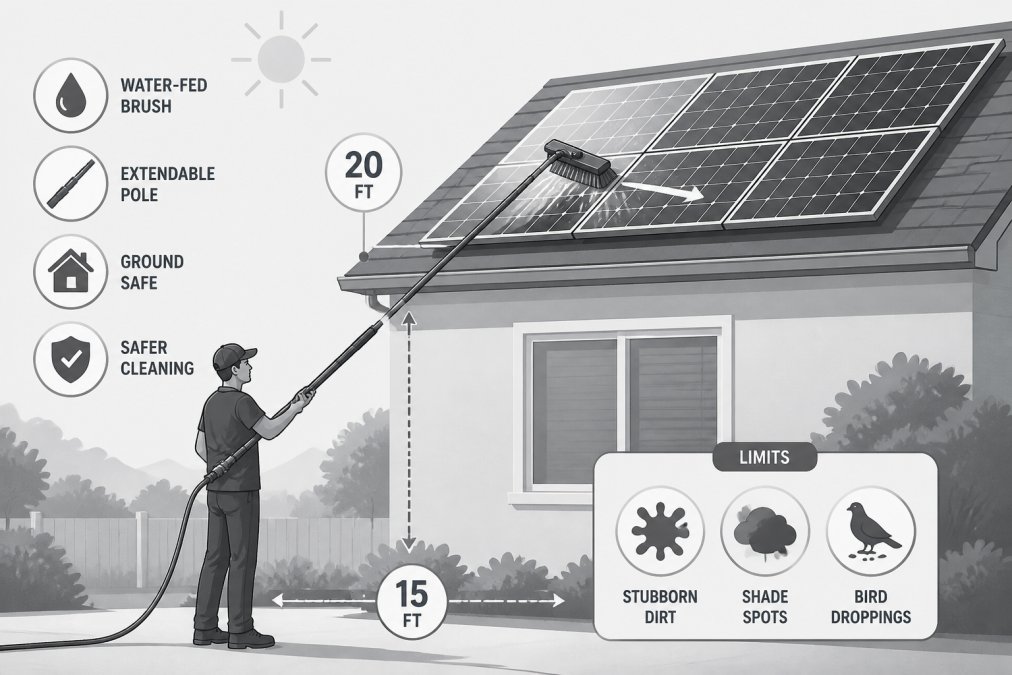
Tools That Work: Water-Fed Poles and Soft-Bristle Brushes
The right tools make DIY cleaning safer and more effective. A water-fed pole system is the most practical option for most homeowners because it allows cleaning from the ground, eliminating roof access entirely.
The VEVOR Water Fed Pole Kit offers a 12-foot extendable aluminum pole with a 180-degree rotatable brush head and soft PP bristles, with two water jets built into the brush head. It includes a 65.6-foot hose and weighs 5.5 pounds, making it manageable for most adults. It works well for single-story and accessible two-story installations. The 12-foot VEVOR Water Fed Pole Kit costs $85.90. Other VEVOR Water Fed Pole Kits are available, including a 30-foot kit for $149.90 and a 36-foot kit for $164.99.
For tougher grime, the XERO Solar Brush uses a 23-inch head with outer nylon bristles for smooth gliding and inner boar hair bristles for stubborn deposits. Paired with a water-fed pole and a deionized water source, it handles most residential soiling without scratching the panel surface. The XERO Solar Brush costs $204.00.
The ProDesign Solar Panel Cleaning Kit from Mr. LongArm is a more comprehensive option at $294.63, including a 4-12-foot extension pole, a flow-through brush, and an 18-inch squeegee. It’s designed for both solar panels and windows, which makes it a practical multi-use investment.
What to Avoid: Abrasive Cleaners, Hard Water, and Roof Risks
Three things will damage your panels or void your warranty faster than dirt ever will:
- Abrasive cleaners or scrubbing pads: These scratch the anti-reflective coating on panel glass, causing permanent photovoltaic efficiency loss
- Hard water from a standard tap: Mineral deposits left behind are often worse than the original soiling
- Roof access without proper safety equipment: Falls from residential rooftops are among the leading causes of serious home improvement injuries, according to the U.S. Consumer Product Safety Commission’s ladder and roof safety data
If your panels are on a steep pitch, a second story, or a roof you’re not comfortable walking on, stop. This is exactly where professional solar panel cleaning services earn their cost.
Professional Solar Panel Cleaning Services: What to Expect
Professional solar panel cleaning services combine the right chemistry, equipment, and safety protocols to restore your system’s output without risk to your panels, your roof, or the technicians doing the work. A licensed and insured provider brings deionized water systems, water-fed pole systems, and soft-bristle brushes designed specifically for photovoltaic glass.
Simply Superior Window Cleaning technicians undergo rigorous classroom and on-the-job training, with monthly safety meetings that keep roof safety protocols current. That’s not a minor detail. Working at height on residential rooftops requires insurance-compliant practices and ongoing safety accountability that most DIY approaches simply can’t replicate.
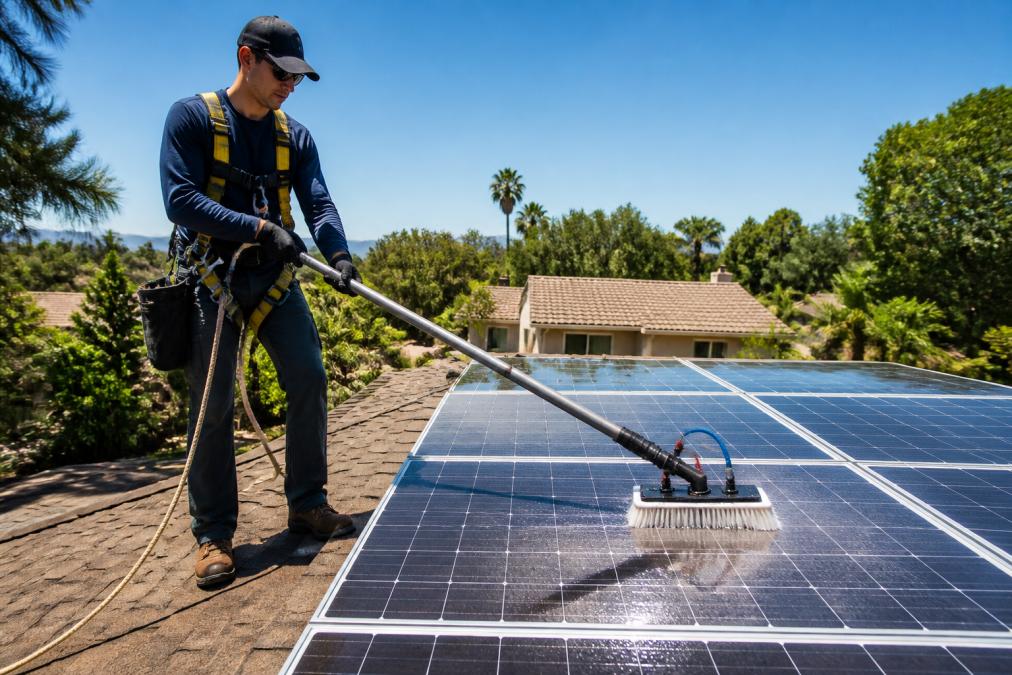
A professional visit should include more than a rinse. Expect a chemical-free, deionized water cleaning process, debris removal from panel edges and racking, and a post-clean inspection for any visible damage or shading issues.
Visual Inspection Checklist a Pro Should Cover
A quality residential solar panel cleaning service should include a visual inspection alongside the cleaning itself. Before you book, confirm your provider covers:
- Panel surface condition: cracks, delamination, or discoloration
- Junction box and wiring integrity from visual check
- Mounting hardware and racking for corrosion or loosening
- Debris accumulation in panel gaps and around edges
- Evidence of bird nesting or wildlife damage beneath the array
- Shading from new tree growth or nearby structures
- Before-and-after photo documentation for warranty records
This checklist isn’t just about thoroughness. It’s about having a documented record if a warranty claim becomes necessary.
Warranty Implications and Environmental Considerations
Most solar panel manufacturers include maintenance requirements in their warranty terms. Neglecting regular cleaning can give a manufacturer grounds to deny a performance warranty claim if soiling is found to have contributed to degradation. According to guidance from the Solar Energy Industries Association, proper system maintenance is a standard condition of most residential solar warranties.
The practical implication: keep a maintenance log. Document every cleaning visit with dates, provider name, and any inspection findings. If you ever need to make a warranty claim, that paper trail is your first line of defense.
On the environmental side, the cleaning method matters. Chemical-free, deionized water processes are the industry standard for good reason. Soap-based cleaners or chemical solutions can run off into landscaping and drainage systems, and some panel manufacturers explicitly prohibit chemical cleaning agents in their warranty terms. A spotless finish doesn’t require anything beyond purified water and the right brush.
Always request a written maintenance record after each professional cleaning visit. This documentation protects your warranty coverage and supports your home’s resale value.
How to Choose a Residential Solar Panel Cleaning Service
The market for solar panel cleaning has grown alongside solar adoption, which means more providers but also more variation in quality. Here’s what separates a reliable service from a liability.
Checklist for evaluating a provider:
- Licensed and insured for roof work in your state
- Uses deionized water, not tap water or soap-based solutions
- Employs soft-bristle brushes or water-fed pole systems, not pressure washers
- Provides before-and-after documentation
- Offers flexible maintenance schedules, not just one-time visits
- Can quote virtually based on panel count and roof specifications
- Has verifiable training and safety protocols for technicians
Pressure washing is a red flag. High-pressure water can force moisture into junction boxes, dislodge wiring, and damage panel seals. Any provider recommending pressure washing for solar panels doesn’t understand photovoltaic systems.
Simply Superior Window Cleaning offers virtual on-site quote capability, which means you get an accurate estimate based on your specific panel count and roof configuration without waiting for a site visit. For homeowners managing busy schedules, that convenience matters. The team handles everything from single-story residential arrays to multi-story commercial installations, with the capacity to meet contracts of all sizes.
The right provider isn’t necessarily the cheapest. It’s the one with trained technicians, proper insurance, the right equipment, and a documented process that protects your system and your warranty.
Frequently Asked Questions
Is it worth paying to have solar panels professionally cleaned?
For most homeowners, yes. Soiling loss from bird droppings, pollen accumulation, and dust can reduce photovoltaic efficiency by 15-25% in some conditions. A professional cleaning restores energy output, which translates directly to lower electricity bills. When you factor in the return on investment over a full billing cycle, professional service typically pays for itself, especially for systems that have gone more than a year without cleaning.
How often should residential solar panels be cleaned?
Most solar array owners benefit from cleaning once or twice per year. Homes near high-traffic roads, agricultural areas, or under heavy tree cover may need quarterly service due to faster pollen accumulation and debris buildup. Monitoring your inverter performance data is the clearest signal: a consistent drop in energy production that does not match weather patterns usually means it is time to schedule a cleaning.
Can I clean my own solar panels, or should I hire a professional?
Ground-level DIY solar panel cleaning with a water-fed pole system and deionized water is safe and effective for single-story homes with accessible panels. Roof access changes the calculation significantly. Working on a pitched roof without proper training, safety equipment, and insurance coverage creates serious fall risk. For panels on second-story roofs or steep pitches, a licensed and insured professional service is the safer and often more thorough choice.
Will cleaning my solar panels void the warranty?
Using abrasive cleaners, pressure washing at high PSI, or hard water that leaves mineral deposits can void manufacturer warranties on panel coatings and surfaces. Most manufacturers recommend chemical-free cleaning with deionized water and a soft-bristle brush. Hiring a professional who follows manufacturer-approved methods protects your warranty. Always ask a service provider whether their cleaning process is insurance-compliant and aligned with your panel manufacturer's maintenance guidelines.
What factors affect the cost of solar panel cleaning services?
Solar panel cleaning cost depends on the number of panels in your solar array, roof pitch and height, ease of access, and your location. Recurring maintenance plans typically cost less per visit than one-time cleaning appointments. Additional services like a visual inspection report, bird-proofing, or debris removal from around the array can also affect the final price. Request a detailed quote that itemizes each service so you can compare providers accurately.
Underperforming solar panels are a fixable problem, but only if you act before soiling loss compounds into permanent panel degradation. Simply Superior Window Cleaning provides cost-effective solar panel cleaning with trained technicians, insurance-compliant safety practices, and flexible maintenance schedules designed around your system’s needs. Schedule a free quote today and find out exactly what your panels need to perform at their best.
This article was written using GrandRanker