
Table of Contents
- What a Solar Maintenance Contract Actually Covers
- The Main Benefits of a Solar Maintenance Contract
- What Residential Solar Panel Cleaning Services Include
- What Solar Panel Maintenance Cost Looks Like
- Solar Panel Warranty Requirements and Coverage
- Risks and Tradeoffs: Pros, Cons, and Hidden Fees
- Exit Strategy: How to Terminate a Solar Maintenance Contract
- Frequently Asked Questions
Last Updated: September 16, 2026
What a Solar Maintenance Contract Actually Covers
A solar panel maintenance contract benefits review starts with the basics: it is a service agreement in which a provider handles scheduled inspections, cleaning, and performance checks on your photovoltaic system for a set term.
Preventative Maintenance and Annual Cleaning
Preventative maintenance covers the recurring work that keeps a solar array producing at its rated capacity. A typical schedule includes annual cleaning, torque checks on mounting hardware, and inspection of wiring and connectors for corrosion.
Performance Monitoring and Remote Diagnostics
Performance monitoring tracks your system’s energy generation against expected output. When production drops below the baseline, remote diagnostics let the provider identify whether the cause is soiling, shading, a failing inverter, or a wiring fault, often before you notice anything on your utility bill.
The Main Benefits of a Solar Maintenance Contract
The core benefit of a solar panel maintenance contract is predictable system performance: you trade an unknown repair bill for a known service fee and a documented maintenance history. For most homeowners, that trade is worth it once the system is more than a few years old.
Here’s what a contract actually buys you:
- Warranty compliance. Most manufacturer warranties require documented upkeep. Missing records can void a claim.
- Faster troubleshooting. Remote diagnostics catch component failure early, before it cascades.
- Budget certainty. A fixed annual fee replaces unpredictable service call charges.
- Longer system life. Regular service protects the inverter and slows the degradation rate.
Documented maintenance is what keeps your warranty coverage intact when you actually need to file a claim.
What Residential Solar Panel Cleaning Services Include
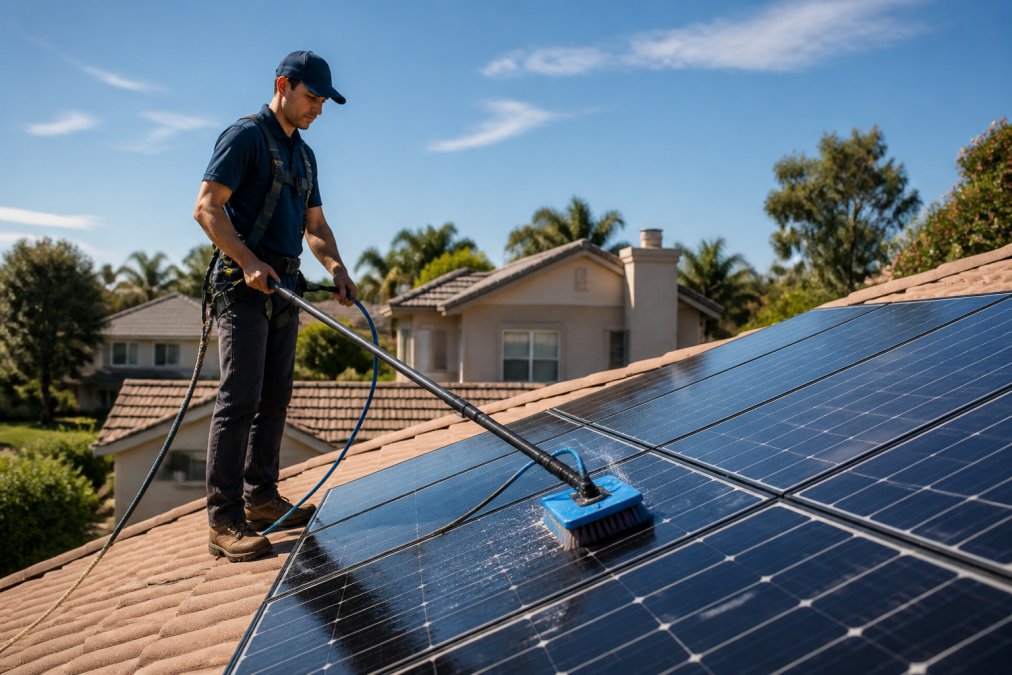
Residential solar panel cleaning services cover the physical work of removing soiling from your array safely and without voiding warranties. A professional visit typically includes a pre-cleaning inspection, deionized-water washing, and a post-service performance check.
What Solar Panel Maintenance Cost Looks Like
Solar panel maintenance cost depends on system size, roof pitch, access, and how much of the work is bundled into a contract versus billed per visit. Because pricing varies that widely by property, we don’t quote a flat figure; we assess each roof and provide a written proposal. What we can do is show you the line items that show up in almost every quote, so you can compare proposals apples to apples instead of staring at a single number.
The main cost drivers to expect in any quote:
- System size and panel count. More panels means more time on the roof. A typical residential array runs 15-30 panels, and cleaning time scales roughly with count.
- Access and height. Steep or multi-story roofs require more safety setup, harness anchoring, and sometimes a lift, all of which add labor hours.
- Service frequency. Annual plans usually cost less per visit than on-demand calls because the provider can route your property into an existing schedule.
- Bundled services. Combining solar cleaning with gutter and window maintenance often lowers the total versus booking each service separately.
- Water quality and method. Deionized-water systems and water-fed poles cost the provider more to run than a garden hose and a brush, and that shows up in the quote.
The Fee Structure Behind the Number
A maintenance contract is rarely one flat fee. It is usually a stack of line items, and knowing the names helps you spot padding:
| Fee Type | What It Is | Watch For |
|---|---|---|
| Base annual fee | Covers scheduled inspections and one cleaning | Whether it includes parts or labor only |
| Per-visit service call charge | Trip fee billed on top of the base fee | Often waived only for the first visit |
| Diagnostic fee | Charged to investigate a production drop | Whether it is credited toward repair |
| Parts and labor | Replacement components (inverter, optimizer, connector) | Whether markup is capped |
| Emergency or after-hours rate | Premium for weekend or same-day response | Whether it is defined or open-ended |
| Cancellation or early-termination fee | Charged if you exit before term end | Flat vs. prorated vs. remaining balance |
What Is Typically Excluded
This is the gap most guides skip. Standard maintenance agreements usually exclude:
- Inverter replacement. The inverter is the most common major failure and often the most expensive single component. Many contracts cover diagnosis but not the part.
- Roof work. If a leak or structural issue is found, that is a roofing contractor’s scope, not the solar tech’s.
- Damage from storms, hail, or rodents. Usually routed to your homeowner’s insurance instead.
- Monitoring hardware replacement after the warranty period.
- Cosmetic issues like discoloration that do not affect production.
The most common hidden fee in solar maintenance contracts is the service call charge. Some agreements advertise a low annual rate but bill a separate trip fee for every visit beyond the included one, plus a diagnostic fee that is only credited if you approve the repair. Read the fee schedule before you sign, not after your first breakdown.
How to Compare Two Proposals
Put both quotes side by side and answer four questions: What is the base fee, and what does it include? What triggers an extra charge? Is the diagnostic fee credited toward repair? And what is the total cost if you need one inverter replacement in year three? The proposal that answers all four in writing is almost always the safer contract, even if its headline number is higher.
Ask each provider for a sample invoice showing a routine visit and a repair visit. The difference between the two tells you more about real cost than any advertised annual rate.
Solar Panel Warranty Requirements and Coverage
Solar panel warranty requirements almost always include a maintenance clause, and this is where the fine print decides your coverage. Manufacturers typically require that the system be kept free of debris and that any work be performed by qualified technicians using approved methods. Miss either condition and a claim can be denied even when the defect itself is covered.
Warranty coverage generally splits into three layers:
| Coverage Type | Typical Term | What It Covers |
|---|---|---|
| Product warranty | 10-25 years | Panel defects and materials |
| Performance warranty | 25 years | Guaranteed output above a set degradation rate |
| Workmanship warranty | 5-10 years | Installation and mounting faults |
How the Maintenance Clause Actually Works
The maintenance clause is not a single sentence you can skim. It usually has three moving parts:
- A care obligation. Keep the array free of debris, snow, and shading. Some manufacturers specify a cleaning frequency; most say “as needed” and leave the judgment to you.
- A qualified-technician requirement. Any work on wiring, connectors, or mounting hardware must be done by a licensed or manufacturer-certified installer. Cleaning is sometimes exempt, sometimes not.
- A documentation requirement. You must be able to show records, invoices, service reports, or a monitoring log, if a claim is questioned.
DIY Cleaning and Your Warranty
This is the question competitors dodge. The honest answer is that it depends on what the warranty says and what you actually do.
- Rinsing dust off with a hose is generally low-risk and rarely triggers a warranty issue on its own.
- Using a abrasive brush, a pressure washer, or a harsh detergent can scratch the glass or degrade the anti-reflective coating. That damage is typically classified as improper maintenance and excluded.
- Walking on panels or removing mounting hardware to reach a stubborn spot can void both the product and workmanship warranties.
- Cleaning during peak sun can thermal-shock the glass. Manufacturers and installers generally recommend early morning or evening.
What None of the Three Warranties Cover
The gap most homeowners discover too late: none of these cover cleaning, and some explicitly exclude damage caused by improper cleaning. A scratched panel from an abrasive brush is an out-of-pocket replacement, not a warranty claim. The same is true for damage from a pressure washer, from standing on the glass, or from a cleaning product that leaves a residue.
Documented maintenance is what keeps your warranty coverage intact when you actually need to file a claim, and it is the one thing a DIY owner can replicate for free, as long as they keep records.
Risks and Tradeoffs: Pros, Cons, and Hidden Fees
A solar panel maintenance contract benefits review has to weigh the drawbacks honestly, because a contract isn’t right for every owner. Here’s the balanced picture.
Pros:
- Documented maintenance protects warranty coverage
- Remote diagnostics reduce downtime and emergency repair costs
- Predictable annual cost instead of surprise service bills
- Professional cleaning avoids the DIY damage risk
Cons:
- You pay for service in years when nothing goes wrong
- Long contract duration can lock you in past the point of value
- Bundled services you don’t need inflate the price
- Cancellation terms are often stricter than the sales conversation implies
Exit Strategy: How to Terminate a Solar Maintenance Contract
Terminating a solar maintenance contract cleanly requires reading the cancellation clause before you need it. Most agreements specify a notice window, an early-termination fee, and whether you keep the monitoring hardware after you leave.
Before signing, confirm four things in writing:
- Notice period. How many days’ notice to cancel without penalty?
- Early-termination fee. Is it flat, prorated, or tied to remaining contract duration?
- Equipment ownership. Do you keep the monitoring hardware, or does it get removed?
- Escalation clauses. Does the annual fee rise with inflation or utility rate increases?
Ask for the cancellation terms in writing before you sign, and photograph the signed copy. Providers that won’t put exit terms in the contract are telling you something about how the relationship will end.
Frequently Asked Questions
Is it hard to get out of a solar panel contract?
It depends on the terms in your solar lease agreement. Most contracts include an early termination clause, but you may owe a buyout fee or remaining payments. Some contracts have a specific exit window, often after five years. Review the contract duration, termination fees, and any transfer options before signing. If you sell your home, some contracts allow the new owner to assume the agreement, which can make exiting easier.
How much does solar panel maintenance cost?
Solar panel maintenance cost varies based on system size, location, and service scope. Annual cleaning and inspection plans typically range from a few hundred dollars, while comprehensive contracts with performance monitoring and remote diagnostics cost more. Pricing depends on the number of panels, roof access difficulty, and whether the plan includes inverter replacement or component failure coverage. Request a quote for your specific system to get an accurate figure.
What is typically included in a solar panel maintenance agreement?
A standard agreement covers preventative maintenance, annual cleaning, performance monitoring, remote diagnostics, and troubleshooting. Many contracts also include system efficiency checks, inverter inspections, and warranty coverage verification. Some plans bundle services like gutter cleaning or window cleaning. Review the service level agreement to confirm what is included and what triggers an extra service visit or service call charge.
Do solar panel warranty requirements mandate a professional maintenance contract?
Most manufacturer warranties require regular maintenance but do not always mandate a paid contract. They typically specify that panels must be kept clean and free of debris, and that inspections be documented. Skipping maintenance can void warranty coverage if damage results from neglect. Keeping records of annual cleaning and performance monitoring helps prove you met the warranty requirements. Check your specific warranty terms for exact obligations.
What are the risks of skipping solar panel maintenance?
Skipping maintenance leads to dust, bird droppings, and debris blocking sunlight, which lowers energy production and system efficiency. Over time, uncleaned panels can develop hot spots, and inverters may fail without warning. Without performance monitoring, small issues become costly repairs. Neglect also risks violating warranty coverage. A preventative maintenance schedule protects your return on investment and keeps your photovoltaic system producing at its rated capacity.