Table of Contents
- Professional Pressure Washing vs DIY: A Side-by-Side Comparison
- Cost Analysis: DIY Equipment vs. Hiring a Pro
- Risks of DIY Power Washing: Surface Damage and Safety
- Key Benefits of Hiring Professional Pressure Washers
- Time Investment and Efficiency: DIY vs. Professional Crews
- Insurance, Liability, and Environmental Concerns
- Surface-Specific Cleaning: When to Call a Pro
- Conclusion: Making the Right Choice for Your Home
- Frequently Asked Questions
Last Updated: September 5, 2026
Professional Pressure Washing vs DIY: A Side-by-Side Comparison
The debate over professional pressure washing vs diy methods usually comes down to one question: what is your time worth? Pressure washing is the use of high-pressure water spray to remove dirt, grime, mold, and stains from exterior surfaces. When you compare the true cost of equipment, your labor, and the risk of damaging your home, the scales often tip further toward hiring a pro than most homeowners expect. At Simply Superior Window Cleaning, we have seen the aftermath of both approaches across Ventura and North LA Counties, and the difference in long-term results is significant.
Many homeowners assume that renting a machine for a weekend is the obvious money-saver. That assumption ignores the hidden expenses of DIY work, from surface damage to the cost of your own time. Below, we break down the real numbers, the risks, and the situations where each option makes sense.
Cost Analysis: DIY Equipment vs. Hiring a Pro
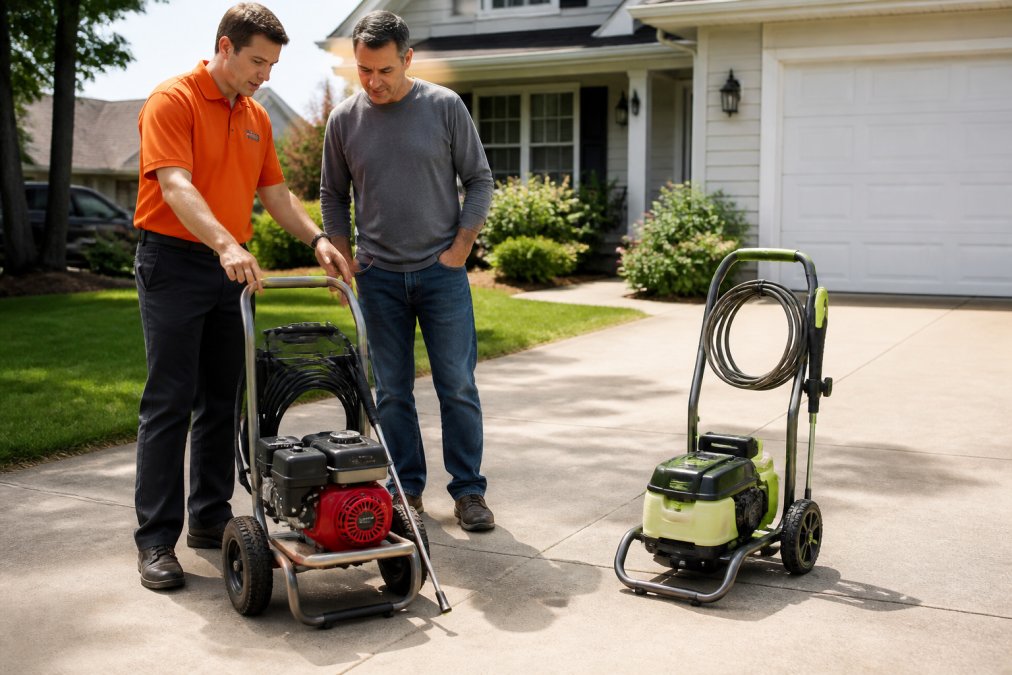
The upfront cost of pressure washing equipment rental is lower than hiring a professional, but that gap narrows quickly when you account for everything involved. A typical rental runs approximately $75 to $90 per day from major home improvement retailers, which seems reasonable for a single project.
What most guides miss is that the rental is only the beginning. You also need detergent, nozzle tips, and safety gear, and you must transport the machine yourself. For a full house exterior, you will likely need the equipment for a full day, and rushing to return it by closing time often leads to sloppy work.
The Full DIY Cost Breakdown
A realistic DIY cost sheet for a single-family home exterior includes more than the rental fee:
- Equipment rental: $75-$90 per day (gas unit from a national chain)
- Detergent and chemicals: $20-$40 (surface-specific cleaners for concrete, wood, and siding)
- Nozzle tips: $10-$25 (a set of color-coded tips, since rentals rarely include the full range)
- Safety gear: $15-$30 (eye protection, non-slip boots, gloves)
- Transportation: $5-$15 (fuel and vehicle space for hauling a 50-80 lb machine)
- Total DIY cost: $125-$200 for one weekend
A professional service typically quotes $250-$600 for a similar scope, depending on square footage, surface types, and story height. The gap is real, but it narrows when you factor in what happens after the rental is returned.
The Hidden Cost of Owning a Machine
Buying your own unit eliminates rental fees but introduces new expenses that most cost comparisons ignore. A consumer-grade electric model like the DeWalt 2600 PSI Electric Jobsite Pressure Washer costs around $300-$400. But ownership carries ongoing costs:
- Annual maintenance: $30-$60 per year for pump oil, spark plugs, and air filters on gas units; electric models need less but still require hose and wand inspection
- Winterization: $15-$30 for antifreeze or storage procedures if you live in a freezing climate
- Storage space: The machine occupies roughly 2-3 cubic feet of garage or shed space, which many homeowners undervalue
- Depreciation: Consumer units typically last 3-5 years with regular use; a $350 machine used twice a year costs $70-$115 per use in depreciation alone
When you add maintenance, storage, and depreciation, the true cost of ownership for a DIY machine used twice per year lands at $150-$250 per project, comparable to hiring a professional once you include your labor time.
Rental vs. Purchase vs. Hire: A Decision Framework
| Scenario | Best Option | Why |
|---|---|---|
| One-time driveway cleaning | DIY rental | Lowest upfront cost; low risk on flat concrete |
| Annual full-exterior cleaning | Hire a pro | Avoids storage, maintenance, and technique risk |
| Frequent use (4+ times/year) | Buy a consumer unit | Ownership pays off with repeated use |
| Multi-surface or two-story home | Hire a pro | Surface-specific knowledge and liability coverage |
The real cost comparison is not rental fee vs. service quote. It is the full lifecycle cost of equipment ownership, your labor hours, and the financial risk of surface damage, which most DIY cost analyses conveniently omit.
Pressure Washing Equipment Rental Costs
Renting from a national chain like Home Depot Tool Rental gives you access to professional-grade gas units without the storage commitment. The tradeoff is that you assume full responsibility for operating the machine correctly, and the rental center does not provide training on proper technique.
Hidden Costs of DIY: Maintenance and Storage
Buying your own unit eliminates rental fees but introduces new expenses. A consumer-grade electric model requires annual maintenance, space in your garage, and eventual replacement. The DeWalt 2600 PSI Electric Jobsite Pressure Washer is a solid consumer option, but it still demands proper winterization and storage to avoid costly repairs.
DIY pressure washing is the most common cause of exterior property damage we see. A single pass at the wrong angle or PSI can etch concrete, strip siding, or blast water under shingles, leading to repairs that far exceed the cost of professional service.
Risks of DIY Power Washing: Surface Damage and Safety
The risks of DIY power washing extend beyond a botched cleaning job. Operating a high-pressure stream without training can cause serious injury, and using incorrect settings can permanently damage your home’s exterior surfaces.
Understanding PSI and GPM to Protect Your Home
PSI (pounds per square inch) measures water pressure, while GPM (gallons per minute) measures water flow. Together, they determine cleaning power. Most consumer machines push 1,500 to 2,600 PSI, which is more than enough to etch concrete or gouge wood siding if held too close.
Professional crews match PSI and GPM to each specific surface. Soft washing, which uses low pressure combined with chemical surfactants, is often the correct approach for delicate materials like vinyl siding and roofs. Most DIYers do not own the equipment for soft washing, nor do they understand when to use it.
Key Benefits of Hiring Professional Pressure Washers
The benefits of hiring professional pressure washers center on expertise, efficiency, and accountability. A trained technician knows the correct pressure for concrete, brick, wood, and siding, and carries insurance to cover any accidental damage.
Professional-Grade Equipment vs. Consumer Models
Professional-grade equipment delivers higher temperatures and more consistent chemical application than consumer models. Hot water cleaning removes oil and grease that cold water simply pushes around. Commercial units also operate faster, meaning the job takes a fraction of the time a rental would require.
The real value of hiring a pro is not the machine. It is the knowledge of which settings to use on which surfaces, and the liability coverage if something goes wrong.
Time Investment and Efficiency: DIY vs. Professional Crews
A full exterior cleaning that takes a professional crew a few hours will consume an entire weekend for a first-time DIYer. Between moving the machine, mixing chemicals, testing surfaces, and cleaning gutters and siding, the labor is intensive.
Consider what your weekend is worth. A professional crew arrives with the right equipment and completes the job in a fraction of the time, often while you are at work. For busy homeowners, the time savings alone can justify the cost difference.
Insurance, Liability, and Environmental Concerns
This is the gap most comparison guides miss entirely. When you rent a pressure washer, you assume all liability for property damage and personal injury. If you blast water through a window seal or fall off a ladder, that is on you.
Professional companies carry liability insurance and follow EPA regulations on wastewater runoff to ensure that chemical-laden water does not contaminate storm drains. DIYers rarely consider where their detergent runoff goes, which can create legal exposure in addition to environmental harm.
Surface-Specific Cleaning: When to Call a Pro
Not all surfaces respond to the same treatment. Concrete driveways tolerate high pressure, but wood decks require lower pressure with a wider fan spray. Vinyl siding needs soft washing to avoid forcing water behind the panels, and roofs should almost never be pressure washed at high PSI.
PSI Reference Guide by Surface Material
The precision gap between DIY and professional work comes down to matching pressure and flow to the material. Most consumer machines operate in the 1,500-2,600 PSI range, which is appropriate for only a narrow set of surfaces. The table below summarizes recommended settings and the failure mode when those settings are exceeded:
| Surface | Recommended PSI | Recommended GPM | DIY Feasibility | Damage Mechanism at High PSI |
| — | — | — | — |
| Concrete driveway | 2,500-3,000 | 2.5-3.0 | Feasible with rental | Etching and surface pitting from concentrated stream |
| Brick or masonry | 1,200-1,500 | 2.0-2.5 | Moderate | Mortar erosion between bricks |
| Wood deck (softwood) | 500-800 | 1.5-2.0 | Low | Gouging and splintering of wood fibers |
| Wood deck (hardwood) | 800-1,200 | 1.5-2.0 | Low | Cupping and surface roughness |
| Vinyl siding | 500-1,000 (soft wash preferred) | 1.0-1.5 | Very low | Water forced behind panels, causing mold growth |
| Roof shingles | 500-600 (soft wash only) | 1.0-1.5 | Very low | Granule loss, accelerated aging, leaks |
| Painted surfaces | 800-1,000 | 1.5-2.0 | Low | Paint stripping and surface etching |
| Second-story areas | N/A, requires ladder safety | N/A | Very low | Fall risk and inability to control angle |
Why PSI Alone Does Not Tell the Full Story
PSI measures pressure, but GPM (gallons per minute) determines how much water hits the surface. A machine with 2,500 PSI and 1.2 GPM cleans differently than one with 2,500 PSI and 2.8 GPM. The higher-flow unit strips dirt faster but also carries more water into gaps and seams, increasing the risk of water intrusion behind siding or under shingles.
Professional crews match both numbers to the surface. For delicate materials like vinyl siding and roofs, they use soft washing, a technique that combines low pressure (typically under 500 PSI) with biodegradable chemical surfactants that break down mold, mildew, and algae without abrasive force. Most DIY rental units cannot operate at these low pressures, and homeowners rarely own the downstream injectors needed for proper chemical application.
Surface-Specific Failure Modes
The damage from incorrect PSI is not always immediate. Common patterns include:
- Vinyl siding: Water forced behind panels creates a dark, damp environment where mold thrives. The damage appears weeks later as streaks that are impossible to clean without removing the siding.
- Wood decks: High pressure strips the soft grain between harder growth rings, leaving a fuzzy, rough surface that splinters and absorbs stain unevenly.
- Roof shingles: The blast dislodges protective granules, accelerating UV degradation. A roof that would have lasted 20 years may need replacement in 10-12.
- Concrete: A concentrated stream at close range etches a permanent groove or discolored patch that cannot be repaired, only resurfaced.
When to Call a Pro
The table below summarizes which approach fits common scenarios:
| Surface | DIY Feasibility | Recommended Approach | Risk Level |
|---|---|---|---|
| Concrete driveway | Feasible | DIY rental at 2,500-3,000 PSI | Low |
| Wood deck | Moderate | Professional soft wash | Medium |
| Vinyl siding | Low | Professional soft wash | High |
| Roof shingles | Very low | Professional only | High |
| Second-story areas | Very low | Professional crew | High |
A pressure washer does not discriminate between dirt and the surface beneath it. The same 2,500 PSI stream that cleans a driveway in minutes can permanently scar a wood deck or force water behind vinyl siding. The precision required for mixed-surface exteriors is the strongest argument for professional service.
Conclusion: Making the Right Choice for Your Home
Choosing between professional pressure washing vs diy methods comes down to your tolerance for risk, your available time, and the specific surfaces you need cleaned. For flat concrete work where you already own a machine, DIY can work. For multi-surface exteriors, delicate materials, or anything above the first story, the risks of DIY power washing quickly outweigh the savings.
Choosing the right approach for your home should not require a weekend of rented equipment and a prayer that nothing gets damaged. Simply Superior Window Cleaning provides professional exterior cleaning with technicians who undergo rigorous classroom and on-the-job training, backed by monthly safety meetings. We handle pressure washing, window cleaning, and gutter maintenance for properties up to four stories tall, with virtual quote options that make getting started simple. Get started with Simply Superior Window Cleaning and schedule a free quote today.
Frequently Asked Questions
1] Q: Is it cheaper to pressure wash my own house or hire a professional?
Renting a pressure washer costs roughly $75-$90 per day, which seems cheaper upfront. However, professional pressure washing vs DIY methods often favors the pro when you factor in the cost of cleaning solutions, nozzle tips, safety gear, and your own time. A professional completes the job in a fraction of the time and brings expertise that prevents costly surface damage. For a thorough estimate, contact Simply Superior Window Cleaning for a virtual quote.
2] Q: What are the main risks of DIY power washing?
The biggest risks of DIY power washing include etching concrete, gouging wood siding, and forcing water behind vinyl siding or into window seals. Using too high a PSI or holding the nozzle too close can strip paint and damage softer surfaces like cedar. There is also personal safety risk from slips and falls. Professional technicians are trained to match pressure and technique to each surface, protecting your home’s exterior.
3] Q: Do professional pressure washers use their own water?
Most professional pressure washing companies, including Simply Superior Window Cleaning, arrive with their own water supply and professional-grade equipment. This avoids any issue with your home’s water pressure or flow rate. Their equipment is designed to deliver consistent PSI and GPM, ensuring a thorough clean without the risk of damaging your property. This is a key advantage of hiring a professional over renting a machine.
4] Q: What surfaces are most susceptible to damage from improper pressure washing?
Soft materials like wood siding, stucco, and older brick are most at risk from high-pressure streams. Asphalt shingles can be granule-stripped, and window seals can be breached. Even concrete can be permanently etched if the nozzle is held too close. A professional service uses soft washing and lower PSI for these delicate areas, which is a major benefit of hiring professional pressure washers.
This article was written using GrandRanker