
Table of Contents
- Why a Commercial Exterior Maintenance Contract Beats On-Demand Calls
- The Real Cost of Commercial Exterior Maintenance: Contract vs. Reactive
- Risk Mitigation and Liability Management Through Scheduled Care
- Protecting Asset Value and Curb Appeal Over the Property Lifecycle
- Maintaining Tenant Satisfaction and Retention with a Clean Storefront
- Your Commercial Property Maintenance Checklist: What a Contract Should Cover
- Setting the Right Commercial Window Cleaning Frequency in Your Agreement
- Exit Clauses, KPIs, and Accountability: Structuring a Smart Agreement
- Conclusion
- Frequently Asked Questions
Last Updated: September 6, 2026
Why a Commercial Exterior Maintenance Contract Beats On-Demand Calls
Waiting until a storefront looks neglected before calling a service provider is the most expensive maintenance strategy a property owner can adopt. A commercial exterior maintenance contract benefits your bottom line by shifting the focus from emergency response to scheduled, preventive care, which protects both the building envelope and your budget from unpredictable spikes.
The core advantage is simple: predictability. Under a reactive model, you pay a premium for urgency and accept the risk that a small issue becomes a larger structural problem. A contract inverts that logic, securing a fixed schedule, a dedicated vendor relationship, and cost certainty.
The Real Cost of Commercial Exterior Maintenance: Contract vs. Reactive
The true cost difference between a contract and reactive calls is rarely visible on a single invoice. It shows up in the capital expenditure you avoid when deferred maintenance forces a premature roof replacement or facade repair.
Budget predictability is the primary financial advantage of a contract. By converting unpredictable operational expenditure into a fixed monthly or quarterly line item, facility managers can allocate funds more accurately. Scheduled visits also allow for early detection of minor wear, preventing costly structural interventions.
The financial logic of a contract hinges on catching small problems early. A scheduled cleaning that identifies a failing sealant bead costs hundreds to fix; finding it after water intrusion has damaged the interior drywall costs thousands.
Risk Mitigation and Liability Management Through Scheduled Care
A commercial exterior maintenance contract is a primary tool for risk mitigation, directly addressing liability concerns associated with property maintenance. When a vendor works under a contract, their obligations are defined by a service level agreement (SLA), which typically includes proof of insurance, safety protocols, and compliance with OSHA standards (osha.gov). This shifts the liability burden for accidents, such as a fall from height or damage to a third party’s property, squarely onto the contractor.
Scheduled care also reduces the risk of regulatory non-compliance. Building codes often require specific safety and accessibility standards for walkways, parking lots, and entry points. A contract that includes pressure washing for slip hazards or snow removal ensures compliance, and the documentation provided by a professional contractor serves as your evidence of diligent upkeep in any liability dispute.
Protecting Asset Value and Curb Appeal Over the Property Lifecycle
Curb appeal is not vanity; it is a direct driver of asset value and a key factor in tenant retention. A building that is consistently cleaned and maintained commands higher rents and attracts higher-quality tenants. Dirt, pollution, and biological growth like mildew do not just look bad; they actively degrade siding, masonry, and window seals, compromising structural integrity (peer-reviewed research).
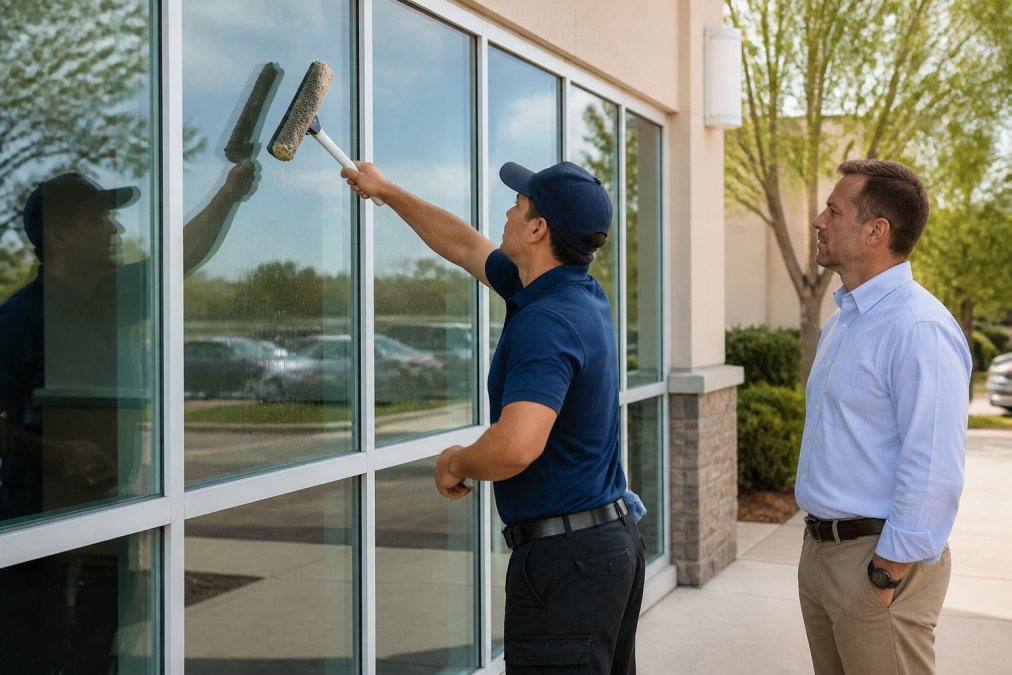
A proactive maintenance schedule preserves the building envelope, extending the lifespan of expensive components like glazing and exterior cladding. This is the essence of preventative care: spending a modest amount on regular cleaning to avoid the massive cost of replacing degraded materials. The visual signal of a well-kept property also reduces vacancy rates.
Maintaining Tenant Satisfaction and Retention with a Clean Storefront
Tenants notice when a property is cared for. A clean storefront and well-maintained grounds directly influence tenant satisfaction and lease renewal decisions. For retail tenants, a dirty exterior means lost sales; customers do not want to walk into a store with grimy windows and littered entryways (psu.edu).
An exterior maintenance contract ensures the property always presents its best face without requiring the property manager to chase vendors. This operational efficiency reduces the administrative burden on your staff, freeing them to focus on tenant relations. When tenants see a consistent schedule of window cleaning and pressure washing, they feel their lease payments are justified.
Your Commercial Property Maintenance Checklist: What a Contract Should Cover
A generic contract is a recipe for disputes. A smart agreement is built on a specific commercial property maintenance checklist that defines the scope of work, frequency, and performance standards for every element of the exterior. This checklist is your safeguard against “scope creep” and ensures you are receiving the exact services you are paying for.
| Maintenance Task | Recommended Frequency | Primary Benefit |
|---|---|---|
| Window Cleaning | Monthly to Quarterly | Curb appeal, natural light, UV protection |
| Pressure Washing | Semi-Annual | Preventative care, slip hazard removal |
| Gutter Cleaning | Quarterly | Structural integrity, water damage prevention |
| Solar Panel Cleaning | Semi-Annual | Operational efficiency, energy output |
Your checklist should also specify the handling of emergency repairs and define response times for after-hours issues. It must clearly delineate contractual obligations, such as who is responsible for water supply access or disposing of debris. The most effective contracts also include a clause for a site inspection after each service, allowing you to sign off on the work before payment is released.
The Missing Piece: KPIs That Turn the Checklist Into a Management Tool
Most guides stop at the checklist. The competitive edge comes from building a performance audit framework into the contract itself. A checklist only tells you what should happen; KPIs tell you whether it actually happened to an acceptable standard.
Define measurable standards for every task. Instead of “clean windows,” specify “no visible streaks, smudges, or hard water spots on glass, frames, or sills when viewed from a 3-foot distance under daylight conditions.” Instead of “pressure washing,” specify “no visible dirt, mildew, or oil stains on walkways or parking surfaces, with water draining freely and no standing puddles.” These are enforceable standards tied to payment.
Track response time metrics. Your contract should state a maximum response time for non-emergency service requests (e.g., 48 hours) and for emergency calls (e.g., 4 hours). Require the vendor to log the time of your request and the time of arrival, and provide a monthly report showing average response times.
Monitor work order completion rates. For a multi-site portfolio, require the vendor to submit a monthly work order summary listing every scheduled visit, the date completed, and any follow-up items. A completion rate below 95% is a red flag.
Conduct quarterly site audits. Do not rely solely on the vendor’s self-reporting. Walk the property with a simple checklist of your own, take dated photos, and compare them against the contract’s performance standards. If you find a deficiency, document it in writing and require a corrective action plan within a defined timeframe.
Add a clause that allows you to request a third-party inspection at the vendor’s expense if you find repeated deficiencies. This is a powerful deterrent against substandard work and gives you a neutral arbiter in a dispute.
This KPI framework is the difference between a contract that merely exists and one that actively protects your asset, giving you the evidence you need to exercise an exit clause or negotiate better terms at renewal time.
Setting the Right Commercial Window Cleaning Frequency in Your Agreement
Determining the correct commercial window cleaning frequency is a balancing act between budget and presentation standards. For most retail and office environments, a monthly or bi-monthly schedule is sufficient, though properties near busy roads, in industrial zones, or in areas with high pollen counts may require more frequent service.
The frequency should also be tied to the type of business. A restaurant with large front windows will need more frequent cleaning than a law office with tinted glass on an upper floor. The agreement should establish a baseline schedule and a mechanism to adjust it seasonally, as weather conditions in regions like Ventura and North LA Counties can deposit significant dust and salt residue.
Exit Clauses, KPIs, and Accountability: Structuring a Smart Agreement
Most guides ignore the legal mechanics of the contract, but the exit clause is where a bad agreement becomes a nightmare. A fair contract should include a termination clause that allows either party to exit with 30 to 60 days’ notice, and should specify the process for resolving disputes, such as a third-party site inspection to verify a claim of incomplete work.
Accountability is enforced through Key Performance Indicators (KPIs). The contract should define measurable standards, such as “no visible streaks on glass after drying” or “all gutters free of debris and flowing freely after service.” These KPIs, tied to the SLA, give you the ability to demand corrective action or withhold payment for non-compliance.
The Exit Clause: Your Safety Valve, Negotiated Upfront
The exit clause is not a legal formality; it is your primary leverage against vendor complacency. Here is what a well-structured exit clause should contain.
Notice period and timing. A 30-day notice for termination without cause is standard for month-to-month or quarterly service agreements; for annual contracts, a 60-day notice is more common. Align the notice window with your budgeting cycle so you are never forced to renew because you missed a deadline.
Termination for cause. The contract should allow immediate termination for cause, such as failure to maintain required insurance, safety violations, or repeated failure to meet the defined KPIs. Specify what constitutes “repeated” (e.g., three documented deficiencies in a 90-day period) to avoid ambiguity.
Automatic renewal traps. Avoid contracts with automatic renewal clauses that require you to “opt out” months in advance. Always negotiate for a mutual, written notice period that aligns with your budgeting cycle. If the vendor insists on auto-renewal, require a written reminder from them at least 60 days before the renewal deadline.
Transition and data ownership. The exit clause should also address what happens to your property’s maintenance history, photos, and inspection reports. Ensure you own that data and that the vendor must provide it in a usable format (e.g., PDF or CSV) within 10 business days of termination.
The Dispute Resolution Ladder
A good contract anticipates disagreements. Instead of a vague “disputes will be resolved in court,” build a step-by-step ladder:
- Written notice describing the deficiency and the desired correction.
- Vendor corrective action within a defined timeframe (e.g., 5 business days).
- Third-party inspection if the vendor disputes the deficiency, with the cost borne by the party found to be in error.
- Mediation before any litigation, to avoid costly legal fees.
This ladder gives you a clear path to enforce the contract without burning the relationship over a single missed cleaning.
Document every interaction. If you call the vendor about a problem, follow up with an email summarizing the conversation and the agreed-upon next steps. This paper trail is your evidence if a dispute escalates to mediation or termination.
By negotiating these mechanics upfront, you transform the contract from a liability into a management tool, buying a predictable, auditable process that protects your asset and your budget.
Conclusion
Managing a commercial property’s exterior presents the constant challenge of balancing aesthetic standards with operational budgets. The solution lies in a well-structured agreement that prioritizes preventive maintenance, clearly defines the scope of work, and builds in the legal and performance safeguards that protect your investment. Simply Superior Window Cleaning supports property managers with flexible maintenance schedules, rigorous technician training, and virtual quote options.
Frequently Asked Questions
What are the primary benefits of a commercial exterior maintenance contract?
The main benefits are budget predictability, reduced risk of costly emergency repairs, and consistent curb appeal that supports tenant retention. A contract shifts your focus from reactive fixes to preventive maintenance, which protects the building envelope and structural integrity over time. This approach also simplifies vendor management by establishing clear accountability, service level agreements, and a fixed maintenance schedule, so you avoid the higher costs and uncertainty of on-demand calls.
Is a recurring maintenance contract more cost-effective than on-demand services?
For most properties, yes. On-demand services often carry premium rates for emergency repairs and address issues after damage occurs, increasing your capital expenditure. A contract provides long-term savings through scheduled preventive care, which extends the life of exterior surfaces and equipment. It also smooths your operational expenditure into predictable intervals. The cost of commercial exterior maintenance under a contract is typically lower per visit than hiring a provider for a single, unplanned job.
What should be included in a standard commercial exterior maintenance agreement?
A strong agreement should define the specific scope of work, the commercial window cleaning frequency, and a detailed commercial property maintenance checklist. It must also include a service level agreement, clear pricing terms, and an exit clause. Look for provisions covering emergency repairs, site inspection protocols, and compliance with local building codes. The contract should also specify the vendor’s liability insurance and how performance will be measured against agreed-upon KPIs.
How does a maintenance contract ensure compliance with safety standards?
A professional contractor brings trained technicians who follow OSHA standards for working at height and handling equipment. The contract should require documented safety meetings and proof of insurance. This reduces your liability for on-site injuries. A scheduled preventive maintenance plan also ensures your property meets building codes related to occupant safety, such as clear walkways and secure fixtures, which supports regulatory compliance and lowers your risk of fines or lawsuits.