
Table of Contents
- How Often Should Solar Panels Be Cleaned Professionally?
- Factors That Change Your Solar Panel Cleaning Frequency
- Signs Solar Panels Need Cleaning
- DIY vs Professional Solar Panel Cleaning
- The Cost of Professional Solar Panel Cleaning and Its Return
- Residential Solar Panel Cleaning Services: What to Expect
- Frequently Asked Questions
Last Updated: September 10, 2026
How Often Should Solar Panels Be Cleaned Professionally?
The short answer most homeowners want: once or twice a year. But that figure assumes a mild climate with regular rain. In dusty, dry, or heavily treed areas, professional cleaning may need to happen quarterly to protect energy production.
This guide from Simply Superior Window Cleaning breaks down the factors that actually determine your schedule, so you can stop guessing and start protecting your photovoltaic system. Below, we’ll show you exactly how to read the signs your panels are due, and why the “wait for rain” approach fails more often than most homeowners realize.
The Standard Recommendation: Once or Twice a Year
For most homes, an annual or semi-annual professional cleaning keeps a photovoltaic system operating near its rated capacity. That baseline works because it aligns with seasonal soiling patterns: pollen in spring, dust through summer, leaf litter in fall.
A common approach is to schedule one cleaning in late spring after pollen season and a second in early fall before winter rains. Homes near agricultural land, construction, or busy roads usually need the higher end of that range. Homes in mild coastal areas with frequent rain can often stretch to once yearly.
The right number is not universal. It depends on your environment, your roof, and what’s landing on the glass.
Why Rain Does Not Count as a Cleaning
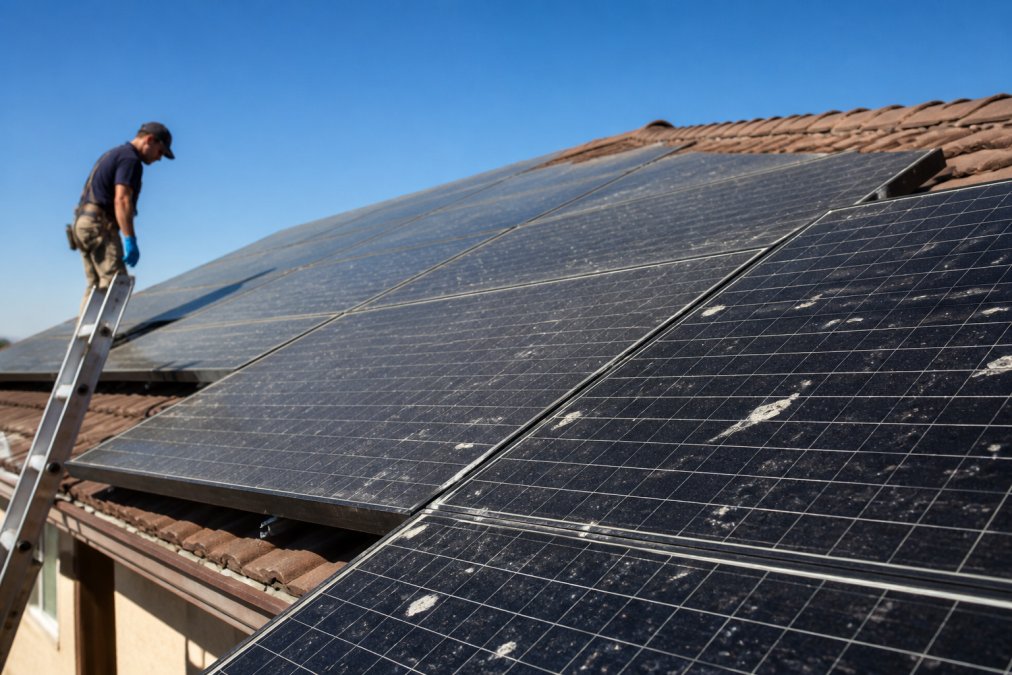
Rain rinses loose dust, but it does not remove the sticky, baked-on layer that actually blocks sunlight. Bird droppings, pollen residue, and mineral deposits survive rainfall and continue to reduce energy production.
Worse, rain can leave hard water stains as it evaporates. Those mineral rings etch into the glass coating over time and are far harder to remove than fresh soiling. On a tilted array, rain also runs unevenly, so some panels get rinsed while others stay coated.
Relying on rain is the most common mistake homeowners make. It looks like free maintenance. In practice, it lets efficiency loss compound quietly for months.
Factors That Change Your Solar Panel Cleaning Frequency
Cleaning frequency is not a fixed interval. It’s a function of your climate, your tilt angle, and what lives above your roof.
Local Climate and Seasonal Conditions
Dust, pollen, and environmental pollutants drive how fast soiling builds up. In dry inland areas, debris accumulation happens faster than in coastal zones with regular rain.
Seasonal patterns matter just as much:
- Spring: heavy pollen buildup on the panel surface
- Summer: dust and wildfire ash in dry regions
- Fall: leaf litter and debris from nearby trees
- Winter: rain rinses some panels but leaves mineral residue
A home in a windy, dusty corridor may need quarterly cleaning. A home in a mild, wet climate may do fine with one annual visit.
Tilt Angle, Tree Cover, and Wildlife
A steep tilt angle sheds debris and rain more effectively than a shallow one. Flatter arrays collect more soiling and hold it longer.
Tree cover is the bigger variable. Homes under or near trees deal with sap, leaf litter, and constant bird droppings. Wildlife roosting nearby can coat panels in days. If birds regularly sit on your roof line, your cleaning frequency goes up regardless of climate.
Signs Solar Panels Need Cleaning
Your system tells you when it’s due if you know where to look. Watch for these signals:
- A visible film of dust, pollen, or bird droppings on the glass
- A drop in daily energy output on your inverter monitoring app
- Uneven streaks or hard water stains across the panel surface
- Output that no longer matches your historical performance for the same weather
Energy output monitoring is the most reliable indicator. If production falls on clear, sunny days without another explanation, soiling is a likely cause. Performance degradation from dirt rarely announces itself loudly. It shows up as a slow, steady decline.
DIY vs Professional Solar Panel Cleaning
Both options exist, and the right choice depends on your roof, your comfort with heights, and your warranty terms. The decision usually comes down to three questions: Can you safely reach the array? Can you clean it without damaging the glass or the cells? And does your warranty allow it?
The Risks of DIY Cleaning
The biggest risk is not the cleaning itself. It’s the roof access. Falls from residential roofs are a leading cause of home-injury emergency visits, and a solar array adds both a slip hazard and a fragile surface you can’t safely step on (the CDC).
Walking on panels can cause micro-cracking, hairline fractures in the silicon cells that aren’t visible to the eye but reduce output and can worsen over years of thermal cycling. Micro-cracks are one of the most common causes of underperforming panels, and they’re almost always caused by mechanical stress: foot traffic, dropped tools, or improper handling.
Abrasive materials or a stiff brush can scratch the anti-reflective glass coating permanently, which reduces light transmission for the life of the panel. Hard water from a garden hose leaves calcium and mineral deposits that are harder to remove than the dirt you started with, and repeated hard-water rinsing can etch the glass.
Thermal shock is another concern. Spraying cold water on hot panels in direct sun can stress the glass and, in extreme cases, crack it (energy.gov). The safe practice is to clean early in the morning or on an overcast day when the glass is cool.
There’s also the warranty question. Many manufacturers specify approved cleaning methods and explicitly warn against pressure washing, abrasive cleaners, and harsh detergents. Using the wrong tools, pressure, or water can give a manufacturer grounds to deny a warranty claim on glass or performance issues.
What Professional Technicians Do Differently
Professional maintenance removes the guesswork and the risk. Trained technicians use deionized water, which dries without leaving mineral spots, and soft-bristle brushes designed for the panel surface. They work from the ground with extension poles or from safe roof positions rather than walking on the glass.
They also inspect while they clean. A technician notices cracked glass, loose mounting, degraded wiring, or junction box issues that a homeowner focused on scrubbing would miss. That system inspection is part of the value, not an add-on.
At Simply Superior Window Cleaning, technicians go through rigorous classroom and on-the-job training, with monthly safety meetings to keep roof work safe. That matters when your array sits on a two-story roof you’d rather not climb.
Never pressure wash solar panels. High pressure can force water past seals, crack cells, and void your warranty. The same applies to abrasive pads and harsh detergents.
A Simple Decision Framework
| Your Situation | Recommended Approach |
|---|---|
| Single-story, ground-mount, or easily reached array; light dust only | DIY is reasonable with a soft brush, plain water, and early-morning timing |
| Two-story or steeper roof; any visible droppings or baked-on soiling | Professional cleaning |
| Hard water at the tap; visible mineral spotting | Professional cleaning with deionized water |
| Any concern about warranty coverage | Professional cleaning with documented methods |
| Array older than a few years, or output trending down | Professional cleaning plus inspection |
If you’re unsure, the cost of a professional visit is almost always less than the cost of a cracked panel, a denied warranty claim, or a fall. When in doubt, leave the roof work to trained technicians and keep the monitoring app as your early-warning system.
The Cost of Professional Solar Panel Cleaning and Its Return
Pricing for residential solar panel cleaning typically scales with array size, roof pitch, height, and access difficulty. As a general range, most single-story residential arrays fall in the low-to-mid hundreds of dollars per visit, with two-story roofs, steep pitches, or heavy soiling pushing toward the higher end. Rather than quote a flat number that may not fit your roof, a virtual quote based on photos of your array and roofline gives you an accurate figure in minutes.
The more useful question is not what cleaning costs, it’s what soiling costs you while you wait. That’s where a simple ROI framework helps.
Running the Numbers on Soiling Loss
Energy production loss from soiling is well documented across the solar industry. A common planning figure used by installers and system designers is that moderate soiling can reduce output by a few percent, while heavy soiling, bird droppings, wildfire ash, agricultural dust, can cut production by a meaningfully larger share until the glass is cleaned. The exact number depends on your location, tilt, and how long the soiling sits.
Here’s how to frame the decision:
- Find your daily production baseline. Your inverter monitoring app shows kilowatt-hours (kWh) produced on clear days. Compare a recent clear day to the same month last year.
- Estimate your soiling loss. If production is down and weather isn’t the cause, soiling is the leading suspect. A 5% loss on a system producing 30 kWh per day is 1.5 kWh per day.
- Multiply by your utility rate. At a typical residential rate, that lost production has a real dollar value every sunny day until it’s recovered.
- Compare to the cleaning cost. If the recovered production over the next several months exceeds the cleaning fee, the math favors cleaning, and that’s before counting the longevity benefit of removing caustic droppings and mineral deposits.
For most homeowners with visible soiling, the payback window is short. The calculation gets more favorable the larger your array, the higher your utility rate, and the longer the soiling has been allowed to accumulate.
The Hidden Return: Inspection and Longevity
A professional cleaning visit is also an inspection. Technicians on the roof can spot cracked glass, loose mounting hardware, compromised wiring, or junction box issues that a homeowner monitoring an app would never see. Catching a loose connection or a cracked panel early typically costs far less to address than the same problem discovered after it has damaged the system.
There’s also a warranty dimension. Many panel manufacturers require reasonable maintenance and specify approved cleaning methods. Documented professional cleaning with deionized water and soft brushes supports a warranty claim if glass or coating issues ever arise. Improper DIY cleaning, abrasive tools, hard water, pressure washing, can give a manufacturer grounds to deny coverage.
Treat cleaning as a small recurring expense against the value of the energy your system produces over its 25-plus-year rated life. When soiling cuts output, you lose production every sunny day until it’s addressed. The return comes from recovering that output, protecting the glass coating, and catching small problems before they become expensive repairs.
Frequency and Cost by Situation
| Situation | Recommended Frequency | Why |
|---|---|---|
| Mild climate, regular rain, no trees | Once a year | Rain handles light soiling |
| Pollen-heavy or moderately dusty area | Twice a year | Seasonal buildup returns fast |
| Dry, dusty, or wildfire-prone region | Quarterly | Debris accumulation is constant |
| Heavy tree cover or nearby wildlife | Quarterly or as needed | Sap and droppings coat glass quickly |
If you’re weighing whether cleaning is worth it, start with the monitoring app. A clear-day production dip that doesn’t match the weather is the strongest signal that soiling is costing you money right now.
Residential Solar Panel Cleaning Services: What to Expect
A professional visit is straightforward. Expect a technician to assess your array, clean the panel surface with deionized water and soft brushes, and inspect for damage or soiling patterns that suggest a recurring problem.
For homeowners in Ventura and North LA Counties, Simply Superior Window Cleaning offers flexible maintenance schedules and convenient virtual quotes, so you can lock in a recurring plan without a contract hassle. We handle buildings up to four stories, which covers most residential roofs and many small commercial properties.
If you also need gutter maintenance or pressure washing, bundling services into one visit keeps your exterior maintenance on a single schedule.
Ask your cleaning provider to note your array’s tilt angle and any persistent soiling zones. That record helps you fine-tune next year’s schedule instead of repeating the same guesswork.
Solar panels reward homeowners who stay ahead of soiling, and the cost of ignoring it shows up in your energy output long before it shows up on your roof. If you’re tired of guessing when your array is due, Simply Superior Window Cleaning can help. Our trained technicians use deionized water and soft-bristle brushes, offer flexible maintenance schedules, and provide convenient virtual quotes for an accurate price without the runaround. Get started with Simply Superior Window Cleaning and keep your solar investment producing at its best.
Frequently Asked Questions
Is cleaning solar panels worth it?
For most homes, yes. Soiling from dust, pollen, and bird droppings reduces energy production, and a professional solar panel cleaning restores that output. The value depends on your local conditions: homes near farmland, trees, or coastal air accumulate debris faster than those in open, rainy areas. If your inverter monitoring shows a gradual drop in production that does not match weather patterns, a cleaning is usually worth scheduling.
How many times a year should solar panels be cleaned?
Once or twice a year works for many homes, but your schedule should reflect local conditions. Properties with heavy pollen, nearby trees, or regular bird activity often need quarterly service. Homes in dry, dusty areas may also need more frequent visits. The signs solar panels need cleaning, such as visible debris or a drop in energy output monitoring, matter more than a fixed calendar.
Does rain clean solar panels effectively?
Rain removes loose dust but leaves behind hard water stains and mineral buildup, especially in areas with dry spells between storms. Bird droppings and pollen often stick to the glass coating and survive rainfall. Relying on rain alone usually leads to soiling that gradually reduces performance degradation over time. A soft-bristle brush and deionized water do what rain cannot.
Can dirty solar panels cause permanent damage?
Debris alone rarely causes permanent damage, but it can create conditions that do. Heavy soiling that traps moisture against the panel surface, or abrasive materials used during a careless DIY cleaning, can scratch the glass coating and lead to micro-cracking risks. Untreated hard water stains can also etch the surface. Professional maintenance with proper tools protects both your system longevity and your warranty.