
Last Updated: October 27, 2026
Quick Summary
Complex architectural glass cleaning succeeds by solving access and chemistry before dirt: match extension poles, pivoting heads, and plastic scrapers to each angle and recess, then use pH-neutral soap and purified water on coated panes. Pre-rinse loose grit, clean top to bottom, dry edges immediately, and photograph the glass before work starts.
- Use a plastic scraper blade on coated glass and metal only on bare glass.
- A water-fed pole reaches glass up to roughly three to four stories without a ladder or lift.
- Test soap and scraper on an inconspicuous corner before cleaning the full pane.
- Dry edges right after each pass and overlap squeegee strokes by a couple of inches.
- Never dry scrape grit, use acid cleaners on coatings, or clean hot glass in direct sun.
Table of Contents
- Why Complex Architectural Glass Fails Standard Cleaning Methods
- Hard-to-Reach Window Cleaning Tools for Angled and Recessed Panes
- Water-Fed Pole Window Cleaning on Tall Glass Facades
- Curved Glass Window Cleaning Without Smears or Scratches
- Streak-Free Window Cleaning on Large and Coated Panels
- Step-by-Step Sequence for a Full Complex Glass Exterior
- Common Mistakes That Damage Architectural Glass
- Booking a Professional Assessment for Your Glass
- Frequently Asked Questions
Why Complex Architectural Glass Fails Standard Cleaning Methods
Complex architectural glass cleaning covers any glazing with angles, curves, deep recesses, or factory coatings that resist a simple squeegee pass. It fails standard cleaning methods because those methods assume flat glass with open access.
Standard soap leaves a film that bonds to coated surfaces. A fixed squeegee cannot follow a curve. And a ladder cannot reach a recessed pane set behind a steel fin.
Here is what most guides get wrong: they treat complex glass as a dirt problem. It is an access and chemistry problem.
- Angled panes trap water at the low edge
- Recessed panes collect dust on every face
- Coatings scratch when grit gets dragged across them
- Hard water spots etch if left to dry
Get access and chemistry right, and the cleaning gets simple. Get them wrong, and you risk damage that no second pass can undo. Readers worried about scratching or damaging coated glass can learn how professional window cleaning protects glass integrity.
Hard-to-Reach Window Cleaning Tools for Angled and Recessed Panes
The right tools for angled and recessed panes are extension poles, pivoting heads, and the correct scraper. Each solves one access problem. None solves all three. The technique is in matching the tool to the geometry before you climb anything. For a deeper guide to the equipment and techniques used on tricky panes, see the complete guide to commercial window cleaning equipment and techniques.
Extension poles, pivoting heads, and scraper selection
- Pole: fiberglass or aluminum, telescoping, with a locking collar at each section
- Head: pivoting, lockable at the angle you set
- Scraper: plastic blade for coated glass; metal only on bare glass
- Detail tools: microfiber pads for edges and frames
Choosing the access method before you choose the tool
- Ground reach with a water-fed pole. Best for glass up to roughly three to four stories where the pole can stay under control. No ladder, no lift, no rope.
- Ladder with a stabilizer. Only for short reaches where the ladder can be footed on level ground and tied off. Not for recessed panes behind fins, where the ladder cannot get the operator close enough to see the edge.
- Lift or scaffold. For tall facades, deep recesses, and any pane where the operator needs both hands and a clear line of sight. This is where cost jumps and scheduling gets longer.
- Rope access. For the tallest or most obstructed facades where a lift cannot be positioned. Requires certified technicians and a separate safety plan.
Never extend a pole into the path of overhead power lines or near rooftop equipment. Check the work zone from the ground before the pole goes up, not after.
Water-Fed Pole Window Cleaning on Tall Glass Facades
Water-fed pole window cleaning is a method that pumps purified water up a pole and through a brush head, then lets the glass air-dry without a squeegee. It works on tall facades because the pole reaches height the operator cannot.
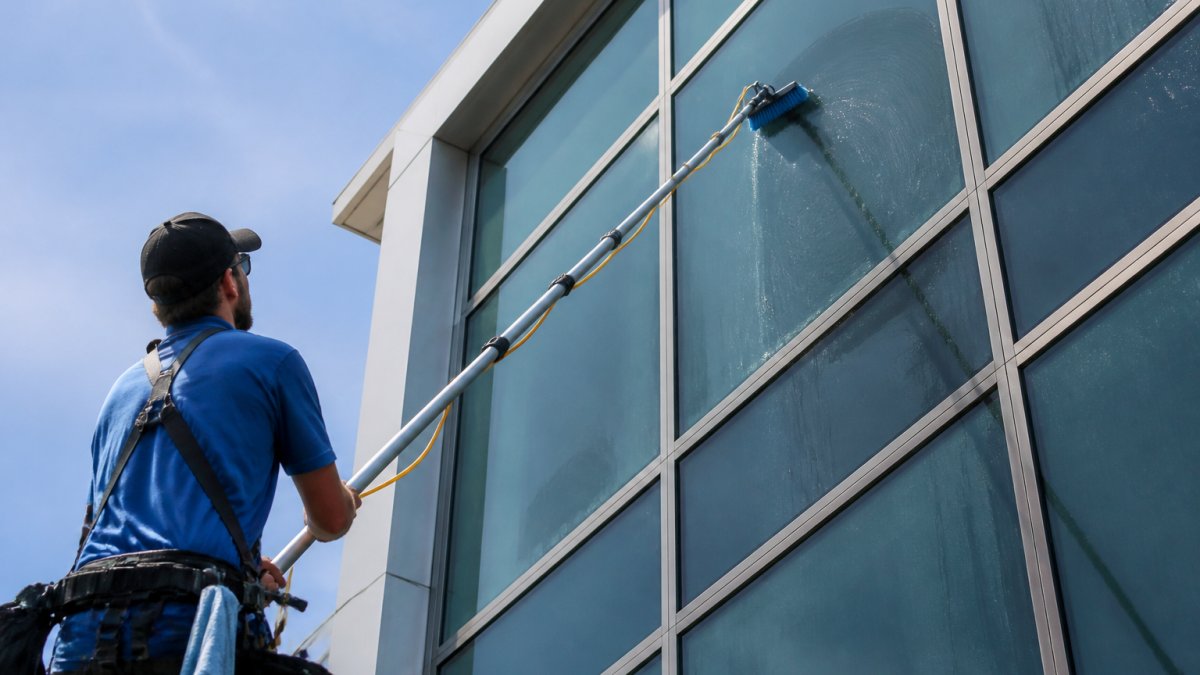
Pure water, resin filtration, and reach limits
- Water purity drives the result, not brush pressure
- Resin needs monitoring; spent resin leaves spots
- Wind pushes water off target and onto the building
- Very tall facades need a different access plan
Curved Glass Window Cleaning Without Smears or Scratches
Watch out: dragging a dry brush across curved coated glass is the fastest way to leave fine scratches you cannot polish out.
Streak-Free Window Cleaning on Large and Coated Panels
Streak-free window cleaning on large and coated panels comes down to three things: drying the edges, holding the right squeegee angle, and using soaps that will not attack the coating. For the specific method to deal with spotting and smears, see how to get streak-free windows with hard water. Miss any one and you get lines.
Drying edges, squeegee angles, and coating-safe soaps
- Dry the edges immediately after each pass
- Overlap strokes by a couple of inches
- Keep the blade clean between passes
- Use pH-neutral soap on coated panes
Step-by-Step Sequence for a Full Complex Glass Exterior
- Assess access and coatings. Note angles, recesses, and any factory coating. Photograph the glass before work starts, including any pre-existing scratches, chips, or failed sealant. This is the single most useful habit on complex glass: a dated photo set answers most damage disputes before they start.
- Confirm the safety plan. Identify overhead hazards, power lines, pedestrian traffic, and the fall-protection method for the access type. On lifts and rope access, confirm the operator is trained and the equipment is inspected.
- Protect the surroundings. Cover plants, walkways, and anything below the work zone. On coated glass, tape off adjacent metal and stone that harsh runoff could dull.
- Test an inconspicuous spot. Before any cleaner touches the full pane, test the soap and the scraper on a small corner, ideally near a frame where a mistake is least visible. Factory coatings vary, and a cleaner that is safe on one coating can dull another.
- Pre-rinse the glass. Float off loose grit before any tool touches the surface. On dusty facades, rinse top to bottom so grit does not run back over clean panes.
- Clean top to bottom. Work in sections so dirty water never runs over clean glass. To understand how interior and exterior processes differ and sequence together, read interior vs exterior window cleaning process. Keep the pole or squeegee moving in overlapping strokes and dry the edges as you go.
- Detail the edges and frames. Dry channels and wipe frames right away. Water sitting in a channel is the most common source of a streak that shows up an hour later.
- Inspect in raking light. Streaks hide in flat light and show up at an angle. Walk the glass with a light held low and parallel to the surface.
- Document the finished work. Photograph the same panes from the same angles as the pre-job set. Note any areas that need a return visit and any coating concerns for the property owner.
Common Mistakes That Damage Architectural Glass
- Dry scraping grit across the pane
- Using acid-based cleaners on coated glass
- Cleaning hot glass in direct sunlight
- Letting hard water dry on the surface
- Pressing hard with a worn blade
- Skipping the pre-rinse on dusty facades
The U.S. General Services Administration also publishes guidance on glass and facade maintenance for federal buildings, which is a useful reference for coated and historic glazing.
Booking a Professional Assessment for Your Glass
At Simply Superior Window Cleaning, we offer virtual on-site quotes. Our technicians go through classroom and on-the-job training, and we hold monthly safety meetings. We work on buildings up to four stories tall.
Simply Superior Window Cleaning offers virtual on-site quotes and flexible maintenance schedules, and serves buildings up to four stories. We also handle pressure washing, solar panel cleaning, and gutter maintenance.
Frequently Asked Questions
How do you clean curved architectural glass without leaving streaks?
Curved glass needs a flexible squeegee and a working angle that follows the arc rather than a straight pull. Apply a small amount of low-residue soap, work in overlapping vertical passes, and wipe the blade after each stroke. On coated curved panes, skip abrasive pads entirely. Architectural glass cleaning on curves is slower by design, so budget extra time and check the surface under raking light before you call it finished.
What tools work best for hard-to-reach windows on complex facades?
The core kit is an extension pole with a pivoting or swivel head, a squeegee sized to the pane, and a microfiber scrubber. For recessed or angled panes, a short-handled applicator plus a pole-mounted scraper covers most situations. Water-fed pole window cleaning handles anything above roughly 20 feet without a ladder. Match the tool to the reach and the glass type, and test any scraper on a corner pane first.
Can pressure washing damage architectural glass or seals?
Yes. High pressure forced at glazing edges can push water past seals and, on older units, break the bond between glass and frame. It can also pit coated or frosted surfaces. Keep pressure washers for masonry, siding, and hardscape, and clean glass with pole brushes, squeegees, and controlled water flow. If a surface has failing sealant, have it repaired before any cleaning starts.
How often should complex architectural glass be cleaned?
Most commercial facades need cleaning two to four times a year, and coastal properties often sit at the higher end because salt and airborne grit build up faster. Residential glass with heavy tree cover or nearby construction may need quarterly attention. Curved and coated panes benefit from a regular schedule because baked-on mineral deposits are harder to remove later. A professional assessment will set the right interval for your building.