
Table of Contents
- Why Exterior Cleaning Quotes Vary So Much
- The Main Cost Factors for Commercial Building Exterior Cleaning
- Commercial Exterior Cleaning Cost per Square Foot: How Pricing Is Built
- Labor Hours, Production Rates, and Staffing Costs
- Soft Washing vs Pressure Washing Commercial Buildings
- Commercial Exterior Cleaning Frequency and Scheduling Variables
- Your Commercial Cleaning Quote Checklist
- Conclusion
- Frequently Asked Questions
Last Updated: October 17, 2026
Why Exterior Cleaning Quotes Vary So Much
Two bids for the same building can land thousands of dollars apart, and the gap rarely comes down to markup. It comes down to scope.
Commercial exterior cleaning is the process of removing soil, staining, and biological growth from a building’s outside surfaces, including glass, concrete, brick, and metal, using water-fed poles, soft washing, and pressure washing equipment.
Below, we break down every cost driver so you can read a quote like a contractor would. The sections ahead show exactly how pricing is built, from square footage to production rates.
The Main Cost Factors for Commercial Building Exterior Cleaning
Pricing rests on four core variables: size, height, surface condition, and frequency. Get those right in the estimate and the number holds up. Miss one and the job either loses money or the client gets a change order mid-project.
Building Size and Square Footage
Square footage sets the baseline. Contractors measure cleanable surface area, not floor plans, because a 10,000-square-foot warehouse with few windows costs far less than a 10,000-square-foot office building wrapped in glass. Ask whether the quote counts glass only or the full exterior envelope. The difference between those two scopes can be the largest single gap between two bids.
Building Height and Access Equipment
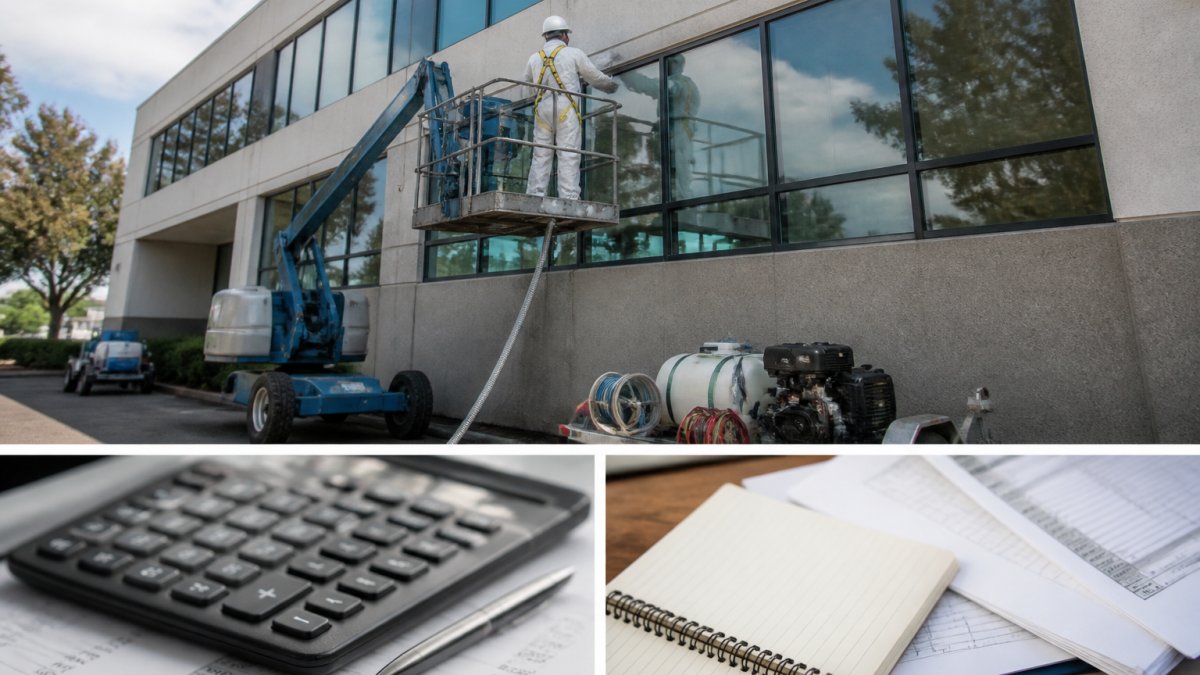
Height changes the equipment, and equipment changes the price. Ground-level storefronts need poles and hoses. Anything above two stories typically requires lifts, boom trucks, or rope access, plus certified operators.
Access equipment is a cost line of its own, not a footnote:
- Water-fed poles and hoses, cheapest, but limited to what a technician can reach safely from the ground.
- Scissor and boom lifts, rented by the day or week, delivered to the site, and operated by trained staff. Rental, delivery, and setup all appear in the quote.
- Rope access, suited to tall or awkward façades where a lift cannot be positioned, but it requires certified technicians and a rescue plan.
- Scaffolding, slow to erect and dismantle, usually reserved for large or long-duration projects.
Each step up in access adds mobilization time before the first surface is cleaned and demobilization time after the last. That is why a four-story façade can price well above a simple multiple of its square footage.
Safety Requirements, Permits, and Site Layout
Safety planning is not overhead you can wave away; it is labor you pay for. Fall-protection requirements, harnesses, anchor points, and a designated safety spotter all consume crew hours.
Site layout compounds the effect. A building with a clear perimeter and level ground lets a lift park close to the façade. A building hemmed in by landscaping, parked cars, or a narrow alley forces longer hose runs, more setup, and slower production.
The most expensive mistake we see is pressure washing the wrong surface. High pressure on aged brick, failing sealant, or oxidized metal forces water behind the façade and strips coatings. The repair bill usually exceeds the cleaning contract.
Surface Material, Condition, and Soil Buildup
Glass, concrete, brick, and metal each demand different methods and cleaning agents. Porous brick holds soil; oxidized metal needs gentler chemistry; concrete collects tire film and irrigation staining. Heavy soil buildup or years of deferred cleaning multiplies labor hours before a single pane is rinsed.
Frequency and Scheduling
Frequency drives the per-visit price down and the annual value up. Quarterly maintenance keeps glass and concrete ahead of soil buildup and typically costs less per visit than annual deep cleans, because each visit starts from a cleaner baseline. Scheduling matters as well: spring pollen, coastal salt air, and rainy-season grime all shift how often a façade needs attention. Many property managers find a recurring schedule easier to budget than unpredictable one-off calls.
Commercial Exterior Cleaning Cost per Square Foot: How Pricing Is Built
Most contractors price exterior work per square foot, then adjust for height, access, and condition. The formula is straightforward: production rate (square feet per hour) divided into labor cost, plus equipment, supplies, and margin. What separates a comparable quote from a vague one is whether the contractor shows you the assumptions behind that formula.
A useful way to read a per-square-foot price is to break it into four layers:
- Base rate, the price for the easiest version of the surface at ground level, in good condition.
- Height and access multiplier, added when lifts, rope access, or traffic control are required.
- Condition multiplier, added for heavy soil, biological growth, oxidation, or deferred maintenance.
- Frequency adjustment, a discount per visit when the work is scheduled on a recurring basis.
Illustrative Price Ranges by Service Type
The ranges below are illustrative planning figures, not quotes. They assume a commercial property in reasonable condition, daytime access, and a crew that supplies its own water and equipment. Actual pricing depends on your building, your market’s labor rates, and the scope you approve.
| Exterior Service | Typical Unit | Illustrative Range (USD) | What Moves the Number |
|---|---|---|---|
| Ground-level storefront glass | per pane or per linear foot of frontage | Low end of a contractor’s range | Number of panes, frame type, hard-water film |
| Low-rise window washing (1-2 stories) | per square foot of glass | Low to moderate | Glass area, interior access, screen removal |
| Mid-rise window washing (3-4 stories) | per square foot of glass | Moderate | Lift rental, setup time, safety planning |
| Concrete flatwork and sidewalks | per square foot | Low | Soil severity, gum, oil, drainage |
| Building façade soft wash | per square foot of wall | Moderate | Surface porosity, organic growth, height |
| Pressure washing hard surfaces | per square foot | Low to moderate | Surface hardness, runoff containment |
| Gutter and awning cleaning | per linear foot | Varies widely | Access, debris volume, height |
A Worked Example: How a Quote Is Assembled
Consider a three-story, 12,000-square-foot office building with roughly 2,400 square feet of glass, 6,000 square feet of concrete flatwork, and a stucco façade showing light biological growth. A contractor might build the estimate like this:
- Glass: 2,400 sq ft at a mid-rise rate, plus lift setup and a safety spotter.
- Concrete: 6,000 sq ft at a flatwork rate, with a condition add for gum and oil near the entrances.
- Façade: soft wash priced per square foot of wall, with a modest add for the organic growth.
- Mobilization: a single setup charge covering equipment, water, and travel.
The total is the sum of those lines, not a single blended number. When you ask for a quote, ask the contractor to show the lines. A quote that separates glass, flatwork, façade, and mobilization is one you can compare against another bid. A single lump sum hides which surface is driving the price.
Assumptions That Change the Number
Every per-square-foot price rests on assumptions. Confirm these in writing before you compare bids:
- Water and power: Does the contractor supply water, or must it connect to your building? Connection can add time and cost.
- Access windows: Daytime access is cheapest. After-hours, weekend, or tenant-sensitive scheduling adds labor.
- Runoff and containment: Capturing and disposing of wastewater, especially around storm drains, adds equipment and time.
- Surface condition at bid time: A price based on a walkthrough beats a price based on a photo, because condition drives labor hours.
| Cost Factor | What It Changes | Effect on Price |
|---|---|---|
| Square footage | Total cleanable area | Sets the base |
| Building height | Access equipment and setup | Moderate to high increase |
| Surface type | Method, chemistry, tools | Varies by material |
| Soil condition | Labor hours required | High increase if deferred |
| Frequency | Scheduling and mobilization | Lower per-visit cost |
| Water and power source | Setup time and logistics | Low to moderate increase |
| Runoff containment | Equipment and disposal | Moderate increase |
Ask for a sample line-item quote on a comparable building. A contractor who can walk you through the assumptions, glass area, lift height, soil level, water source, is pricing your building, not guessing at it.
Labor Hours, Production Rates, and Staffing Costs
Labor is the largest line item in any exterior cleaning quote. Production rate, the square footage one technician cleans per hour, depends on surface type, soil severity, and access. Glass with a water-fed pole moves quickly; stained concrete around loading docks does not.
Ask contractors how many labor hours they budgeted. A quote that lists hours and crew size is a quote you can trust.
Soft Washing vs Pressure Washing Commercial Buildings
Soft washing uses low pressure and specialized cleaning agents to kill and lift organic growth; pressure washing uses high-pressure water to blast soil away. For commercial exteriors, soft washing suits stucco, painted surfaces, brick, and anything fragile. Pressure washing fits concrete walkways, dumpster pads, and hard flatwork. Choosing wrong risks surface damage and voids the value of the service.
Ask any contractor which method they plan for each surface and why. A crew that answers specifically, naming the surface and the risk, knows the building. A crew that says “we pressure wash everything” is telling you something too.
Commercial Exterior Cleaning Frequency and Scheduling Variables
Frequency drives the per-visit price down and the annual value up. Quarterly maintenance keeps glass and concrete ahead of soil buildup and typically costs less per visit than annual deep cleans, because each visit starts from a cleaner baseline. Scheduling matters as well: spring pollen, coastal salt air, and rainy-season grime all shift how often a façade needs attention. Many property managers find a recurring schedule easier to budget than unpredictable one-off calls.
Your Commercial Cleaning Quote Checklist
Use this checklist before signing any exterior cleaning contract:
- Cleanable square footage listed, with glass separated from hard surfaces
- Building height and access equipment named
- Method specified per surface (soft wash vs pressure wash)
- Labor hours and crew size disclosed
- Cleaning agents and protective measures described
- Wastewater containment and runoff plan included
- Frequency and per-visit pricing broken out
That last item matters more than most buyers expect. A thorough guide to contract scope and change orders from the American Institute of Architects explains why written scope protects both sides.
A quote is only comparable when scope matches. Line up two bids against this checklist and the cheaper number often stops looking cheaper.
Conclusion
Exterior cleaning quotes vary because scope, access, and surface condition vary, and the only way to compare bids fairly is to compare what each one actually covers. At Simply Superior Window Cleaning, we build quotes around your building’s real surface area, height, and condition, and we offer virtual on-site quotes so you can get an accurate proposal without waiting for a walkthrough.
Frequently Asked Questions
What factors affect commercial exterior cleaning costs the most?
Building size and height usually drive the largest share of an exterior cleaning quote, because they determine labor hours and access equipment. Surface material and condition come next: glass, concrete, and brick each need different methods and cleaning agents, and heavy soil buildup or stain removal adds time. Frequency, site access, and special requests round out the list. A property manager can lower costs by scheduling recurring service and clearing access to the facade before crews arrive.
Does building height increase exterior cleaning costs?
Yes. Height changes the equipment and safety requirements, which changes labor hours. A single-story storefront can often be reached with extension poles and ladders, while a three- or four-story building may need lifts or rope access, plus protective gear and a second technician on site. Those resource requirements raise the cost per square foot even when the wall area is identical. Buildings up to four stories typically sit in a moderate range compared with high-rise work.
Is pressure washing more expensive than soft washing for commercial buildings?
The two methods carry different costs depending on the surface. Pressure washing uses high-pressure water and is often faster on concrete and hard paving, which can lower labor hours. Soft washing uses low pressure with cleaning agents and takes longer per square foot, but it protects siding, painted surfaces, and glass from damage. On a building with mixed materials, a crew may use both methods, and the quote should state which surface gets which treatment.
What should a commercial exterior cleaning quote include?
A complete quote names the cleaning scope surface by surface, the method for each (soft washing, pressure washing, or window cleaning), the number of visits, and any exclusions such as interior glass or roof work. It should also list access equipment, wastewater handling, and whether stain removal is included or billed separately. Ask for the commercial cleaning quote checklist in writing so you can compare bids on the same scope instead of on headline numbers alone.