
Table of Contents
- Why Natural Factors Cut Solar Panel Efficiency
- How to Clean Solar Panels Safely Without Damaging Them
- Solar Panel Maintenance Best Practices for Homeowners
- Step-by-Step: How to Improve Solar Panel Efficiency Naturally
- Smart Monitoring and IoT Tools That Track Efficiency
- DIY vs. Professional Solar Panel Care: Risks to Weigh
- Frequently Asked Questions
Last Updated: September 25, 2026
Why Natural Factors Cut Solar Panel Efficiency
Solar panel efficiency drops mainly because of things you can see and control: dust, shade, heat, and time. Panels are built to turn sunlight into power, but their output falls when light can’t reach the cells or when the cells get too hot.
A photovoltaic panel works best in cool, bright conditions. When dust or pollen settles on the glass, it blocks light before it ever hits the cells.
Soiling Loss and Peak Sun Hours
Peak sun hours measure how much usable sunlight a location gets per day. Dust, bird droppings, and pollen cut into those hours by scattering and blocking light.
Heat, Shade, and Panel Degradation
Panel degradation is the natural, slow loss of output over the years, and heat speeds it up. Shade makes it worse in a different way: even a small shadow across one cell can drag down a whole string.
How to Clean Solar Panels Safely Without Damaging Them
Learning how to clean solar panels safely comes down to three rules: use soft tools, work in cool conditions, and never scratch the glass. Harsh scrubbing, hard water, and abrasive pads can etch the surface, and that damage is permanent.
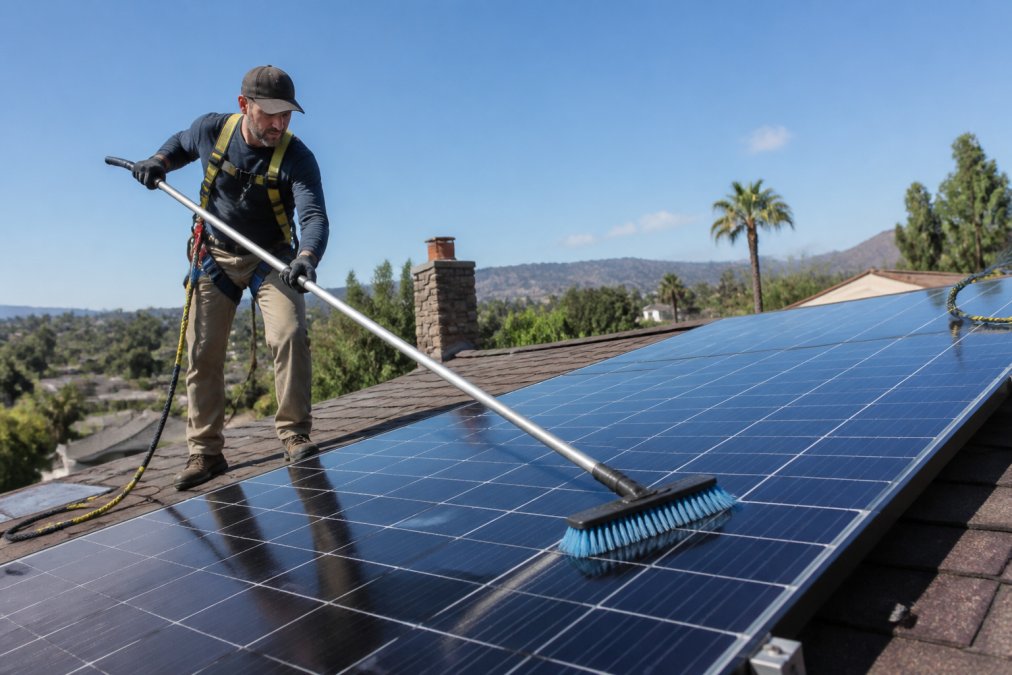
Follow these steps for a safe clean:
- Shut the system down if your manual says to, or clean early morning when panels are cool.
- Rinse loose dust first with a garden hose, no pressure washer.
- Wash with a soft brush and mild soap in a bucket of water.
- Rinse top to bottom so dirty water doesn’t streak clean glass.
- Squeegee or let them air-dry before the sun gets strong.
Never use a pressure washer or abrasive scrubber on panels. The high pressure can crack cells and void your warranty, and scratches on the glass permanently cut output.
When to Call Residential Solar Panel Cleaning Services
Call residential solar panel cleaning services when your roof is steep, your panels are hard to reach, or you’re not comfortable on a ladder. Safety is the real reason, not laziness.
Solar Panel Maintenance Best Practices for Homeowners
Good solar panel maintenance best practices are mostly about watching, not scrubbing. Most of the work is prevention: keep shade away, keep panels cool, and check output regularly.
Your routine should cover:
- Trim trees and shrubs before they shade the solar array.
- Clear leaves and debris from the roof edge and gutters.
- Check mounting hardware for looseness twice a year.
- Note output on clear days and flag sudden drops.
- Avoid walking on panels or leaning tools against them.
Step-by-Step: How to Improve Solar Panel Efficiency Naturally
You can improve solar panel efficiency naturally with a simple seasonal routine. No gadgets required, just consistent habits. Here’s the sequence that works.
- Inspect first. Walk the array and look for cracks, hot spots, or loose wires before cleaning.
- Clean the glass. Rinse, wash with a soft brush, and rinse again.
- Clear the shade. Trim vegetation and remove anything casting a shadow.
- Cool the airflow. Leave a gap under panels so heat can escape.
- Check the angle. A tilt angle near your latitude helps capture more sun.
- Watch the numbers. Compare output month to month to catch slow losses.
Clean panels in the early morning when they’re cool. Cool glass cleans faster, streaks less, and won’t shock hot cells with cold water.
Smart Monitoring and IoT Tools That Track Efficiency
Most guides stop at “get an app.” The real skill is reading the data well enough to tell why output dropped, soiling, shade, heat, or a failing component, before you climb a ladder or call anyone. That diagnostic layer is where monitoring pays for itself.
What Each Layer of Hardware Actually Reports
- Micro-inverters (Enphase is the best-known brand) convert DC to AC at each panel and report per-panel production. That granularity is the whole point: if one panel reads 15% below its neighbors on a clear day, you have a panel-level problem, not a system-level one.
- String inverters (SMA, SolarEdge, Fronius) report at the array or string level. Cheaper and simpler, but a single underperforming panel is averaged into the group, so a slow loss can hide for months.
- DC power optimizers (SolarEdge’s approach) attach to each panel and pair with a string inverter, giving panel-level data at a lower cost than full micro-inverters.
- Revenue-grade vs. consumption-only meters, utility-facing production meters are accurate but coarse; a separate consumption monitor (Sense, Emporia) tells you whether the array or the house changed.
Reading the Data Like a Diagnostician
The useful habit is comparing panels to each other and to their own history, not staring at a single daily total.
- One panel low, neighbors normal → localized soiling (bird droppings, a leaf, pollen drift), a cracked cell, or a loose connector.
- A whole string low, others fine → shading on that row, a string-level fault, or a tripped optimizer.
- All panels down on a clear, cool day → inverter fault, grid curtailment, or a monitoring/communications dropout.
- Output sags only in afternoon heat → normal temperature coefficient behavior, not a defect. Panels lose roughly 0.3-0.5% of output per degree Celsius above 25°C (about 0.17-0.28% per °F), so a hot roof genuinely produces less.
- Gradual decline over weeks with no weather change → cumulative soiling; schedule a clean.
A Simple Weekly Routine
- Open the app on a clear midday and note per-panel output.
- Flag any panel more than about 10% below the array median.
- Cross-check the weather and time of day before assuming a fault.
- Log the anomaly; if it persists across three clear days, investigate physically.
- Compare month-over-month totals to catch slow soiling that never triggers an alert.
Set alert thresholds in the app rather than relying on memory. A 10% deviation alert catches most real problems without flooding you with noise from passing clouds.
Where Monitoring Meets Maintenance
Monitoring doesn’t replace cleaning or trimming, it tells you which task to do and where. A panel-level dip on the west row points to afternoon shade; a uniform dip across the array points to soiling. That distinction saves you from scrubbing panels that were never the problem, and it gives a professional a precise starting point if you do call one.
ENERGY STAR guidance on home energy monitoring
DIY vs. Professional Solar Panel Care: Risks to Weigh
This is the section most guides skip, and it’s the one that costs homeowners the most. The question isn’t “can I clean my panels?”, it’s “which tasks are safe and warranty-neutral, and which ones can void coverage or put me on the roof in a way I shouldn’t be?”
The Three Risks That Actually Matter
1. Warranty voiding. Most panel manufacturers (LG, REC, Q CELLS, Silfab) and the major inverter makers tie their 25-year performance and 10-12-year product warranties to proper installation and handling. Scratched glass from an abrasive pad, a cracked cell from a pressure washer, or a broken connector from a DIY electrical check can be ruled “customer damage” and excluded. Roof-mounted racking and flashing warranties work the same way, a leak traced to a disturbed mount is often not covered.
A Task-by-Task Decision Rule
| Task | DIY or Pro? | Why |
|---|---|---|
| Ground-level rinse of a ground-mount array | DIY | Low risk, no roof access |
| Single-story, gentle-pitch roof clean | DIY if comfortable | Use soft tools, cool panels |
| Two-story or steep roof clean | Pro | Fall risk dominates |
| Tree trimming near the array | Pro or a certified arborist | Avoid dropping limbs on glass |
| Checking mounting hardware | Pro | Disturbing mounts can void racking warranty |
| Any electrical or inverter work | Pro | DC is live whenever there’s light |
| Post-storm or wildfire-ash cleaning | Pro | Ash is abrasive; roof may be compromised |
The Warranty Paper Trail
If you do hire out, keep documentation: the date, the scope, and who did the work. If a warranty claim ever arises, a record of professional maintenance is far stronger than “I think I rinsed them last spring.” Ask any provider whether they carry liability insurance and whether their method is approved by your panel manufacturer, most specify soft brushes, deionized or low-mineral water, and no high-pressure washing.
Never pressure-wash panels, never walk on the glass, and never open an inverter or junction box yourself. Each of these can void a warranty, and the electrical ones can injure or kill.
The safe rule: clean what you can reach from the ground with a hose and soft brush. Everything on the roof, on the wiring, or touching the mounting system goes to a trained, insured professional, and you keep the receipt.
Frequently Asked Questions
How often should solar panels be cleaned to maintain efficiency?
Most homes need cleaning once or twice a year, but dusty or tree-heavy areas may need it quarterly. Soiling loss builds gradually, so a fixed schedule beats waiting for a visible drop in output. Check your monitoring app for a slow decline in production, then book residential solar panel cleaning services before the loss compounds. Avoid cleaning during peak afternoon heat, since rapid temperature changes can stress the glass.
Is there a way to make solar panels more efficient without new equipment?
Yes. Regular cleaning, trimming shade sources, and keeping the array cool during peak sun hours all raise output without new hardware. You can also verify your inverter settings and check for loose wiring, which causes voltage drop. These habits improve solar panel efficiency naturally and cost little beyond time. Pair them with annual professional inspections to catch panel degradation early.
Does shade significantly impact solar panel performance?
Shade on even one panel can cut string output by a large margin, because most systems wire panels in series. A single shaded cell restricts current for the whole string. Trimming trees and clearing obstructions is one of the cheapest ways to improve solar panel efficiency naturally. Micro-inverters reduce this problem, but vegetation management still matters most.
Why is my electric bill high if I have solar panels?
High bills usually trace to soiling loss, shading, panel degradation, or a mismatch between production and your electrical load. Check your monitoring data first: a gradual decline points to dirt or aging, while a sudden drop suggests a fault. Seasonal changes and lower peak sun hours in winter also reduce output. A professional inspection can separate normal variation from a real problem.