Table of Contents
- What You’ll Need Before You Start
- How Long Does Solar Panel Cleaning Take? A Realistic Breakdown
- Step-by-Step: The Solar Panel Cleaning Process
- Best Tools for Cleaning Solar Panels
- How Often Should Solar Panels Be Cleaned?
- DIY vs Residential Solar Panel Cleaning Services
- Post-Cleaning Performance Verification
- Common Mistakes to Avoid
- Frequently Asked Questions
Last Updated: September 20, 2026
What You’ll Need Before You Start
Most homeowners guess wrong about how long solar panel cleaning takes. This guide from Simply Superior Window Cleaning breaks down the real timing, tools, and safety steps so you can plan the job correctly.
Solar panel cleaning is the process of removing dust, pollen, bird droppings, and other debris from a photovoltaic system to protect energy output. Skipping it lets soiling build up and slowly cut your production.
Before you start, gather these basics:
- A soft-bristle brush with an extendable pole
- Deionized water or a spot-free rinse
- A mild, non-abrasive cleaning solution
- A safety harness and fall protection gear
- A shutoff check on your inverter
You should also check your panel maker’s manual. Many warranties require specific cleaning methods, and the U.S. Department of Energy solar energy resources notes that proper maintenance protects both performance and equipment life.
How Long Does Solar Panel Cleaning Take? A Realistic Breakdown
Commercial arrays take much longer than residential systems because of panel count, height, and access.
Here is a quick summary of what drives the time:
| System Type | Panel Count | Typical Time | Main Time Driver |
|---|---|---|---|
| Small residential | 10-20 panels | 45-90 minutes | Roof access |
| Large residential | 20-40 panels | 1.5-3 hours | Soiling level |
| Commercial | 40+ panels | 4-8 hours | Panel count, safety setup |
Time-Per-Panel Math: Estimate Your Own Job
Most guides stop at a range. You can get closer to your real number by working from a per-panel rate and then adding setup and access time.
Heavier soiling, bird droppings, or mineral film can push cleaning time toward the top of the range or beyond.
Use this formula:
Total time = setup time + (panel count × minutes per panel) + access time
- Setup time: 10-20 minutes to stage water, gear, and safety equipment.
- Minutes per panel: 2-4 minutes for light soiling; 5-8 minutes if a pre-soak is needed.
- Access time: 5-15 minutes for a simple single-story roof; 20-40 minutes or more for steep, tall, or multi-section roofs.
Worked examples:
- 12 panels, single story, light dust: 15 min setup + (12 × 3) + 10 min access = about 61 minutes.
- 30 panels, two stories, moderate pollen: 20 min setup + (30 × 4) + 30 min access = about 170 minutes, or just under 3 hours.
- 80 panels, flat commercial roof, heavy dust: 30 min setup + (80 × 5) + 20 min access = about 450 minutes, or 7.5 hours.
These are estimates, not guarantees. Panel count and access, not the scrubbing itself, usually decide whether a job is an hour or a full day.
Time Variance by System Size: Residential vs Commercial
System size is the single biggest factor. A residential rooftop array with 15 panels is a short job. A commercial rooftop with 100 panels is a full day.
Panel count, tilt angle, and roof layout all add time. Steep roofs slow you down because every step needs care. Flat commercial roofs go faster once the safety gear is set up.
Commercial jobs also carry more non-cleaning time: setting up fall protection across a larger roof, moving water lines, and repositioning equipment between array sections. That overhead can add an hour or more before a single panel is washed.
Regional Environmental Impact on Cleaning Time
Where you live changes how long the work takes. Coastal areas deal with salt spray and pollen. Inland areas face more dust and debris accumulation.
Heavy soiling means a second pass. Bird droppings and mineral deposits often need a pre-soak before brushing. That alone can double your time.
A few common patterns:
- Desert and dry inland areas: fine dust films build fast and can require a full second rinse pass.
- Coastal zones: salt spray leaves a sticky film that resists a single brush pass.
- Pollen-heavy regions: spring pollen coats glass quickly and often needs a pre-rinse before brushing to avoid grinding it in.
- Agricultural or tree-heavy areas: bird droppings and organic debris create the slowest jobs because they need soaking time.
If your array sits in more than one of these conditions, budget toward the higher end of the per-panel range.
Step-by-Step: The Solar Panel Cleaning Process
Following a fixed order keeps the job fast and safe. Rushing any step risks micro-cracks or streaks.
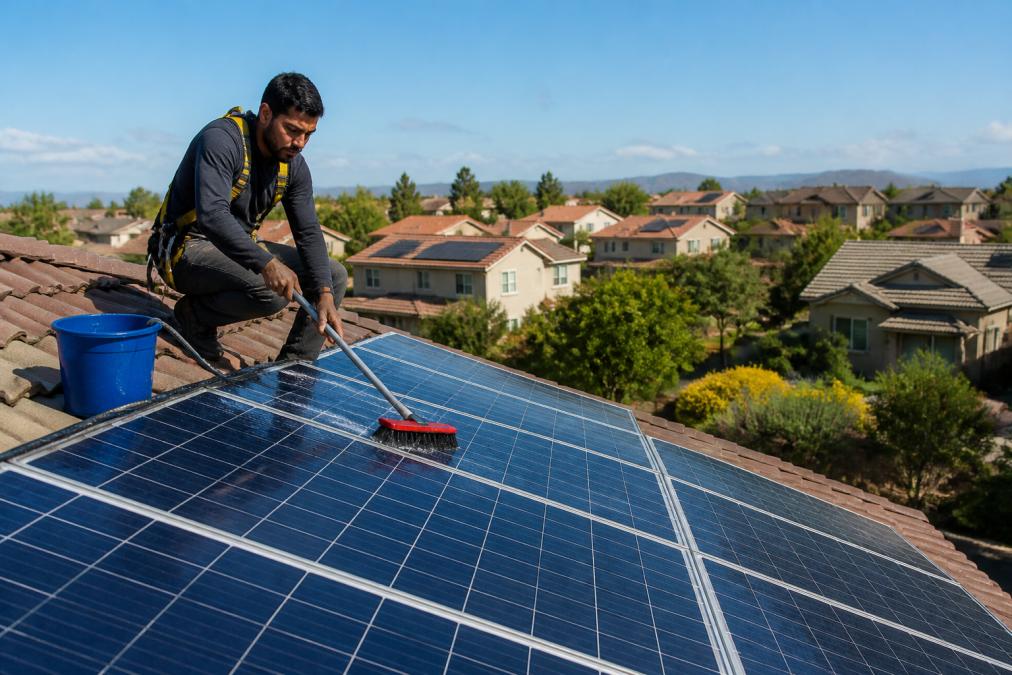
- Shut down safely. Turn off the system at the inverter if your manual says to.
- Check the panels. Look for cracks, loose wiring, or damage first.
- Rinse loose debris. Spray off dust and pollen with low water pressure.
- Apply cleaning solution. Use a mild mix, never abrasive materials.
- Brush gently. Work top to bottom with a soft-bristle brush.
- Rinse with deionized water. This avoids mineral deposits and streaks.
- Inspect the result. Check for missed spots before you climb down.
Safety Gear Checklist for Roof Access
Roof access is where most accidents happen. Gear up before you go up.
- Safety harness rated for fall protection
- Non-slip shoes with good tread
- Anchor point secured and tested
- Gloves to protect against sharp edges
- A spotter on the ground when possible
Never clean panels in high wind or wet conditions. Thermal shock can crack glass if you use cold water on hot panels.
Cleaning hot panels with cold water can cause thermal shock and crack the glass. Always work in early morning or late afternoon when panels are cool.
Best Tools for Cleaning Solar Panels
The best tools for cleaning solar panels are a soft-bristle brush, an extendable pole, and deionized water. Skip anything abrasive.
Hard water leaves mineral deposits that block sunlight. A spot-free rinse solves that. Many pros also carry a water-fed pole to reach panels without standing on the roof edge.
Here is what to avoid:
- Abrasive materials and scouring pads
- High-pressure washers on full blast
- Harsh soaps that leave residue
- Metal scrapers of any kind
Pressure washing can force water behind the frame and damage seals. Keep water pressure low and controlled.
A water-fed pole lets you clean ground-floor and low-slope panels without roof access at all. It cuts both time and risk on smaller systems.
How Often Should Solar Panels Be Cleaned?
Most homes need cleaning once or twice a year. Areas with heavy pollen, dust, or bird activity may need it quarterly.
How often should solar panels be cleaned depends on your local environment. Coastal salt, nearby trees, and dry seasons all speed up soiling. A quick visual check each month tells you when it is time.
Watch for these signs that your panels need cleaning:
- Visible dust, pollen, or bird droppings
- A drop in energy output on your monitoring software
- Streaks or a dull film on the glass
- Debris accumulation around the frame
Monitoring software makes this easy. If output falls on clear days, soiling is often the cause.
DIY vs Residential Solar Panel Cleaning Services
DIY cleaning works for single-story homes with easy roof access. For two-story homes, steep roofs, or commercial buildings, professional service is safer and faster.
A DIY job carries real risk. Falls are a danger, and one slip can cause serious injury. You also risk voiding a warranty if you use the wrong method.
Residential solar panel cleaning services handle safety gear, water access, and post-job checks. Teams trained for roof work finish faster and spot damage early. Simply Superior Window Cleaning provides solar panel cleaning with technicians who train in classroom and on-the-job settings, plus monthly safety meetings.
Homeowners with two-story homes, steep roofs, or large systems who want the job done safely and correctly the first time.
Post-Cleaning Performance Verification
Verifying results takes just a few minutes and confirms the cleaning worked. Check output after the panels are dry.
Compare your energy output before and after on a clear day.
- Loose wiring or connectors
- Cracks or chips in the glass
- Debris trapped under the frame
- New shading from nearby trees
Common Mistakes to Avoid
The biggest mistake is cleaning in the heat of the day. Hot glass plus cold water equals thermal shock and possible micro-cracks.
Other common errors:
- Using abrasive materials or hard brushes
- Skipping the pre-rinse and grinding debris into glass
- Working without fall protection on the roof
- Ignoring the maker’s warranty rules
- Using hard water that leaves mineral deposits
Frequently Asked Questions
Is cleaning solar panels worth it?
Yes, for most homeowners. Dirty panels block sunlight and reduce energy output. Cleaning restores efficiency and helps you get the most from your photovoltaic system. If you live in an area with frequent dust, pollen, or bird activity, the return on cleaning is even higher.
Do solar panels work better when they’re cleaned?
They do. Clean panels allow more sunlight to reach the cells, which directly increases energy output. Soiling level, from dust to mineral deposits, blocks light and reduces performance. Monitoring software can confirm the improvement.
How often does a solar panel need to be cleaned?
Most residential systems need cleaning once or twice a year. If you live near farmland, a highway, or have many trees, you may need quarterly service. Check your manufacturer warranty for specific requirements. A good rule: inspect panels every few months and clean when you see visible debris accumulation or a drop in energy output.
Can I clean my own solar panels or should I hire a professional?
You can clean ground-level panels safely with a soft-bristle brush and deionized water. For roof-mounted systems, especially on two-story homes, professional cleaning is safer and more effective. Professionals have fall protection, the right tools, and experience avoiding micro-cracks and thermal shock. If you are unsure about roof access or warranty terms, hire a residential solar panel cleaning service.
Cleaning solar panels the right way takes planning, the right tools, and respect for roof safety. Get any of those wrong, and you risk injury or damage. Simply Superior Window Cleaning handles solar panel cleaning for homes and commercial buildings up to four stories, with trained technicians, flexible maintenance schedules, and virtual quotes that save you time. Schedule a free quote and keep your system running at optimal performance.