
Table of Contents
- What Full-Service Window Cleaning for Large Estates Includes
- Professional Window Washing Equipment for Multi-Story Properties
- Window Cleaning Cost for Large Homes: What Drives the Price
- Window Cleaning Maintenance Schedule for Large Estates
- Safety Protocols and Insurance for High-Reach Window Cleaning
- How to Choose a Window Cleaning Company for a Large Property
- Frequently Asked Questions
Last Updated: September 21, 2026
What Full-Service Window Cleaning for Large Estates Includes
Residential window cleaning for large estates covers far more than glass: exterior glass, frames, tracks, screens, and often gutters, solar panels, and pressure washing as add-ons. At Simply Superior Window Cleaning, we treat every large property as a system, because one neglected component makes the rest look unfinished.
A full-service visit typically covers:
- Exterior glass cleaning with purified water systems and professional-grade tools
- Frame and sill wiping to remove dirt, pollen, and mineral deposits
- Track vacuuming and detailing
- Screen removal, washing, and reinstallation
- Optional add-ons: gutter cleaning, solar panel cleaning, and pressure washing
Exterior Glass, Frames, Tracks, and Screens
Glass is the visible part, but frames, tracks, and screens are where cheap jobs fall apart. Dust hardens in tracks into a gritty paste that stains surrounding surfaces, and screens trap pollen and salt air that leach back onto clean glass the first time it rains.
Ask any provider how they handle window tracks and screens before you book. If those aren’t in the written scope, you’re paying for a surface-level job that won’t hold up.
Add-On Services: Gutters, Solar Panels, and Pressure Washing
Gutter cleaning protects the roofline and foundation from water damage and pairs naturally with window work since both require ladder access. Solar panel cleaning keeps energy output consistent by removing dust and bird droppings. Pressure washing handles driveways, patios, and exterior walls, but needs the right pressure and nozzle for each surface.
Professional Window Washing Equipment for Multi-Story Properties
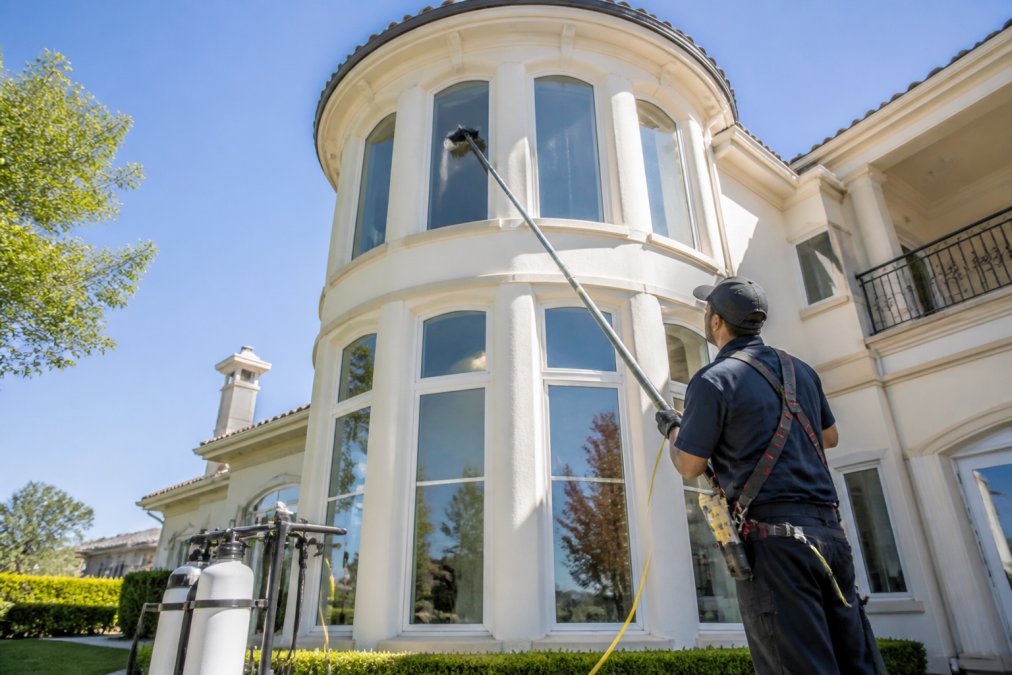
Professional window washing equipment for multi-story properties centers on water-fed pole systems, purified water, and the right reach tools. A water-fed pole delivers deionized water through a telescoping arm, letting technicians clean high exterior glass from the ground.
The core kit for large estates includes:
- Water-fed poles with carbon fiber or aluminum sections for high-reach work
- Deionized water purification systems that leave no spots when the water dries
- Traditional squeegees and scrubbers for lower windows and detail work
- Extension ladders and harnesses for sections poles can’t reach
- Soft-wash and pressure washing equipment for siding and hardscapes
Window Cleaning Cost for Large Homes: What Drives the Price
Window cleaning cost for large homes depends on square footage, window count, height, and condition, not a flat rate. Two same-size houses can price very differently if one has hard water stains, neglected tracks, or a third story.
The biggest pricing factors:
| Factor | Why It Raises Cost | What It Means for You |
|---|---|---|
| Square footage | More glass and surface area | Larger estates take longer |
| Height and access | High-reach poles, lifts, or harnesses | Safety setup adds time |
| Condition | Hard water stains, mineral deposits | May need glass restoration |
| Add-ons | Gutters, solar panels, pressure washing | Bundled pricing is usually better |
| Frequency | One-time vs. recurring | Recurring visits cost less per visit |
Window Cleaning Maintenance Schedule for Large Estates
A window cleaning maintenance schedule for large estates should run quarterly for most properties, with adjustments for climate, tree cover, and exposure. Coastal homes or those under heavy tree canopy need more frequent service. But a frequency list alone doesn’t tell you when to schedule each service, a year-round calendar does, and that’s the piece most estate owners never get.
A Year-Round Calendar for Estate Glass and Exterior Surfaces
Aligning service with seasonal cycles keeps the property consistently presentable instead of lurching between spotless and shabby. Here’s a calendar most large properties can adapt:
- Late winter (February-March): Post-storm cleanup. Remove salt spray, sand, and winter grime from glass, frames, and hardscapes before spring pollen arrives. This is also the right window for glass restoration work, since technicians can assess etching and mineral damage before the busy season.
- Spring (April-May): Full exterior glass, frames, tracks, and screens. Pollen bonds quickly to glass and screens. Gutter cleaning should happen here too, before the first heavy spring rains test drainage.
- Early summer (June): Solar panel cleaning. Pollen and dust reduce output, and cleaning before peak sun maximizes the return. Pressure washing for patios and driveways fits here too, ahead of outdoor entertaining season.
- Late summer (August-September): Mid-season glass touch-up for properties under heavy tree canopy or near irrigation. Hard water from sprinkler overspray is the main threat, and catching it early keeps you in the cleaning category, not restoration.
- Fall (October-November): Full exterior glass, frames, tracks, and screens again. Leaves fill gutters, so gutter cleaning should be timed before the rainy season. This is also the last good window for pressure washing before temperatures drop.
- Winter (December-January): Light touch-up on high-visibility glass, plus a post-holiday exterior check. Winter storms leave salt and grime, and a mid-winter pass keeps the property presentable through the holidays.
Why the Calendar Beats a Frequency List
Spring brings pollen, summer brings dust and hard water, fall brings leaves into gutters, and winter storms leave salt and grime. A frequency list tells you how often to book; a calendar tells you when each service actually pays off, the difference between maintaining a property and reacting to it.
Safety Protocols and Insurance for High-Reach Window Cleaning
Insurance and Liability: What Estate Owners Actually Carry
What to verify before anyone touches your windows:
- General liability insurance: Ask for a certificate of insurance naming the coverage limits. This covers property damage if a technician cracks glass, scratches a frame, or damages siding during pressure washing.
- Workers’ compensation: If a technician is injured on your property and the company isn’t covered, the exposure can land on you. In many states, homeowners can be drawn into a claim when an uninsured worker is hurt on their property. Verify the policy is active, not just that one exists.
- Additional insured endorsement: For large estates, ask to be added as an additional insured on the provider’s policy for the duration of the work. This is standard in commercial contracting and increasingly common for high-value residential work, giving you direct standing under the policy if a claim arises.
- Auto coverage: Confirm the provider carries commercial auto insurance, since a company truck in your driveway is a liability point most owners never consider.
The lowest bid often comes from a provider with no workers’ compensation coverage. That savings is real, but so is the risk: one injury on a third-story ladder can generate a claim that dwarfs the price difference.
Security and Privacy Protocols for High-Value Properties
Security and privacy protocols matter on high-value estates in ways they don’t on ordinary homes. Estate owners often have valuable art, vehicles, and landscaping visible from the exterior, and need to know who is on the property and when.
What a professional provider should offer:
- Background-checked staff. Ask whether technicians undergo background checks before being assigned to residential properties. This is standard in commercial janitorial and security work but inconsistent in residential window cleaning. A provider that vets staff protects your property and your privacy.
- Identifiable uniforms and vehicles. Technicians should arrive in branded uniforms and, ideally, marked vehicles. This makes them easy to identify and reduces the chance of confusion with unauthorized visitors.
- Defined access plans. Before the first visit, the provider should confirm which gates, doors, and areas are in scope, and which are off-limits. A written access plan prevents technicians from wandering into private areas or triggering alarms.
- Arrival and departure communication. A text or call before arrival and after departure gives you a record of who was on the property and when. On large estates with multiple structures, this is the difference between a managed service and an open door.
- Confidentiality expectations. Ask whether the provider trains staff on discretion. Technicians see layouts, vehicles, and routines. A provider that treats that information as confidential is protecting you, not just doing a job.
Training and Equipment Standards
Beyond insurance and vetting, physical safety still matters:
- Training: Look for documented classroom and on-the-job training, not just years on the job.
- Ongoing safety routines: Regular safety meetings signal a company that treats protocols as living practice, not paperwork.
- Equipment standards: Professional-grade harnesses, stable ladder footing, and pole systems rated for the height involved.
Hiring an uninsured or unvetted provider on a high-value estate creates three exposures at once: property damage you may have to cover, injury liability that can land on you, and privacy risk from staff you know nothing about. Verify insurance, ask about background checks, and get the access plan in writing before the first visit.
For estate owners, the right question isn’t just “are they insured?” It’s “are they insured, vetted, and trained to work around a property like mine?” A provider that answers all three in writing is worth hiring.
How to Choose a Window Cleaning Company for a Large Property
A practical selection process:
- Confirm capacity. Ask whether they routinely handle multi-story homes and properties up to four stories. Large estates need equipment and staffing that small operators may not have.
- Request proof of insurance. Get the certificate before scheduling, not after.
- Get a written scope. It should list glass, frames, tracks, screens, and any add-ons. Vague scopes lead to disputes.
- Ask about training and safety. Look for structured training and regular safety meetings.
- Check the quote method. A virtual or on-site assessment gives an accurate price. A phone estimate for a large estate usually isn’t reliable.
- Review the plan for privacy and access. Confirm how they’ll coordinate arrival and move through the property.
Hiring the cheapest bid on a large estate often means no insurance certificate, skipped track and screen work, and pressure washing at the wrong setting. The damage from stripped siding or etched glass usually costs more than the money saved.
Glass restoration versus cleaning is the distinction most owners miss. Cleaning removes surface dirt; restoration addresses etched mineral deposits and hard water stains bonded to the glass. If your windows look cloudy even after a wash, you likely need restoration. Ask directly.
Frequently Asked Questions
What is the best frequency for window cleaning on large estates?
Most large estates benefit from quarterly or bi-annual professional cleaning, but the right window cleaning maintenance schedule depends on your location, tree coverage, and how close the property sits to the coast. Homes near the ocean or with heavy pollen and dust may need monthly or bi-monthly service. A site assessment helps determine a frequency that keeps glass streak-free and protects exterior surfaces year-round.
How do professionals safely clean windows on multi-story estates?
Professionals use water-fed poles with deionized water, extension ladders with stabilizers, and fall-protection gear rated for the working height. Reputable companies hold general liability and workers’ compensation insurance and run monthly safety meetings. Before hiring, ask about their safety protocols, training program, and whether technicians are covered on your property. This protects both the crew and you as the homeowner.
What factors influence window cleaning cost for large homes?
Pricing depends on square footage, number of panes, height and accessibility, condition of the glass, and whether add-on services like gutter cleaning or solar panel cleaning are included. Hard water stains and mineral deposits require glass restoration, which takes more time. Because every estate is different, the most accurate approach is a free proposal based on a virtual or on-site assessment of your specific property.
Do professional window cleaners use specialized equipment for large estates?
Yes. Professional window washing equipment includes water-fed poles that reach up to four stories, purified water systems that leave glass streak-free without chemicals, squeegees, scrubbers, and pressure washing units for exterior surfaces. Deionized water is especially important because it dries without spotting. This equipment lets crews clean high-reach windows, solar panels, and conservatory roofs safely and efficiently.
What should I look for when hiring a window cleaning company for a large property?
Look for proof of insurance, a documented training program, and a clear safety record. Ask whether they offer virtual quotes, flexible maintenance schedules, and services beyond windows, such as gutter cleaning and pressure washing. Check that they can handle the height and square footage of your estate. A company that provides a free proposal and answers questions about liability and security protocols is usually a safer choice.
How does a virtual quote work without an on-site visit?
A virtual quote uses photos, video, or a guided walkthrough of your property to assess window count, height, accessibility, and add-on needs. The company then provides a detailed proposal covering scope and pricing factors. This minimizes contact and speeds up scheduling. For complex estates with glass restoration or heavy mineral deposits, an on-site assessment may still be recommended for the most accurate pricing.