
Table of Contents
- Why Two Story Window Cleaning Is Riskier Than You Think
- Best Tools for Cleaning High Windows Without a Ladder
- Step-by-Step: Safe Window Cleaning for Two Story Homes
- Ladder Safety and Fall Prevention Basics
- DIY Window Cleaning Solutions That Actually Work
- Professional Window Washing Cost: What to Expect
- Residential Window Cleaning Maintenance Schedule
- Equipment Maintenance and Storage Tips
- Environmental Impact of Runoff
- Frequently Asked Questions
Last Updated: September 14, 2026
Why Two Story Window Cleaning Is Riskier Than You Think
Safe window cleaning for two story homes starts with one uncomfortable fact: most of the danger isn’t the height, it’s the ladder. Falls remain a leading cause of fatal injuries in home maintenance work, and ladder misuse sits near the top of the list (the CDC). At Simply Superior Window Cleaning, our staff undergoes rigorous classroom and on-the-job training, and we hold monthly safety meetings.
The risk multiplies with three variables:
- Ladder placement on uneven ground, mulch beds, or sloped driveways
- Reaching sideways instead of repositioning the ladder
- Overconfidence after a few successful climbs
What most homeowners miss is that the scariest part isn’t the top rung, it’s the descent, when grip strength fades and attention drifts. Below, we’ll show you how to clean second-story glass without leaving the ground.
Best Tools for Cleaning High Windows Without a Ladder
The best tools for cleaning high windows are extension poles and water-fed pole systems, both of which let you work from solid ground. What separates a good result from a streaky one is matching the tool to the glass, not buying the most expensive pole on the shelf.
| Tool | Typical Reach | Best For | Skill Level |
|---|---|---|---|
| Extension pole + squeegee | Up to 20 ft | Standard second-story panes, casement and awning glass | Beginner |
| Water-fed pole | 20-40 ft+ | Full exterior glass, frames, sills, screens | Intermediate |
| Microfiber cloth on pole | Up to 12 ft | Touch-ups, sills, tracks, fixed glass edges | Beginner |
| Ladder + stabilizer | Varies | Last resort, low reach only | Advanced |
Water-Fed Pole Systems Explained
A water-fed pole is a telescoping pole that pumps purified water through a scrubber head and rinse jet, cleaning glass without soap or a squeegee. The key is water purity: deionized water or distilled water dries without leaving mineral deposits, which is why the finish stays streak-free.
Tap water carries dissolved calcium and magnesium, which stay behind as white spotting when it evaporates (Hardness of Water). A purification stage, usually a resin filter or a reverse-osmosis unit feeding a deionizer, strips those minerals out before the water touches the pane, so a water-fed pole can skip the squeegee entirely.
The trade-offs are real:
- Cost. A quality system runs into the hundreds of dollars, and you need a purification setup plus replacement resin. For a single two-story home, that math rarely works.
- Water volume. These systems use far more water than a bucket-and-squeegee approach, which matters on a metered supply.
- Weight. A 30-foot pole full of water is heavy. Fatigue sets in fast, and tired arms produce sloppy technique.
For property managers with ongoing contracts, the system pays for itself quickly. For a homeowner cleaning twice a year, an extension pole is the better buy.
Extension Pole Techniques for Hard-to-Reach Glass
An extension pole with a scrubber head and squeegee handles most second-story work. Technique matters more than the tool:
- Scrub the full pane with the scrubber head, working top to bottom
- Rinse the scrubber and re-wet for the squeegee pass
- Pull the squeegee in overlapping horizontal strokes, wiping the blade between each
- Finish edges and corners with a microfiber cloth
The mistake beginners make is squeegeeing in one long vertical stroke. It looks efficient, but it leaves streaks every time.
Pole length is where most buyers get it wrong. A pole rated for 20 feet of reach is measured tip to base, not from your hands to the glass, and once you account for holding angle and distance from the wall, effective reach drops by several feet. Buy one size longer than you think you need, and check the locking clamps before every use.
Matching the Tool to the Window Type
The right approach changes with the architecture:
- Casement windows crank outward, so the exterior glass faces you at an angle. A pole-mounted squeegee works, but use a swivel head so the blade stays flat against the tilted pane.
- Awning windows hinge at the top and push out from the bottom. The lower edge is hardest to reach and where water pools. Scrub that edge first, then squeegee downward so runoff doesn’t streak the clean surface above.
- Fixed glass (picture windows, transoms) has no sash or hardware to work around, making it the easiest target for a water-fed pole.
- Single- and double-hung windows are the standard case. If the sashes tilt in, clean them from inside and skip the pole entirely.
- Storm windows add a second pane. Clean the inner surface of the storm and the outer surface of the primary sash separately, or you’ll trap dirt between them.
A quick rule: if the glass tilts toward you, work from inside; if it doesn’t, work from the ground with a pole. Ladders are for the narrow set of cases where neither works.
Step-by-Step: Safe Window Cleaning for Two Story Homes
Safe window cleaning for two story homes follows a fixed sequence: set up on stable ground, work top to bottom, and never lean past your center of gravity.
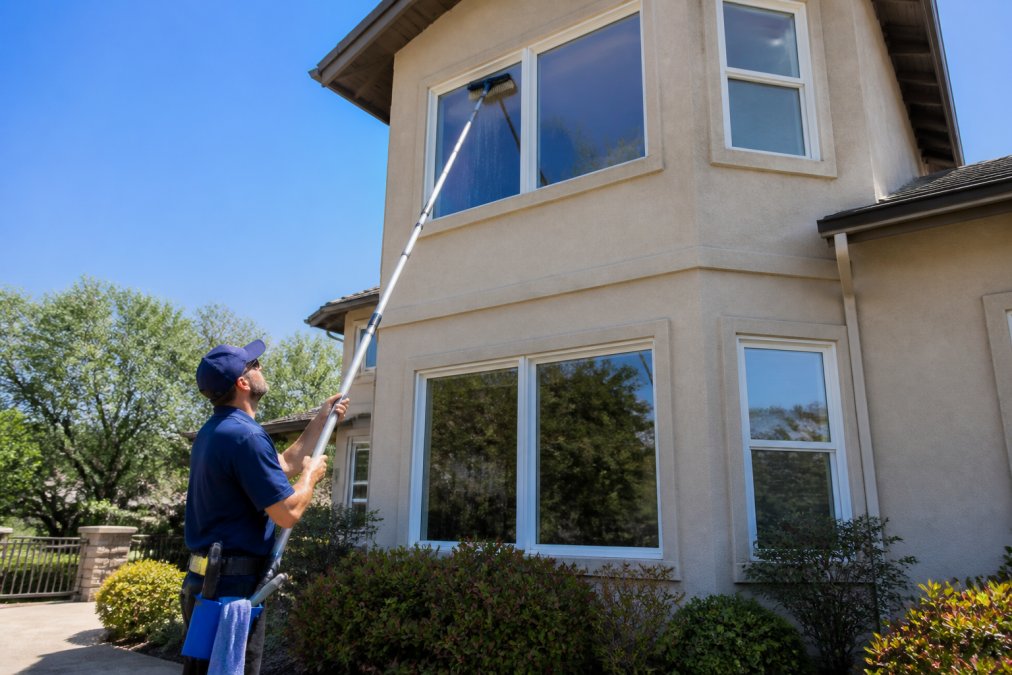
Step 1: Clear the work zone. Move furniture, planters, and hoses. Check the ground under your feet before extending anything overhead, a pole that shifts your balance on uneven mulch is its own fall risk.
Step 2: Mix your solution. A few drops of dish soap in a bucket of water works for most glass. Add a splash of rubbing alcohol for greasy kitchen windows. Skip ammonia-based cleaners on tinted glass.
Step 3: Scrub the upper panes first. Dirty water drips down. Working top to bottom means you’re not re-cleaning lower panes.
Step 4: Squeegee and wipe. Overlap each stroke. Wipe the blade with a microfiber cloth after every pass.
Step 5: Clean the tracks and sills last. Use a dry brush or vacuum first, then wipe. Wetting loose debris just creates mud.
Wash windows on a cloudy day. Direct sun dries the cleaning solution before you can squeegee it, which is the single biggest cause of streaks on exterior glass.
Adjusting the Method to Your Window Type
Here’s how the steps change by window type:
- Casement windows: Crank them open to a comfortable angle and lock the crank so the sash doesn’t drift. Clean the hinge-side edge last, it collects the most grit and the least light.
- Awning windows: These push out from the bottom, so the lower rail traps water. Scrub and squeegee the bottom edge first, then work upward, so you’re never dragging dirty water over a clean pane.
- Fixed glass: No sash, no hardware, no gasket to soak. Scrub the full pane, squeegee in horizontal passes, and check the frame seal, a worn gasket lets water into the wall cavity, a repair far more expensive than a dirty window.
- Tilt-in sashes: Skip the pole entirely. Tilt the sash inward and clean both faces from inside.
- Storm windows: Treat them as two jobs. Clean the storm pane’s inner face and the primary sash’s outer face separately, or you’ll trap a film of dirt between the layers.
Cleaning Tilt-In Windows From Inside
Tilt-in windows are the homeowner’s cheat code. The sash tilts inward, so you can clean both sides of the glass from inside the room, no pole, no ladder, no risk.
Release the tilt latches at the top of the sash, tilt it toward you, and clean both faces. Wipe the window track with a damp cloth before tilting back. If the sash won’t tilt, don’t force it. Older hardware seizes, and a broken sash is a much bigger repair than a dirty window.
Preventing Streaks and Water Spots
Streaks come from three sources: too much soap, dirty water, or a dry squeegee blade. Water spots come from minerals left behind when hard water evaporates. The fix: use less soap than you think you need, change your water when it turns gray, wipe the squeegee blade after every stroke, and finish edges with a dry microfiber cloth. In hard water areas, a final wipe with distilled water removes minerals before they dry.
Troubleshooting: When the Job Goes Wrong
Most rework comes from a handful of predictable problems:
- Cloudy or hazy glass after drying. Usually soap residue, not dirt. Rinse with plain water and re-squeegee. If it persists, the glass may have hard-water etching, a mineral bond only a polishing compound removes.
- Streaks that reappear in the same pattern. A nicked or hardened squeegee blade. Run a fingernail along the rubber; if it catches, replace the blade.
- White spots that won’t wipe off. Mineral deposits from tap water. Switch to distilled water for the final rinse.
- Dirt that streaks back down after you clean. You’re working bottom to top, or your rinse water is already dirty. Reset the sequence.
- Water seeping into the wall or sill. A failed gasket or seal, not a cleaning problem. Stop and inspect before you add more water.
Never clean glass that’s hot to the touch. Thermal shock, cold water on sun-heated glass, can crack a pane, and the risk is highest on the upper story where sun exposure is greatest (Checking your browser).
The sequence is fixed, but the technique isn’t. Match your method to the window type, and you’ll spend less time re-cleaning panes you already finished.
Ladder Safety and Fall Prevention Basics
If you must use a ladder, treat ladder safety as a checklist, not a feeling. Fall prevention on a two-story home comes down to four rules:
- Place the ladder on firm, level ground and use a ladder stabilizer on soft surfaces
- Maintain a 4:1 ratio: base one foot out for every four feet of height
- Keep three points of contact and never overreach sideways
- Use a safety harness when working above the second story or on a roof edge
Ladder mitts protect your gutters and siding from scratches and keep the ladder from sliding on smooth surfaces.
The most common fatal mistake is climbing with tools in your hands. Both hands belong on the rails. Haul tools up with a rope or use a tool belt.
DIY Window Cleaning Solutions That Actually Work
Homemade window washing solution works fine for most residential glass:
- 2 cups water
- 1/2 teaspoon dish soap
- 1/4 cup rubbing alcohol (for greasy or smoky glass)
- Optional: 1/2 cup white vinegar for hard water
Skip the vinegar if you have tinted film. Skip ammonia entirely on tinted glass and on any window with a factory coating.
An ammonia-free solution matters for two reasons: it’s safer on films and coatings, and it doesn’t strip the wax on nearby car finishes when runoff drips onto a driveway. What most guides get wrong is the ratio, more soap doesn’t mean cleaner glass, just more residue and streaks.
Professional Window Washing Cost: What to Expect
Professional window washing cost depends on window count, height, accessibility, and whether you’re bundling other services. Any quote that sounds too good usually reflects a crew cutting corners on safety equipment. Pricing varies by panes and stories, interior vs. exterior only, screen and track cleaning, and add-ons like gutter clearing or pressure washing.
At Simply Superior Window Cleaning, we offer virtual quote options so you get an accurate number without waiting for a walkthrough. Our technicians undergo rigorous classroom and on-the-job training, and we hold monthly safety meetings, which matters when your second-story glass is on the line.
Residential Window Cleaning Maintenance Schedule
A residential window cleaning maintenance schedule keeps glass clear without emergency scrubbing. For most homes, twice a year works: spring after pollen season and fall before the rainy months.
| Home Type | Frequency | Best Timing |
|---|---|---|
| Standard single-family | 2x per year | Spring, fall |
| Coastal or dusty areas | 3-4x per year | Quarterly |
| Pre-sale preparation | 1x before listing | 2-4 weeks before showings |
| Commercial storefronts | Monthly | Ongoing contract |
Homes near the coast or in dusty inland areas need more frequent service. Salt spray and windblown grit etch glass over time, and once etching happens, no amount of cleaning restores clarity. That’s the argument for a schedule rather than a one-off call.
Glass clarity is a maintenance outcome, not a cleaning event. Homes on a fixed schedule stay clearer than homes cleaned only when they look bad.
Equipment Maintenance and Storage Tips
Your tools last years if you store them right. Poles, squeegees, and scrubber heads degrade in predictable ways.
- Rinse squeegee blades after every use and dry them before storage
- Store poles fully collapsed and horizontal to prevent bending
- Replace rubber blades when they nick or harden, usually once a season
- Keep microfiber cloths out of fabric softener, which clogs the fibers
- Store water-fed pole hoses coiled loosely, never kinked
The thing nobody tells you about extension poles is that the locking clamps fail first. Test each clamp before every job by extending the pole and pressing down firmly. A pole that collapses mid-scrub can send a scrubber head through a window.
Environmental Impact of Runoff
Runoff from window cleaning carries soap, dirt, and whatever was on the glass into your landscaping and storm drains, a small issue per home, but a real one on a commercial contract with dozens of panes.
The fixes are simple. Use ammonia-free solution and biodegradable soap. Rinse plants near the foundation before and after cleaning. On larger jobs, direct runoff toward a lawn or gravel bed instead of pavement, where it can filter naturally.
Homeowners who want streak-free glass without touching a ladder, and property managers who need a recurring schedule with documented safety practices.
Cleaning second-story windows safely is a discipline, not a dare. The homeowners who get hurt are rarely the ones who lack equipment; they’re the ones who trust a ladder and a steady hand over a pole and a plan. Simply Superior Window Cleaning handles two-story and multi-story exteriors with trained technicians, monthly safety meetings, and equipment built for the job, including pressure washing, solar panel cleaning, and gutter maintenance. Schedule a free quote and get pristine glass without the climb.
Frequently Asked Questions
How much is window cleaning for a two story house?
Professional window washing cost for a two-story home depends on the number of windows, accessibility, and whether interior cleaning is included. Most companies price by pane count and story height. For an accurate quote, request a virtual or on-site estimate from a local provider. Simply Superior Window Cleaning offers free virtual quotes for homes in Ventura and North LA Counties, so you get a real number without guesswork.
How to clean second-story windows without a ladder?
Use a water-fed pole system or a telescoping extension pole with a scrubber head and squeegee. These reach up to 20 feet or more from the ground, eliminating the need to climb. Pair with an ammonia-free solution and microfiber cloth for a streak-free finish. For tilt-in windows, clean the exterior glass from inside by tilting the sash inward. Always keep both feet on solid ground and never lean out a window to reach glass.
Is it safe to use a pressure washer on second-story windows?
No. Pressure washers can force water past seals, crack glass, and damage window frames or siding. High-pressure spray also creates a fall hazard if you’re on a ladder while handling the wand. For exterior glass on a two-story home, use a low-pressure garden hose with a scrubber or a water-fed pole instead. Reserve pressure washing for driveways, patios, and siding, not windows.
How often should you clean exterior windows on a two-story home?
Most homes need exterior window cleaning two to four times per year, depending on local dust, pollen, and salt air. Coastal areas often require quarterly service. A residential window cleaning maintenance schedule of every three to four months keeps glass clear, prevents hard water spots from bonding, and makes each cleaning faster. If you’re selling your home, schedule a deep clean before listing photos and again before showings.