
Table of Contents
- Residential vs Commercial Window Cleaning: A Side-by-Side Comparison
- Scope and Project Size: One Home vs Multi-Story Buildings
- Equipment and Techniques: Water-Fed Poles, Squeegees, and Aerial Lifts
- Window Cleaning Safety Regulations and OSHA Standards
- Commercial Window Cleaning Cost Per Window vs Residential Pricing
- Residential Window Cleaning Frequency: How Often Should You Schedule?
- Insurance, Liability, and Contractual Obligations
- Environmental Impact and Sustainable Practices
- Frequently Asked Questions
Last Updated: September 11, 2026
Residential vs Commercial Window Cleaning: A Side-by-Side Comparison
The difference between residential and commercial window cleaning comes down to scale, safety, and structure. Residential work is one-off, low-rise, and often booked by a homeowner. Commercial window cleaning is recurring, contract-based, and built around multi-story buildings and workplace safety rules.
This guide from Simply Superior Window Cleaning breaks down both sides so you can decide what your property actually needs. Below, we’ll show you exactly how scope, equipment, pricing, and insurance diverge, and where most people get the comparison wrong.
Quick Comparison Table: Scope, Safety, Pricing, and Contracts
| Factor | Residential | Commercial |
|---|---|---|
| Typical scope | Single home, 1-2 stories | Multi-story building, storefronts |
| Scheduling | One-time or seasonal | Recurring service contract |
| Access method | Ladder, extension pole | Water-fed pole, aerial lifts, rope access |
| Safety rules | General duty of care | OSHA fall protection standards |
| Pricing basis | Flat job rate | Cost per window, per visit |
| Insurance | Basic general liability | Higher liability limits required |
| Decision maker | Homeowner | Property management |
Scope and Project Size: One Home vs Multi-Story Buildings
Scope is the first and biggest divider. A residential job covers a single structure, usually a home with 15 to 30 windows, and often includes window tracks, screen cleaning, and window frame cleaning. Commercial work covers a multi-story building, a retail storefront, or an office complex with hundreds of glass panes and shared entrances.
That scale changes everything downstream. A homeowner books one visit. A property manager needs a service level agreement that locks in recurring service across a full calendar. The project scope also drives which equipment is even viable. On a four-story building, a ladder will not cut it.
Equipment and Techniques: Water-Fed Poles, Squeegees, and Aerial Lifts
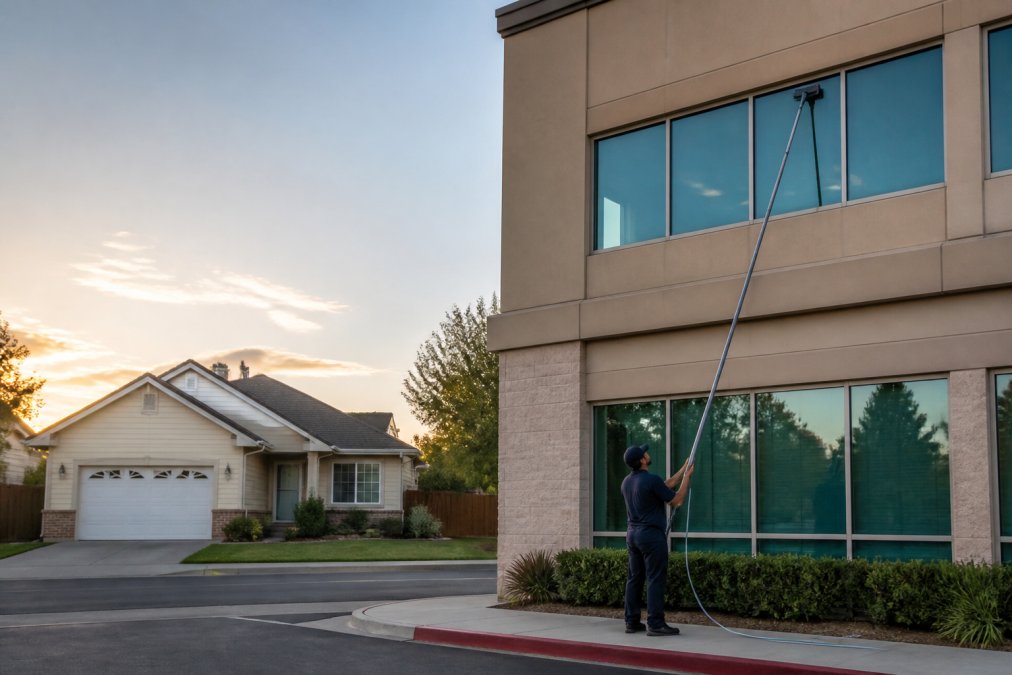
Equipment follows the height. For ground-level and low residential glass, technicians use a traditional window squeegee and a bucket-and-scrub method. For taller work, the toolkit shifts to water-fed pole systems that pump deionized water through a brush head, plus aerial lifts, scaffolding, or rope access for the highest panes.
Deionized water matters more than most people realize. It dries spot-free without a squeegee, which is why it dominates commercial exterior glass maintenance. The interior side of commercial buildings still leans on squeegees and commercial grade chemicals. Residential crews often skip the lift entirely, since most homes sit within safe reach of an extension pole.
Window Cleaning Safety Regulations and OSHA Standards
Safety is where the two services truly separate. Commercial window cleaning safety regulations OSHA enforces apply directly to multi-story buildings, and they are not optional. Residential work falls under general duty of care, but commercial work triggers explicit fall protection requirements under 29 CFR 1910 Subpart D.
Fall Protection and Training Requirements
The OSHA standard for fall protection in general industry sets the trigger height for required protection at four feet in general industry workplaces (29 CFR 1910.28), and window cleaning above that threshold demands a compliant system (osha.gov). That means anchor points rated to 5,000 pounds per employee, full-body harnesses, and documented training under 29 CFR 1910.30 (osha.gov). Aerial lifts and scaffolding bring their own inspection and operator rules under 29 CFR 1910.67 and 1926.451.
For rope access work on high-rises, many commercial crews follow the ANSI/IWCA I-14.1 Window Cleaning Safety standard, which is the industry consensus standard referenced by OSHA in citations (iwca.org). It covers rope descent systems, roof anchors, and the two-rope backup requirement.
How Safety Rules Differ for Homes and Businesses
A homeowner’s two-story window rarely triggers a formal fall protection program because the work is typically done from a ladder or extension pole at low height. A commercial building does, every time. This is the gap most comparison articles skip: the legal exposure is not the same, and neither is the training burden. A residential cleaner may never need a harness; a commercial cleaner on a five-story building needs documented training, inspection logs, and a rescue plan.
Hiring an uninsured or untrained crew for a multi-story building puts the property owner in the liability chain if someone falls. Confirm fall protection training and coverage in writing before work starts.
State and Local Add-Ons
Federal OSHA sets the floor, but several states run their own OSHA-approved State Plans with stricter rules. California, Washington, Oregon, and Michigan, for example, have additional fall protection and rope access requirements. Property managers should verify the crew is compliant with the state plan that covers the building, not just federal OSHA.
Commercial Window Cleaning Cost Per Window vs Residential Pricing
Commercial window cleaning cost per window is typically quoted as a per-pane or per-visit rate tied to a recurring schedule, while residential pricing is usually a flat rate for the whole home. The commercial model rewards volume and consistency; the residential model prices a single event.
What Drives the Price Up or Down
Several variables move the number in either direction:
- Height and access: Lifts, rope access, and scaffolding cost more than a pole from the ground.
- Pane count: More glass lowers the cost per window.
- Frequency: Recurring service contracts almost always beat one-off rates.
- Condition: Hard water stain removal and heavy buildup add labor.
- Interior access: After-hours work and security check-ins raise cost.
Pricing depends on quantity, access, and frequency, so the only accurate figure comes from a site assessment. Request a quote rather than trusting a generic online estimate.
Residential Window Cleaning Frequency: How Often Should You Schedule?
Residential window cleaning frequency depends on your environment and how the glass looks, but most homeowners land on twice a year. Coastal air, pollen, and dust push that toward quarterly. Inland properties with less exposure can stretch to annual.
A simple rule: schedule when you stop noticing the view through the glass. For sellers preparing a home for market, a deep clean before showings and again before closing keeps curb appeal sharp. For ongoing maintenance, spring and fall cover most homes.
Book exterior cleaning right before your rainy season, not during it. Glass stays cleaner longer when the first heavy rain hits an already-clean surface.
Insurance, Liability, and Contractual Obligations
Insurance and contracts are the differences competitors gloss over. Commercial clients routinely require a certificate of liability insurance before any crew touches the building, and many property management firms set minimum coverage limits in the contract itself. Residential clients rarely ask for proof, though they should.
Coverage Types and Typical Limits
The coverage stack differs by segment. Residential jobs usually need general liability of $1 million per occurrence and $2 million aggregate, plus a commercial auto policy if the crew drives to the site. Commercial high-rise work adds workers’ compensation (required in nearly every state once a company has employees), an umbrella or excess liability policy that pushes limits to $5 million or more, and sometimes a separate rigging or rope access endorsement. Property managers often ask for additional insured status and a waiver of subrogation, which means the cleaner’s insurer cannot come back after the building owner for a loss.
Contractual Obligations: Work Orders vs. SLAs
The contract structure differs just as sharply. Commercial work runs on a service level agreement (SLA) that defines visit frequency, response times, scope, and remedies if the vendor misses a scheduled visit. A typical commercial SLA spells out:
- Frequency: weekly, biweekly, or monthly exterior cleaning, with quarterly or semiannual interior.
- Response time: how fast the vendor returns for a complaint, often 24 to 48 hours.
- Scope exclusions: whether hard water stain removal, construction debris, or post-storm cleanup is included or billed as an add-on.
- Damage and liability: who pays for scratched glass, broken seals, or landscaping damage.
- Term and termination: auto-renewal clauses, notice periods, and price escalation.
Residential work is usually a one-page work order with a flat price and no ongoing obligation. If you manage a building, insist the agreement spell out who handles hard water stain removal, who covers damage, and how scheduling flexibility works around tenants.
Certificates and Risk Transfer
Before the first visit, request a certificate of insurance naming the property owner or manager as additional insured, and verify the policy is current by calling the insurer, not just trusting the PDF. For high-rise work, ask for proof of workers’ compensation and the rope access endorsement. This is the step that separates a professional commercial vendor from a residential crew trying to scale up.
For commercial properties, the contract and insurance certificate matter as much as the cleaning itself. Get both in writing before the first visit.
Environmental Impact and Sustainable Practices
Sustainable window cleaning leans on two things: water use and chemistry. Water-fed pole systems that rely on deionized water can clean exterior glass with far less runoff than traditional bucket methods, and they avoid the detergent load entirely on the exterior. Interior work still needs commercial grade chemicals, but low-impact formulas are widely available.
There is a practical angle here too. Fewer chemicals and less water mean less tracking into landscaping and fewer streaks from residue. For property managers tracking sustainability goals, choosing a provider that favors deionized water and low-impact products is an easy, defensible line item.
The gap between residential and commercial window cleaning is not just height. It is safety compliance, insurance, contracts, and the equipment that ties them together. Simply Superior Window Cleaning handles both sides, from single homes to buildings up to four stories, with technicians who complete rigorous classroom and on-the-job training and attend monthly safety meetings. Flexible maintenance schedules, virtual quote options, and comprehensive service for windows, solar panels, and gutters keep the whole property covered. Schedule a free quote with Simply Superior Window Cleaning and get a plan built around your property.
Frequently Asked Questions
What is the primary difference between residential and commercial window cleaning?
The primary difference lies in scope, safety requirements, and pricing structure. Residential window cleaning typically involves single-family homes with fewer windows and simpler access, while commercial window cleaning covers multi-story buildings, storefronts, and office complexes that require specialized equipment like aerial lifts or rope access. Commercial work also demands stricter safety compliance, liability insurance, and often recurring service contracts. Understanding these distinctions helps property managers and homeowners choose the right provider for their needs.
How does commercial window cleaning cost per window compare to residential pricing?
Commercial window cleaning cost per window is often lower on a per-unit basis due to economies of scale, but the total project cost is higher because of larger scope, specialized equipment, and insurance requirements. Residential pricing tends to be higher per window since each home is unique and jobs are smaller. For accurate quotes, request a site assessment or virtual estimate, as factors like building height, window type, and frequency of service significantly impact the final price.
What safety standards apply to commercial window cleaning?
Commercial window cleaning must comply with OSHA standards, including fall protection for work at heights, proper use of aerial lifts and scaffolding, and training on hazardous materials. Residential cleaning may have fewer regulatory requirements but still demands safe practices. Professional companies conduct regular safety meetings and provide rigorous training to ensure technicians are prepared for both residential and commercial environments, reducing risk for property owners and workers alike.
Is the frequency of cleaning different for homes versus businesses?
Yes, residential window cleaning frequency typically ranges from every three to six months, depending on climate and homeowner preference. Commercial properties often require more frequent service, such as monthly or quarterly, to maintain curb appeal and meet lease or brand standards. Property managers may schedule recurring maintenance contracts, while homeowners often book one-time or seasonal cleanings. Discussing your specific needs with a provider helps determine the ideal schedule.
Can a residential window cleaner handle commercial properties?
Most residential window cleaners lack the specialized equipment, insurance, and training required for commercial properties, especially multi-story buildings. Commercial work often involves OSHA compliance, liability coverage, and techniques like rope access or water-fed pole systems. Hiring a company experienced in both residential and commercial services ensures safety and quality. Always verify credentials and ask about their experience with commercial projects before booking.