
Last Updated: November 1, 2026
Quick Summary
To clean exterior windows without streaks, rinse the glass first, scrub with a soft scrubber using a light solution, then squeegee in continuous strokes at about a 30-degree angle while wiping the blade dry. Work in shade on cool glass and finish with a clean-water rinse to prevent residue.
- Clean in shade or early morning, never on glass that is hot to the touch.
- Use only a few drops of mild dish soap in a homemade vinegar and water solution.
- Hold the squeegee at roughly a 30-degree angle and overlap each pass by about an inch.
- Wipe the squeegee blade dry after every pass so wet solution does not drag back onto the glass.
- Use low-mineral water such as distilled water for the final rinse to avoid hard water spots.
Table of Contents
- Why Exterior Windows Streak and What Causes It
- Choosing a Window Cleaning Solution and Making a Homemade Window Cleaner
- Window Cleaning Tools and Equipment You Need
- Step-by-Step Workflow for Cleaning Exterior Glass
- How to Clean Hard-to-Reach Exterior Windows Safely
- Weather, Timing and Water Quality Tips
- Fixing Persistent Marks and How Often to Clean Exterior Windows
- Booking Professional Exterior Window Cleaning in Ventura and North LA Counties
- Frequently Asked Questions
Why Exterior Windows Streak and What Causes It
Streaks usually come from three things: leftover soap, hard water minerals, and cleaning in direct sunlight. These problems are common across Ventura and North LA Counties, and most of them are easy to avoid once you know how to get clean exterior windows.
Streaking happens when a thin film of residue dries on the glass. The film can be soap, dirt that was never rinsed away, or minerals from the water.
A common mistake is cleaning a window that is hot to the touch. The cleaner dries before you can wipe it, and it leaves marks behind. Clean in shade or early in the morning when the glass is cool.
Common streak causes:
- Too much cleaning solution left on the glass
- Dirt that was scrubbed around instead of rinsed off
- Hard water spots from mineral-heavy tap water
Choosing a Window Cleaning Solution and Making a Homemade Window Cleaner
Most people do fine with a simple homemade window cleaner.
Keep the soap amount small. A few drops is enough. Too much soap is the number one cause of soap residue and streaks.
Vinegar cuts through grime well. It also helps dissolve light mineral deposits.
Commercial glass cleaners work too. Look for a product labeled for glass and read the directions.
Quick homemade recipe:
- 1 cup white vinegar
- 1 quart warm water
- 2-3 drops mild dish soap
Window Cleaning Tools and Equipment You Need
You do not need expensive gear. A few basic tools handle most exterior windows well.
- Garden hose with a gentle spray setting for rinsing
- Bucket for mixing or holding a cleaning solution
- Soft-bristle brush or scrubber for loosening dirt
Replace worn squeegee blades before you start. A nicked blade leaves lines across the glass.
Step-by-Step Workflow for Cleaning Exterior Glass
A streak-free exterior window is the product of sequence, not product. The order below is a practical sequence for exterior glass, and skipping or reordering a step is a common reason a homeowner ends up with haze, drips, or lines that reappear the next morning.
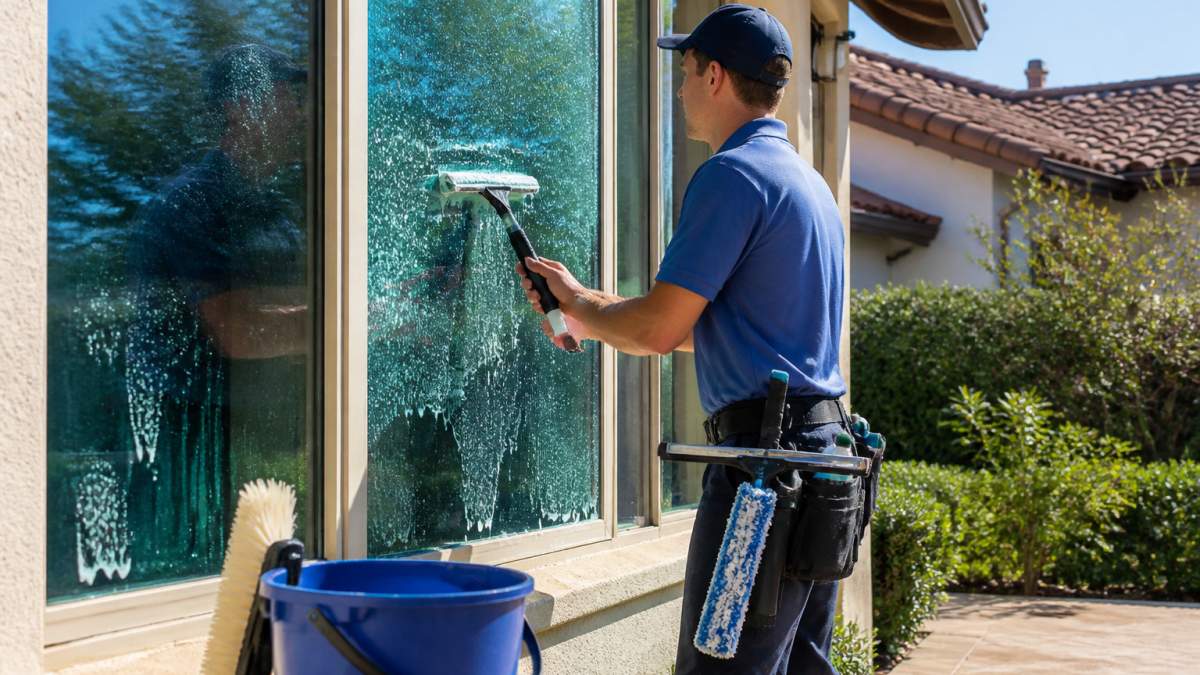
Step 1: Prep the Surroundings Before You Touch the Glass
Before any water hits the pane, do a two-minute walk-around. Move potted plants, patio furniture, and grills out of the drip line. Close the windows and check that screens are removed or taped off.
Check the glass temperature with the back of your hand. If it is hot to the touch, wait. Cleaning hot glass is the single fastest way to bake a film onto the surface.
Step 2: Rinse and Pre-Soak to Lift Loose Dirt
Set your hose to a gentle shower or fan setting, not a jet. A hard jet drives grit into the frame and can force water past seals. Rinse top to bottom, working left to right, and let the water sheet off.
On heavily soiled panes, let the pre-soak sit for 30 to 60 seconds before scrubbing. On lightly soiled glass, a quick pass is enough.
Step 3: Apply Solution With a Scrubber, Not a Spray Bottle
For exterior glass, a bucket-and-scrubber method beats a spray bottle. Spray bottles atomize solution into the air, dry too fast on warm days, and leave uneven coverage.
Work in small sections, roughly one window pane at a time. Scrub in overlapping circles or a figure-eight pattern, then finish with a straight pass along the top edge so the solution does not pool in the frame channel.
Keep a second bucket of clean water nearby. Rinse the scrubber head every few panes so you are not redistributing dirt you already lifted.
Step 4: Squeegee With the Right Angle and Overlap
This is where most streaks are born. Hold the squeegee at roughly a 30-degree angle to the glass, with the blade edge leading.
After each pass, wipe the blade on a dry cloth or towel. A wet blade drags solution back onto clean glass.
For the final pass along the bottom edge, angle the squeegee slightly so water channels off the glass and onto the ground rather than into the sill.
Step 5: Detail the Edges and Sill
Even a perfect squeegee pass leaves a bead of water at the frame and sill. Left alone, that bead wicks back onto the glass and dries into a spot. Run a microfiber cloth along the top, sides, and bottom edge of the pane, then wipe the sill and frame channel dry.
Use a separate dry cloth for the final buff. A damp cloth just smears the residue you are trying to remove.
Step 6: Final Rinse and Inspection
On multi-pane windows, do a light final rinse with clean water from the top down after the last squeegee pass, then detail the edges again. This removes any solution that migrated from the frame during squeegeeing.
Step back and inspect the glass at an angle, not straight on. Angled light reveals haze and missed edges that disappear in direct view.
The sequence is prep, rinse, scrub, squeegee, detail, inspect. If you change one thing, change the order: rinse before you scrub, and detail after every squeegee pass.
The core steps for a streak-free finish, in order:
| Step | What to do | Timing or detail |
|---|---|---|
| 1. Prep | Move plants, furniture and grills; check glass is not hot | Walk-around before any water |
| 2. Rinse | Pre-soak top to bottom with a gentle hose setting | Soak 30-60 seconds on heavy soil |
| 3. Scrub | Apply solution with a soft scrubber in small sections | One pane at a time |
| 4. Squeegee | Pull at about 30 degrees, wiping the blade dry each pass | Overlap each pass by about an inch |
| 5. Detail | Dry the edges, top, sides and sill with microfiber | Use a separate dry cloth for buffing |
| 6. Inspect | Final clean-water rinse, then check glass at an angle | Angled light shows missed spots |
How to Clean Hard-to-Reach Exterior Windows Safely
Upper-story windows are where most people get into trouble. Reaching them safely is the goal, not reaching them quickly.
Use a sturdy extension pole when you can. It keeps you on the ground and lets you work from a safer position.
If you do use a ladder, set it on firm, level ground.
Simply Superior Window Cleaning serves residential and commercial properties throughout Ventura and North LA Counties.
Weather, Timing and Water Quality Tips
Most streak problems are decided before you pick up a squeegee. Temperature, sun exposure, wind, and the mineral content of your water all change how fast the solution dries and what it leaves behind. The guidance below is the practical version of what professional crews check before they start a route.
Timing: Work the Shade, Not the Clock
A common pattern among experienced cleaners is to follow the shade around the house rather than the clock. Start on the side of the home that is in shadow and move with the shade as the sun shifts.
As a rule of thumb, avoid cleaning when the glass is warm to the touch. Warm glass accelerates evaporation, so the solution flashes off before you can squeegee, and the residue left behind is what shows up as haze.
Temperature and Wind: The Flash-Dry Problem
Two conditions cause most flash-drying: direct sun on the glass and steady wind. Wind is the sneakier of the two because the glass can feel cool while a breeze strips moisture off the surface in seconds.
If you must work in wind, shrink your sections.
Avoid cleaning in freezing temperatures. Solution can freeze on the glass and in the frame channel, and the expansion can damage seals. If temperatures are near or below freezing, postpone the job.
Water Quality: Why Hard Water Spots Come Back
Hard water is the most misunderstood cause of recurring spots. Tap water carries dissolved calcium and magnesium. When that water dries on glass, the minerals stay behind as a white, chalky film.
A simple test: fill a clear glass with tap water and let it evaporate on a dark plate. If a white ring remains, your water is leaving minerals on your windows every time you rinse.
Do not use a hard-water rinse as your final pass. Whatever minerals are in the water will be in the spots you see the next morning.
The Final Rinse: Use Clean Water
For the final rinse, use water with low mineral content. Distilled water is the simplest option for a homeowner and leaves essentially no residue.
If you are not set up for purified water, do not skip the final rinse. Instead, squeegee and detail the glass immediately after the rinse so the water never has time to dry in place.
Regional Water Reality
Hard water is common in many municipal systems that draw from groundwater. If you see white, chalky spots that return within days of cleaning, the cause is usually mineral buildup rather than dirt. In that case, a vinegar soak followed by a purified-water rinse is more effective than repeated scrubbing with soap.
Pick a cool, shaded window of time, keep sections small on windy days, and finish with low-mineral water. Those three choices prevent more streaks than any squeegee technique.
Fixing Persistent Marks and How Often to Clean Exterior Windows
Some marks need more than a basic cleaner. Try these fixes before calling for help.
- Hard water spots: Use a vinegar solution and let it sit for a few minutes before scrubbing.
- Tree sap or bird droppings: Soften them with warm water first, then wipe gently.
- Paint or adhesive residue: Use a plastic scraper and a glass-safe cleaner.
Cleaning frequency depends on the property. Homes near trees, roads, or the ocean may need more frequent cleaning. Clean more often before a sale or event.
If stains persist after your best effort, a professional can assess whether the glass or coating is damaged.
Booking Professional Exterior Window Cleaning in Ventura and North LA Counties
Hiring a professional saves time and removes the safety risk for high windows. Simply Superior Window Cleaning provides residential and commercial window cleaning, plus solar panel cleaning, gutter maintenance, and pressure washing for properties throughout Ventura and North LA Counties.
Our team offers flexible maintenance schedules and 24/7 maintenance services, and we prioritize minimal contact through virtual proposals. Pricing depends on property size, number of windows, and access, so the best way to get current figures is to request a quote on our website.
Ready to get streak-free windows without the hassle? Schedule a free quote with Simply Superior Window Cleaning today and let our trained team handle the high, hard-to-reach panes for you.
Frequently Asked Questions
Is vinegar better than Windex for cleaning windows?
Vinegar and water work well for routine exterior glass and cost very little to make at home. Commercial glass cleaners can perform better on heavy film, though they also leave more residue if overused. The bigger factor for streak-free results is how you rinse, how you squeegee, and whether you clean in shade rather than direct sunlight. Whichever solution you choose, use it sparingly and finish with a clean, dry squeegee blade.
Why does Windex leave streaks on windows?
Streaks usually come from applying too much product, letting it dry on the glass, or using a cloth that is dirty or lint-heavy. Hard water and soap residue left on the surface also cause streaking and spotting. Wipe with a lint-free cloth, buff immediately, and rinse the glass well before cleaning so the solution does not dry before you squeegee it.
How often should you clean exterior windows?
Cleaning frequency depends on proximity to trees, dust, coastal salt air, and sun exposure. Homes near busy roads or under heavy tree cover may need more frequent cleaning. Sellers preparing a property for market often schedule a cleaning shortly before listing photos and showings. Simply Superior Window Cleaning can recommend a schedule after a site visit or virtual quote.
Should you clean windows in direct sunlight?
No. Direct sunlight and hot glass cause cleaning solution to dry too quickly, which leaves streaks and residue. Clean in the early morning or late afternoon, or on a cloudy day, and work on one section at a time so each area stays wet until you squeegee it.