
Table of Contents
- How Debris Causes Solar Panel Damage
- Visible Signs of Solar Panel Damage From Debris
- Debris Under Solar Panels: Types and Risk
- Monitoring Solar Panel Output to Detect Damage
- Distinguishing Debris Obstruction From Permanent Damage
- Safe Inspection Steps for Homeowners
- Professional Solar Panel Cleaning Services
- Documentation and Warranty Protection
- Frequently Asked Questions
Last Updated: October 18, 2026
How Debris Causes Solar Panel Damage
Debris doesn’t sit harmlessly on your solar panels. Falling branches, hail, leaves, dirt, and pollen reduce energy output and damage equipment.
Damage happens two ways: heavy debris like branches or hail cracks glass and internal cells, and accumulated debris blocks sunlight from reaching the cells.
Spotting problems early matters because some debris damage is invisible at first; by the time output drops noticeably, panels may have been damaged for weeks.
Visible Signs of Solar Panel Damage From Debris
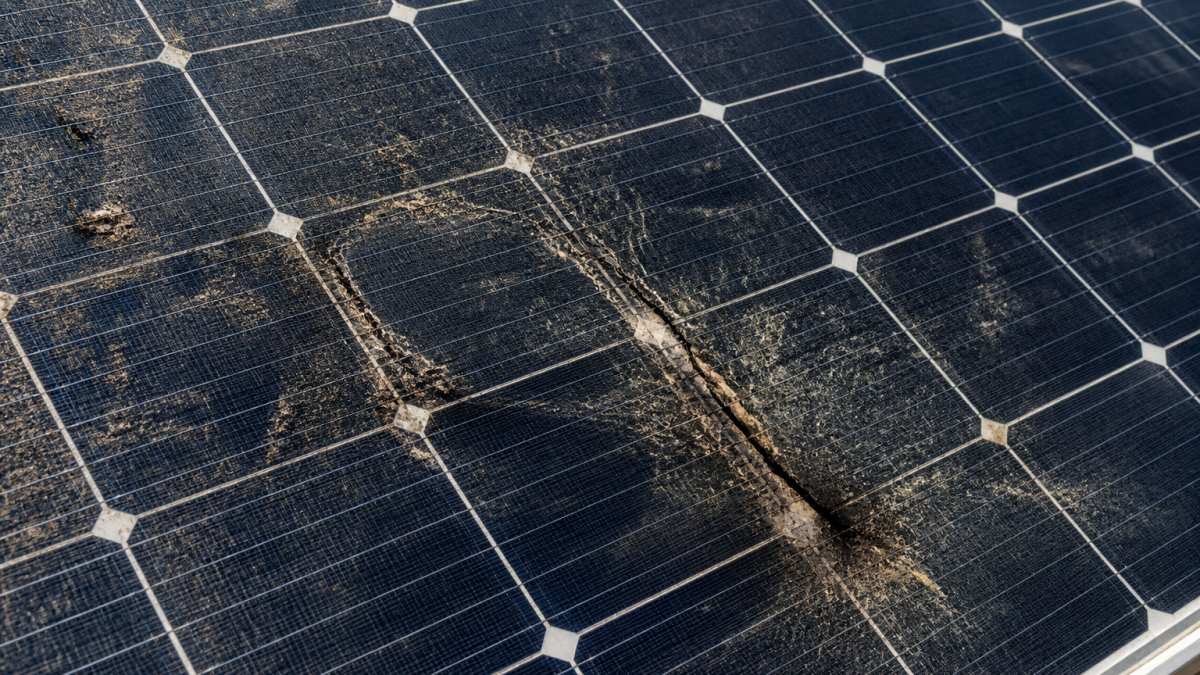
Damage from debris appears in several distinct ways. Some signs are obvious immediately; others develop slowly as moisture seeps into cracks or heat builds up.
Cracked and Shattered Glass
The outer glass layer protects everything underneath. Debris impact forms cracks; small ones look minor but let moisture inside, spreading damage quickly.
Shattered glass is the most obvious sign of impact damage, caused by hail, falling branches, or flying storm debris. Once glass integrity fails, the panel stops working efficiently.
Cell Cracks and Microcracks
Below the glass sit the solar cells, which crack under impact stress. Microcracks are tiny fractures you can barely see, but they break the electrical connections inside the cell, so a panel with microcracks produces less power even though it looks fine.
Cell cracks happen when debris hits with enough force, and from temperature stress as panels heat and cool. Over time they spread and worsen.
Discoloration, Yellowing, and Staining
Leaves, pollen, and dirt leave stains that turn yellow or brown as they oxidize and bake onto the glass.
Discoloration signals two problems: staining blocks light from the cells below, and the material often traps moisture that corrodes the frame and electrical connections. Purple or dark staining usually means moisture has penetrated the panel.
Hotspots and Burnt Edges
Hotspots form when part of a panel stops working while the rest continues. Electricity backs up in the damaged section, creating intense heat that can burn panel material and damage wiring.
Burnt edges appear as dark or blackened areas along the frame or cell edges, indicating excessive heat. Hotspots and burnt areas mean the panel is failing and needs replacement soon.
Frame Warping and Delamination
The aluminum frame holds the panel together. Debris impact or extreme temperature swings can bend or warp this frame. A warped frame doesn’t seal properly, allowing moisture inside.
Delamination happens when the layers inside the panel separate and the glass peels away from the cells below. Air and moisture reach the cells, causing rapid failure; once delamination starts, the panel is essentially finished.
Debris Under Solar Panels: Types and Risk
Not all debris is equal. Some only blocks sunlight and washes away with rain; other material strikes hard enough to fracture glass, dent frames, or sever wiring. Knowing which is which tells you how urgently to act.
Debris that obstructs but rarely damages
Leaves and pine needles. These collect along the lower edge of rooftop arrays and between panels.
Dirt, dust, and agricultural dust. These build up gradually and uniformly.
Pollen. Seasonal and sticky, pollen film is hard to rinse off and holds subsequent dust, compounding shading.
Bird droppings. Acidic and opaque, fresh droppings mostly shade, but left through several heat cycles they can etch the anti-reflective coating and leave a permanent dull spot no cleaning removes.
Debris that can scratch or abrade
Sand, grit, and construction dust. Wind-driven sand and debris from roofing or landscaping can abrade the glass and, more importantly, the anti-reflective coating.
Roofing granules and shingle grit. Common after a roof replacement near an existing array, these particles are sharp and heavy enough to pit glass if walked on or dragged across during cleaning.
Debris that cracks, chips, or deforms
Hail. The highest-impact debris risk in most of the country.
Falling branches and limbs. Impact damage from above is usually obvious at the point of contact: a shattered pane, bent frame rail, or displaced panel.
Ice and snow. Snow is mostly a shading problem, but ice dams at the lower edge can pry at frame seals and, in freeze-thaw cycles, widen existing microcracks.
Quick risk comparison
| Debris type | Primary risk | Typical damage | Urgency |
|---|---|---|---|
| Leaves, needles | Moisture trapping | Frame corrosion, shading | Seasonal |
| Dirt, dust | Shading | Output loss only | Routine |
| Pollen | Shading, masking | Coating etch if left | Seasonal |
| Bird droppings | Shading, etching | Coating damage | Prompt |
| Sand, grit | Abrasion | Coating scratches | During cleaning |
| Hail | Impact | Glass fracture, cell microcracks | Immediate inspection |
| Branches | Impact, mechanical | Shatter, frame bend, wiring | Immediate |
| Stones, balls | Localized impact | Chips, edge cracks | Prompt |
| Ice, snow | Shading, freeze-thaw | Seal damage, crack growth | Seasonal |
The single most useful habit is to photograph the array after every significant storm and compare it to the previous set. Debris damage is far easier to attribute, and to claim, when you have a dated before-and-after record.
If you find shattered glass, a bent frame, or a loose cable under the array, stop and call a qualified installer. Those are not cleaning problems.
Monitoring Solar Panel Output to Detect Damage
Your monitoring system is your best tool for spotting damage early.
Compare your daily output to historical data. A sudden drop of 10-20% usually means something is wrong.
Check your monitoring system after storms. Hail, heavy wind, or falling branches should trigger an inspection.
Pay attention to patterns. If output drops on cloudy days but not sunny ones, debris is likely blocking panels.
Distinguishing Debris Obstruction From Permanent Damage
This distinction matters because it determines your next step. Debris obstruction is temporary.
Temporary obstruction happens when debris covers the panel surface.
Test this by checking your monitoring system before and after cleaning.
Permanent damage reduces output even after cleaning.
Sometimes both problems exist together. Debris covers a permanently damaged panel.
Safe Inspection Steps for Homeowners
Most of what you need to know about debris damage can be learned without leaving the ground. The goal of a homeowner inspection is to decide one thing: does this need a professional, or is it a cleaning job? Work through the steps below in order and stop at the first sign that the answer is “professional.”
Step 1: Do the ground-level walkaround first
Walk the perimeter of the house with binoculars and a phone camera. From the ground you can see:
- Glass condition, cracks, chips, star fractures, or a hazy sheen on any panel.
- Frame and mounting, bent rails, gaps between the panel and the roof, or panels that look out of line with their neighbors.
- Debris accumulation, leaves packed into the lower frame channel, bird nests under the array, or branches resting on the panels.
Photograph each panel from the ground and label the photos by array position (for example, “row 1, panel 3”). This becomes your baseline for the next storm.
Step 2: Read the monitoring data before you climb
Open your monitoring app and compare the last seven days to the same period last month and last year. Look for:
- A step change, output drops on one day and stays down. That pattern points to an event, such as an impact or a failed string.
- A gradual decline, output drifts down over weeks. That pattern points to soiling, shading growth, or a slow defect.
- A single underperforming panel or string, often the signature of physical damage or a hotspot on one module.
If the data shows a step change after a storm, treat it as damage until proven otherwise, even if the glass looks fine from the ground.
Step 3: Know what not to touch
This is the part most guides skip. Do not:
- Touch or step on panels. The glass is load-rated for snow, not for a person. Walking on a panel can crack cells that were previously fine.
- Lift or pry a panel to look underneath. The mounting hardware and wiring are not designed to be moved by hand, and a lifted panel can come free.
- Handle wiring, junction boxes, or connectors. Even with the inverter off, DC conductors can carry live voltage. Damaged insulation is an electrocution risk.
If you see exposed wiring, a burnt smell, scorch marks, or a panel that is visibly arcing or discolored around a junction box, do not approach the array. Shut down the system at the disconnect if it is safely accessible, and call a licensed installer or electrician.
Step 4: Climb only if it is genuinely safe
Roof access is optional, not required. Climb only if all of the following are true:
- The roof pitch is low and the surface is dry.
- The array is on a single-story section with safe ladder placement.
- You have non-slip shoes and a spotter on the ground.
If any of those is not true, stop at Step 3 and book a professional inspection. A fall from a roof is a far worse outcome than a missed crack.
Step 5: Inspect each panel methodically
If you do climb, work panel by panel and check the same five things on each:
- Glass, cracks, chips, star patterns, or a dull haze.
- Cells, discolored or browned squares, dark spots, or snail trails along cell edges.
- Frame, bends, gaps, corrosion at the corners, or a lifted seal.
- Junction box and cabling, loose connectors, abraded cable, or water staining.
- Mounting, loose clamps, missing bolts, or a panel that moves when lightly pressed at the corner (do not press hard).
Record the location of anything you find and photograph it close-up with something for scale.
Step 6: Decide, clean, monitor, or call
Use this simple decision rule:
- Surface debris only, no glass or frame damage → schedule a cleaning.
- Output dropped but glass and frame look intact → clean first, then recheck monitoring for a week. If output does not recover, call a professional.
- Any crack, chip, bent frame, loose wiring, burnt mark, or discoloration → call a qualified installer or electrician. Do not clean around damaged panels.
The safest and most useful inspection is the one you do from the ground with binoculars and your monitoring app. Reserve roof access for professionals, and let the data tell you when a closer look is warranted.
Documentation from this walkaround, dated photos, monitoring screenshots, and notes, is also what your installer, warranty provider, and insurer will ask for first.
Professional Solar Panel Cleaning Services
Professional cleaning removes debris safely and thoroughly. It also provides an inspection for damage.
Simply Superior Window Cleaning offers professional solar panel cleaning.
During a cleaning visit, our team inspects your panels for damage.
Regular cleaning prevents many problems. Removing debris before it accumulates keeps your panels producing at peak efficiency.
Documentation and Warranty Protection
Keeping records protects your investment. Document every cleaning, inspection, and repair.
Take photos before and after cleaning.
Most solar panel warranties cover manufacturing defects but not damage from debris impact or lack of maintenance.
If damage occurs, get a professional assessment immediately.
Report damage to your warranty provider quickly. Most warranties have time limits for filing claims.
Frequently Asked Questions
How do you tell if your solar panels are damaged from debris?
Start with a visual inspection from the ground using binoculars to check for cracked glass, discoloration, or burnt spots. Look for debris like fallen branches, leaves, or dirt accumulation. Then check your monitoring system for sudden drops in energy production or inconsistent output between panels. If output has declined 10-15% or more without weather changes, damage is likely. For safety, avoid climbing on your roof; a professional inspection is the best way to confirm damage and assess whether repair or replacement is needed.
Can dirt and debris damage solar panels permanently?
Yes, certain types of debris cause permanent damage. Falling branches and hail create cracks and shattered glass that reduce efficiency and allow moisture intrusion. Leaves and dirt on the surface cause temporary shading but wash away with rain or cleaning. However, debris trapped under panels or in electrical connections can cause wiring problems and bypass diode failure. The key difference: surface obstruction is temporary, but impact damage, internal cell cracks, and moisture intrusion are permanent and require professional repair or panel replacement.
What should I do if I find debris under my solar panels?
Do not attempt to remove debris from under panels yourself, as this risks damaging wiring, electrical connections, and the frame. Instead, contact a professional solar panel cleaning service. Technicians have proper tools and training to safely remove debris without voiding your warranty. Document what you see with photos before calling for service. If debris is blocking airflow or causing visible damage, prioritize removal within a few days to prevent moisture accumulation and further deterioration of your system.
Should you clean solar panels yourself or hire a professional service?
Professional solar panel cleaning services are the safer choice. Climbing on your roof risks falls and injuries, and using incorrect cleaning methods or pressure washing can damage the glass, electrical connections, and frame, potentially voiding your warranty. Professional technicians know the proper water pressure, cleaning solutions, and techniques to maintain system integrity. They also perform safety inspections during cleaning and document the work for warranty records. For homeowners concerned about cost, a professional inspection to assess damage is worth the investment before attempting any cleaning or repair yourself.
Debris damage to solar panels ranges from minor obstruction to permanent failure. Regular inspection and cleaning prevent most problems. Simply Superior Window Cleaning helps protect your investment with professional cleaning and damage detection. Schedule a Free Quote today to keep your solar panels producing maximum energy.