
Table of Contents
- 1. Gather the Right Exterior Window Cleaning Tools
- 2. Mix a Homemade Window Cleaning Solution That Works
- 3. Remove Loose Dirt Before You Scrub
- 4. Scrub, Squeegee, and Wipe Dry for a Streak-Free Finish
- 5. How to Clean High Windows Safely Without a Ladder Risk
- 6. How Often to Clean House Windows and When to Call a Pro
- Conclusion: Clean Exterior Windows Safely, Season After Season
- Frequently Asked Questions
Last Updated: October 4, 2026
1. Gather the Right Exterior Window Cleaning Tools
The 7 ways to clean exterior house windows safely start with the right gear, not the strongest arm. The 7 ways to clean exterior house windows safely in this guide all depend on having the right kit on hand.
Here is what a basic exterior window cleaning tools setup looks like:
- A squeegee sized to your window panes
- A window scrubber or soft applicator
- An extension pole with a threaded tip
- A microfiber cloth and a few soft cloths
Skip abrasive pads and steel wool. They scratch glass, and scratches never come out.
Match your squeegee width to your pane width. A squeegee that is too wide leaves lines at the edges, and one that is too narrow triples your passes. Most homes need a 12-inch squeegee for standard panes and a 6-inch for small ones.
2. Mix a Homemade Window Cleaning Solution That Works
A homemade window cleaning solution is simple: mix one part white vinegar with one part water in a spray bottle. That is it. For dirty exterior windows, add a few drops of mild soap to help lift dust and insect marks.
Why this mix works:
- White vinegar cuts through mineral deposits and hard-water stains
- Mild soap breaks down oily fingerprints and smudges
- Water rinses everything away without leaving residue
Avoid ammonia-based glass cleaners outdoors in direct sun. They dry too fast and leave streaks. And never mix vinegar with bleach. The fumes are dangerous.
Do not use dish soap straight from the bottle. Too much soap leaves a film that attracts dust within days, and you will be back outside scrubbing sooner than you planned.
3. Remove Loose Dirt Before You Scrub
Removing loose dirt before you scrub is the step most people skip, and it is the one that causes scratches. Dust, grit, and pollen sit on window glass after a windy week. If you scrub that grime across the pane, you grind it into the surface.
Here is the safe order:
- Rinse the window with a hose or a wet cloth to loosen dust
- Wipe down frames and sills first so dirt does not drip onto clean glass
- Use a soft brush or vacuum to clear debris from tracks and corners
- Only then move to your cleaning solution
Work top to bottom, and do the frames before the glass. A common mistake is scrubbing a dry, dusty window and wondering why it looks worse afterward.
4. Scrub, Squeegee, and Wipe Dry for a Streak-Free Finish
A streak-free finish comes down to three moves in the right order: scrub, squeegee, wipe dry.
Finish by wiping the edges and corners with a microfiber cloth. That is where drips collect and streaks form.
Timing matters too. Clean in cool or shaded conditions when you can. Direct sun dries the solution before your squeegee reaches it, and that leaves water spots behind.
| Step | Tool | Why It Matters |
|---|---|---|
| Scrub | Soft applicator | Loosens dirt without scratching |
| Squeegee | Squeegee | Removes solution in one pass |
| Wipe dry | Microfiber cloth | Stops drips and streaks at edges |
5. How to Clean High Windows Safely Without a Ladder Risk
Learning how to clean high windows safely means treating height as the primary hazard, not the dirt. Falls are the leading cause of fatal injuries in home maintenance, and ladder falls are among the most common reasons homeowners end up in emergency rooms after routine chores.
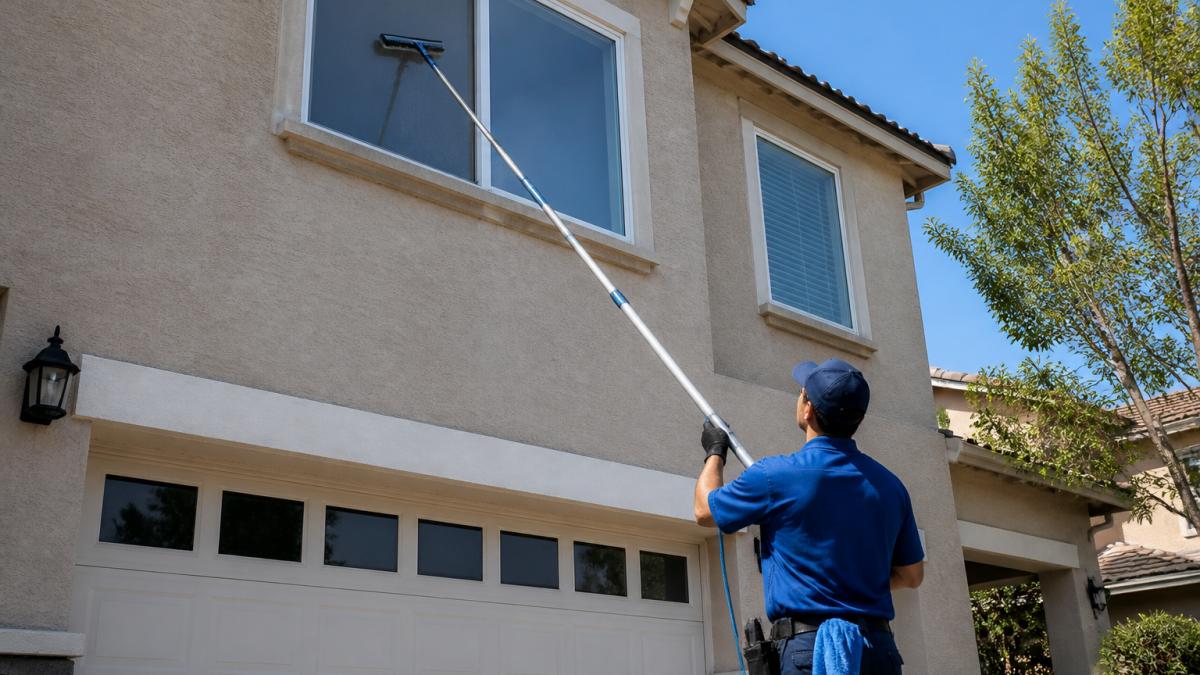
Ground-based reach: what an extension pole actually covers
A threaded extension pole with a squeegee or scrubber head is the safest tool for anything above the first story. The practical limits most practitioners work within:
- One story (roughly 10 feet to the sill): a 6- to 12-foot pole handles it comfortably from a standing position.
- Two stories (roughly 18 to 22 feet to the sill): you need a 20- to 24-foot pole, and the pole itself gets heavy and whippy. Control drops fast above 20 feet.
- Three stories and up: pole work becomes unstable, the squeegee angle is hard to hold, and you cannot see streaks from the ground. This is the point where most professionals switch to water-fed poles with purified water, or decline the job without proper access equipment.
A water-fed pole fed with deionized or reverse-osmosis water is the tool that lets a cleaner skip the squeegee entirely on upper panes: the pure water dries spot-free because it carries no minerals. That is a different kit from a basic squeegee-and-pole setup, and it is the reason a professional can safely do work a homeowner cannot.
If you do climb: ladder setup that actually prevents falls
Sometimes a ladder is unavoidable, usually for a first-story window over a porch or a low second-story pane. When it is:
- Set the angle right. The base should sit one foot out from the wall for every four feet of height to the contact point. Too steep and the ladder tips back; too shallow and the feet slide out.
- Foot it on hard, level ground. Never on grass, mulch, gravel, or a deck board that can shift. If the ground is soft, use a ladder leveler or move the work to a pole.
- Extend three rungs above the roofline or landing point so you have something to hold when you step off.
- Keep three points of contact, two feet and one hand, or two hands and one foot, at all times. Carry tools in a belt or bucket on a rope, not in your hands.
Never use a ladder in wind, rain, or on a surface that might be slick with morning dew. Aluminum conducts electricity, so keep every ladder at least 10 feet from power lines and never work near a service drop.
When to stop and call a professional
Our technicians train in the classroom and on the job, and we hold monthly safety meetings for exactly this reason. The thresholds that should end a DIY job:
- Any pane above the second story
- Windows over a slope, stairwell, skylight, or hardscape you cannot safely foot a ladder on
- Cracked, loose, or fogged glass, or a sash that will not stay put
- Storm windows, screens, or shutters that need removal before cleaning
The safest way to clean high exterior windows is an extension pole from the ground, and a water-fed pole with purified water for anything a squeegee cannot reach. If a pole cannot reach it safely, that window is a job for a trained professional, not a taller ladder.
6. How Often to Clean House Windows and When to Call a Pro
Most homes need exterior windows cleaned two to four times a year. That answer to how often to clean house windows depends on what surrounds you. Coastal salt air, heavy pollen, nearby construction, and mature trees all speed up the grime, and homes in those conditions often need quarterly service. A home on a quiet inland lot with no overhanging trees can stretch to twice a year.
Screens: remove, wash, and reinstall without damage
Screens are the step most guides skip, and they are also where homeowners bend frames and tear mesh. The safe process:
- Label before you remove. Number each screen or mark it with painter’s tape so it goes back on the same opening. Screens are cut to fit and rarely swap cleanly.
- Release the hardware, do not pry. Most screens sit in a channel held by spring-loaded tabs, plunger pins, or small clips. Press the tabs inward and lift the frame straight out. On older wood frames, look for turn buttons or a retaining strip.
- Lay screens flat on a soft surface, a towel or a sheet of cardboard, so the frame does not twist.
- Vacuum first, then wash. Run a vacuum with a brush attachment over both sides to lift dust and pollen. Then wash with mild soap and water and a soft brush, rinse, and let them air-dry flat.
- Never pressure-wash a screen. The stream tears mesh and bends frames. A garden hose on low pressure is the most force a screen should see.
- Reinstall the same way you removed them, seating the frame fully in the channel before you release the tabs. Test that the screen sits flush and the window still operates.
If a frame is already bent, the mesh is torn, or the screen is a fixed storm panel, that is a job for a professional, re-screening and re-glazing are separate trades from window cleaning.
Weather, runoff, and protecting what is below
Check the forecast before you start, and check the thermometer. The best conditions for exterior glass are overcast skies and temperatures between roughly 50°F and 75°F. Direct sun and hot glass dry the solution before your squeegee reaches it, which is what leaves water spots. Below about 40°F, water and cleaning solution can freeze on the glass and on your hands, and many manufacturers’ sealants and gaskets are less forgiving in cold.
Runoff is the other half of the job. Dirty water from exterior windows carries grit, pollen, and whatever was on the glass, and it will stain siding, decking, and concrete if it sheets down and dries. Before you start:
- Cover or move anything below, patio furniture, grills, planters, cars.
- Pre-wet landscaping with a hose so the soil and leaves are less likely to absorb soapy water.
- Rinse plants and hardscape after you finish with plain water.
- Keep runoff out of storm drains where you can. Wash water with soap should go onto a lawn or gravel, not straight into a curb inlet, and never into a creek or wetland.
When to call a professional
Call a professional when:
- Windows sit above the first story, or you cannot safely foot a ladder
- You see hard-water stains or mineral deposits that will not budge with vinegar
- Screens, storm windows, or shutters need removal and reinstallation
- Frames, tracks, or seals show damage, rot, or failed glazing
Frequency is a schedule, not a guess: two to four times a year for most homes, more in coastal, pollen-heavy, or construction-adjacent areas. Screens come off flat, get vacuumed before they get wet, and go back on the same opening. And always check the weather, protect what is below, and stop if the paint is old or the height is beyond a pole.
Conclusion: Clean Exterior Windows Safely, Season After Season
Cleaning exterior windows safely is a routine, not a one-time project. The homeowners who get the best results build a schedule and stick to it. If ladders, high panes, or stubborn mineral spots make the job risky, that is where we come in. Simply Superior Window Cleaning offers flexible maintenance schedules, virtual quotes, and service for buildings up to four stories tall, plus pressure washing, solar panel cleaning, and gutter maintenance.
Frequently Asked Questions
What is the safest way to clean exterior house windows?
Work from the ground whenever possible using an extension pole with a threaded tip, soft scrubber, and squeegee. If you must use a ladder, place it on level ground, keep three points of contact, and never lean sideways to reach. Clean in shaded conditions so the solution does not dry before you squeegee. For second-story or hard-to-reach glass, a professional crew with proper fall-prevention training is the safest option.
What is the best homemade solution for cleaning exterior windows?
A mix of one part white vinegar to one part water in a spray bottle cuts through dust and light mineral film without harsh chemicals. For heavier grime, add a few drops of mild soap to a bucket of water. Avoid abrasive pads and ammonia-based cleaners on tinted or coated glass. Always test a small corner first, and rinse thoroughly so residue does not attract new dirt.
How do you clean high exterior windows safely?
Use a telescoping extension pole with a soft applicator and squeegee so you stay on the ground. If a ladder is unavoidable, use a stabilizer, keep your belt buckle between the rails, and have a spotter. Never stand on the top two rungs or reach past your shoulder. For anything above the first story, or windows over concrete and slopes, hiring trained technicians with fall-prevention protocols is the safest route.
How often should you clean the outside of your windows?
Most homes need exterior windows cleaned two to four times a year. Schedule cleanings in spring and fall, and add one before listing a home for sale. If you notice hard-water stains or mineral deposits forming, clean sooner rather than later, since those spots etch glass over time.