
Table of Contents
- Signs Your Commercial Gutters Need Cleaning Now
- How Often to Clean Commercial Gutters
- Commercial Gutter Cleaning Cost Per Linear Foot: What to Expect
- OSHA Gutter Cleaning Safety Standards and Liability Documentation
- The Commercial Gutter Cleaning Process: Step by Step
- What to Include in a Commercial Gutter Cleaning Contract Template
- How to Schedule Commercial Gutter Cleaning Service
- Conclusion
Last Updated: August 12, 2026
Commercial gutter cleaning is one of those maintenance tasks that property managers tend to postpone until damage is visible. At Simply Superior Window Cleaning, we’ve seen how a clogged drainage system can escalate from a minor inconvenience into a structural repair bill that dwarfs years of preventative maintenance costs. This guide walks you through everything you need to schedule commercial gutter cleaning service effectively: warning signs, cleaning frequency, cost expectations, safety compliance, and what a solid service contract should include.
According to the National Roofing Contractors Association guidance on drainage maintenance, improper water diversion is one of the leading contributors to premature roof failure in commercial facilities. Getting ahead of debris accumulation is foundational to protecting structural integrity.
Signs Your Commercial Gutters Need Cleaning Now
The most reliable indicator that your commercial gutters need immediate attention is visible overflow during or after rain. When water spills over the gutter edge instead of flowing through downspouts, the drainage system is blocked. That overflow lands against your building’s foundation, fascia boards, and exterior walls, accelerating deterioration.
Other signs that warrant prompt action:
- Sagging gutters or sections pulling away from the fascia board. Debris accumulation adds significant weight that gutters aren’t designed to hold.
- Staining or streaking on exterior walls below the gutter line. Dark streaks indicate overflow occurring over multiple rain cycles.
- Plant growth in the gutters. Visible vegetation means enough soil depth and moisture for seeds to germinate.
- Standing water or pooling near the building’s foundation. Compromised downspout clearance prevents water from being directed away from the structure.
- Pest activity near the roofline. Clogged gutters create ideal nesting conditions for birds, rodents, and insects.
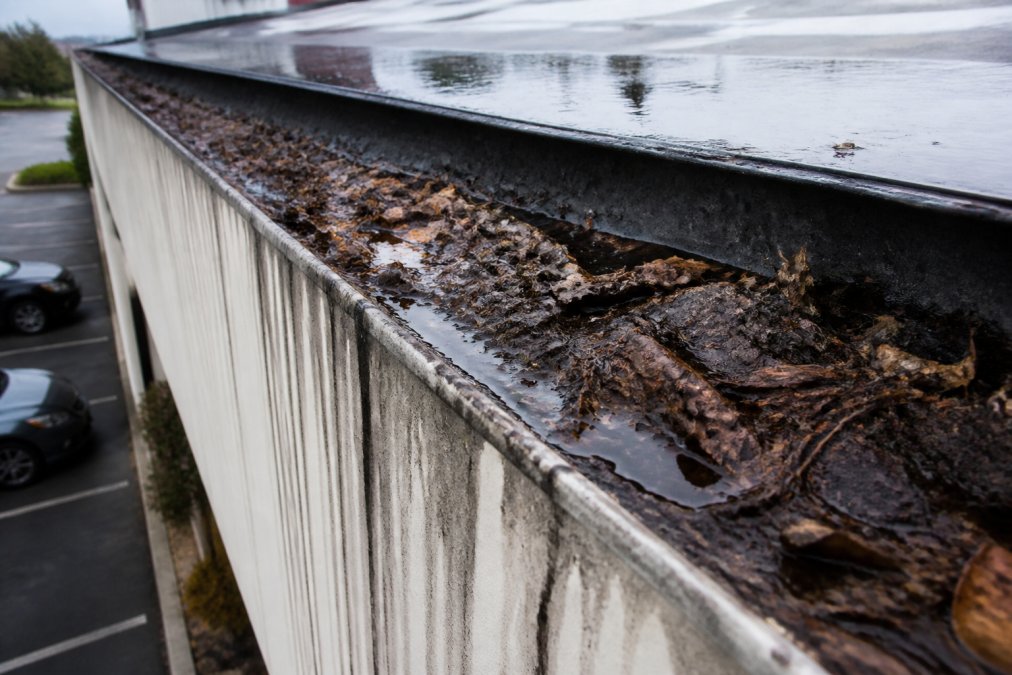
A common mistake property managers make is waiting for a tenant complaint before investigating. By the time occupants notice water intrusion, drainage efficiency has typically been compromised for weeks. Scheduled preventative inspection catches these issues before they reach that stage.
How Often to Clean Commercial Gutters
Commercial gutters should be cleaned at minimum twice per year: once in late spring after pollen and seed dispersal, and once in late fall after deciduous trees have shed. The actual frequency your property requires depends on several variables.
Properties surrounded by mature trees often require quarterly service. Flat or low-slope commercial roofs accumulate debris faster than pitched residential roofs because there is no gravity-assisted runoff. Industrial gutter systems on large warehouse or manufacturing facilities may need monthly inspection during high-debris seasons.
| Property Type | Surrounding Environment | Recommended Frequency |
|---|---|---|
| Office building | Minimal tree cover | Twice per year |
| Retail strip or storefront | Moderate tree cover | Three times per year |
| Warehouse or flat-roof facility | Open exposure | Twice per year + post-storm check |
| Any commercial building | Heavy tree cover | Quarterly |
| Properties with gutter guards | Any environment | Annual inspection minimum |
Gutter guards reduce debris accumulation but do not eliminate maintenance. Fine debris, shingle grit, and organic material still pass through most guard systems and require periodic removal. Factor this into your service contract.
Seasonal Scheduling Strategy for Property Managers
Seasonal scheduling is where most commercial property maintenance programs leave money on the table. The goal is to time cleanings immediately before periods of highest rainfall demand.
Scheduling a fall cleaning for late November or early December, after the bulk of leaf fall is complete but before peak winter precipitation, is smarter than cleaning in October when gutters will be partially blocked again by November. Schedule the spring cleaning for late April or May, after tree pollen and seed release has largely finished.
For properties in regions with distinct dry and wet seasons, align your service contract to ensure the system is fully cleared before the first significant storm of the wet season.
Commercial Gutter Cleaning Cost Per Linear Foot: What to Expect
Commercial gutter cleaning cost per linear foot varies based on building height, accessibility, debris load, and local labor rates. Request a formal quote based on your property’s actual linear footage, story height, and access conditions.
What drives cost variation most significantly:
- Building height. Each additional story increases equipment requirements, setup time, and OSHA fall protection protocols.
- Debris load. A gutter system on a regular schedule is faster and less expensive to service than one neglected for two or more years.
- Downspout clearance complexity. Systems with multiple downspouts, underground drainage connections, or complex routing require more time to flush and inspect.
- Roof access. Properties requiring specialized lifts or scaffolding carry higher service costs than those accessible by ladder.
Contact Simply Superior Window Cleaning for a virtual quote. The virtual proposal process allows for accurate pricing without requiring an on-site visit in most cases.
Cost-Benefit Analysis of a Maintenance Contract
A maintenance contract for commercial gutter cleaning almost always delivers better value than one-off service calls. Scheduled service typically costs less per visit than reactive emergency calls, which often carry premium pricing. More importantly, the cost of a water damage claim, foundation repair, or fascia board replacement dwarfs the cumulative cost of years of preventative maintenance.
A single water intrusion event can trigger interior ceiling damage, mold remediation, disrupted tenant operations, and potential liability exposure. Preventative maintenance is risk management.
A well-structured maintenance contract should include documentation of each service visit, which matters for insurance purposes and lease compliance. Many commercial leases place explicit responsibility on property managers for drainage system maintenance, and documented service records demonstrate due diligence.
The cost-benefit case for a maintenance contract rests on risk avoidance. A single water damage event typically costs far more than several years of scheduled cleanings.
OSHA Gutter Cleaning Safety Standards and Liability Documentation
OSHA gutter cleaning safety standards fall primarily under the OSHA 29 CFR 1926 Subpart M fall protection standards, which govern fall protection for workers at heights of six feet or more. Commercial gutter cleaning on any structure above single-story height requires fall protection systems: safety harness, anchor points, and in many cases, guardrails or safety nets.
This matters to property managers for two reasons. First, if a contractor’s worker is injured on your property due to inadequate fall protection, liability exposure does not rest solely with the contractor. Property owners have a duty to ensure contractors comply with applicable safety standards. Second, hiring an unlicensed or uninsured contractor to reduce cost is a false economy. Liability exposure from a worksite injury will exceed any savings on the service invoice.
Before any commercial gutter cleaning engagement, verify:
- The contractor carries current general liability insurance
- Workers’ compensation coverage is active for all field technicians
- The crew uses OSHA-compliant fall protection equipment for the building height involved
- The contractor can provide a certificate of insurance on request
Documentation of service visits should include the date, scope of work performed, technician names, and any observations about gutter condition or needed repairs.
What to Ask Before Hiring a Contractor
Questions that separate professional commercial gutter cleaning contractors from other providers:
- Are you licensed and insured, and can you provide a certificate of insurance naming our property?
- What fall protection equipment does your crew use for buildings of this height?
- Do you conduct monthly safety meetings or ongoing technician training?
- Will you provide a written service report after each visit?
- Do you offer a service contract with scheduled visits, or only one-off calls?
- How do you handle gutter repairs identified during cleaning?
A contractor who hesitates on any of the first three questions is a liability risk, regardless of price.
The Commercial Gutter Cleaning Process: Step by Step
A professional commercial gutter cleaning follows a defined sequence:
Step 1: Site assessment. The crew evaluates building height, roof access points, gutter configuration, and downspout routing to determine equipment requirements and safety anchor points.
Step 2: Fall protection setup. For any building above single-story, safety harnesses, anchor systems, and where applicable, boom lifts or scaffolding are positioned and inspected.
Step 3: Debris removal. Technicians clear accumulated leaves, dirt, shingle grit, and organic material using professional-grade equipment. Debris is bagged and removed from the property.
Step 4: Downspout clearance. Each downspout is flushed to confirm unobstructed flow. Blockages are cleared mechanically or with pressurized water.
Step 5: Fascia board inspection. Technicians inspect fascia boards and gutter hangers for signs of rot, damage, or loosening, documenting any issues.
Step 6: Final flush and drainage efficiency check. The entire system is flushed with water to confirm that roof runoff flows correctly through all channels and exits cleanly at each downspout.
Step 7: Service documentation. A written report details work completed, identified issues, and recommendations for repair or follow-up.
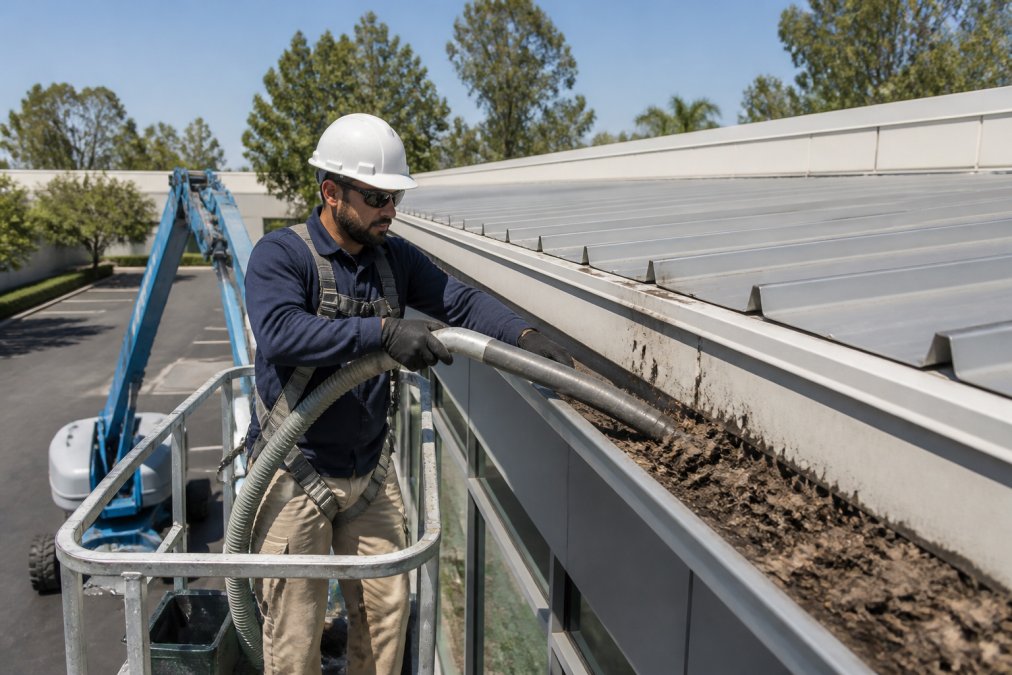
Skipping downspout clearance verification is the most common shortcut in commercial gutter cleaning. A gutter that looks clean at the channel can still have a fully blocked downspout. Always confirm that water exits freely at ground level before signing off on the job.
What to Include in a Commercial Gutter Cleaning Contract Template
A commercial gutter cleaning contract template should protect both parties and create a clear record for compliance purposes.
A complete commercial gutter cleaning contract should include:
- Property address and full description of the gutter system (linear footage, number of stories, downspout count)
- Scope of work: debris removal, downspout clearance, fascia inspection, final flush
- Service frequency and scheduled visit dates for the contract term
- Pricing per visit and total contract value
- Insurance requirements: minimum liability coverage amounts, workers’ compensation confirmation
- Safety compliance statement referencing OSHA fall protection standards
- Documentation deliverables: written service report after each visit
- Repair notification process: how and when the contractor will communicate identified issues
- Cancellation and rescheduling terms
- Payment terms and invoicing schedule
Property managers overseeing multiple commercial facilities should ensure contracts specify each property address individually, with its own scope and pricing.
How to Schedule Commercial Gutter Cleaning Service
Step 1: Assess your current gutter condition. Walk the perimeter after the next rain event and look for overflow, staining, or sagging.
Step 2: Determine your required frequency. Most commercial properties need two to four visits per year.
Step 3: Request a site assessment or virtual quote. Simply Superior Window Cleaning offers virtual quote capability, allowing property managers to receive accurate proposals without scheduling an on-site visit.
Step 4: Verify credentials before signing. Confirm insurance, licensing, and safety training.
Step 5: Establish your service calendar. Align cleaning dates to your seasonal rainfall patterns. Late fall and late spring are standard anchor points; adjust based on your local environment and tree cover.
Step 6: Set up documentation protocols. Confirm that the contractor will provide written service reports after each visit.
Step 7: Review annually. At contract renewal, evaluate whether frequency and scope still match the property’s needs.
According to the Building Owners and Managers Association guidance on preventative maintenance, documented preventative maintenance programs consistently reduce unplanned repair costs and support stronger lease compliance records. Scheduling commercial gutter cleaning service as a formal contract is the single most effective step toward that outcome.
Neglected commercial gutters are a slow-moving liability that most property managers recognize too late. Simply Superior Window Cleaning provides comprehensive commercial gutter maintenance, including debris removal, downspout clearance, and fascia inspection, with rigorous technician training, monthly safety meetings, and flexible maintenance contracts sized to your property portfolio. Schedule a free quote and get a maintenance plan that protects your building before the next rain season arrives.
Frequently Asked Questions
How much does commercial gutter cleaning cost?
Commercial gutter cleaning pricing depends on several factors: linear footage of gutters, building height, debris accumulation level, and service frequency. Multi-story commercial facilities with industrial gutter systems cost more per visit than single-story properties. Properties on recurring service contracts typically pay less per visit than one-time cleanings. For an accurate figure, request a site assessment and free estimate from a licensed and insured provider rather than relying on generic averages.
How often should commercial gutters be cleaned?
Most commercial properties need professional gutter cleaning at least twice a year, typically in late fall after leaves drop and in early spring before heavy rains. Properties surrounded by trees, flat-roofed buildings with heavy roof runoff, or facilities in areas with frequent storms may need quarterly service. A licensed contractor can assess your building's debris accumulation patterns and recommend a customized scheduled service interval.
Are there OSHA requirements for commercial gutter maintenance?
OSHA's fall protection standards under 29 CFR 1926 Subpart M apply to gutter cleaning work performed at heights of six feet or more above a lower level. Contractors must provide fall protection systems such as safety harnesses, guardrails, or safety nets. When hiring a commercial gutter cleaning company, verify that technicians are trained to OSHA standards and that the company carries general liability insurance and workers' compensation coverage to protect your property.
How do I verify if a gutter cleaning company is insured?
Ask the contractor to provide a certificate of insurance before any work begins. The certificate should list general liability coverage and workers' compensation insurance with your property named as an additional insured. A reputable, licensed and insured provider will supply this documentation without hesitation. Also confirm that technicians follow OSHA gutter cleaning safety standards for fall protection, which reduces your liability exposure as the property owner or manager.
This article was written using GrandRanker