
Table of Contents
- Why Commercial Window Cleaning Schedules Matter for Your Building
- Commercial Window Cleaning Frequency Chart by Building Type
- Factors Affecting Your Window Cleaning Schedule
- Signs Your Commercial Windows Need Immediate Attention
- OSHA Window Cleaning Safety Standards and Compliance
- Budgeting, ROI, and the Case for Preventative Maintenance
- How to Build and Manage a Commercial Window Cleaning Schedule
- Conclusion
Last Updated: August 10, 2026
Why Commercial Window Cleaning Schedules Matter for Your Building
Commercial window cleaning maintenance schedules can mean the difference between glass that lasts decades and glass that degrades prematurely. At Simply Superior Window Cleaning, we’ve seen how skipping routine maintenance creates compounding problems: mineral deposits etch into the glass surface, seals fail, and what started as a cleaning issue becomes a costly glass replacement project.
Clean windows protect glass integrity, preserve energy efficiency, and signal professionalism to clients, tenants, and passersby. The right service interval depends on your building type, local environment, glass specification, and the specific contaminants your property faces. A retail storefront in a high-traffic urban corridor needs a completely different approach than a mid-rise office building with curtain wall systems.
Commercial window cleaning is a preventative maintenance discipline, not a cosmetic afterthought.
Commercial Window Cleaning Frequency Chart by Building Type
The right service interval depends primarily on your building type, occupancy, and exposure. Use the chart below as a baseline, then adjust based on the environmental factors covered in the next section.
| Building Type | Recommended Frequency | Primary Concern |
|---|---|---|
| High-traffic retail / storefront | Weekly to bi-weekly | Fingerprints, dust, foot traffic residue |
| Restaurant / food service exterior | Bi-weekly to monthly | Grease, smoke, food odors on glass |
| Low-rise office (1-3 stories) | Monthly to quarterly | General soiling, seasonal debris |
| Mid-rise office / curtain wall systems | Quarterly to semi-annual | Hard water stains, mineral deposits |
| Medical / healthcare facilities | Monthly | Hygiene standards, patient perception |
| Industrial / warehouse | Quarterly to annual | Heavy particulate, chemical exposure |
Low-Rise Retail and Storefront Properties
Retail and storefront properties face the most demanding cleaning requirements. Customer-facing glass at street level accumulates fingerprints, dust, exhaust residue, and seasonal pollen at a rate that makes weekly or bi-weekly cleaning the professional standard.
Curb appeal drives foot traffic. Dirty glass signals neglect to potential customers and compounds quickly. For restaurants and food service businesses, grease and smoke particulate bond to glass more aggressively than standard dust and require specific cleaning agents to remove without streaking.
For retail storefronts, schedule interior glass cleaning on the same cycle as exterior cleaning. Interior surfaces accumulate product residue, HVAC dust, and customer contact at comparable rates.
Mid-Rise Office Buildings and Curtain Wall Systems
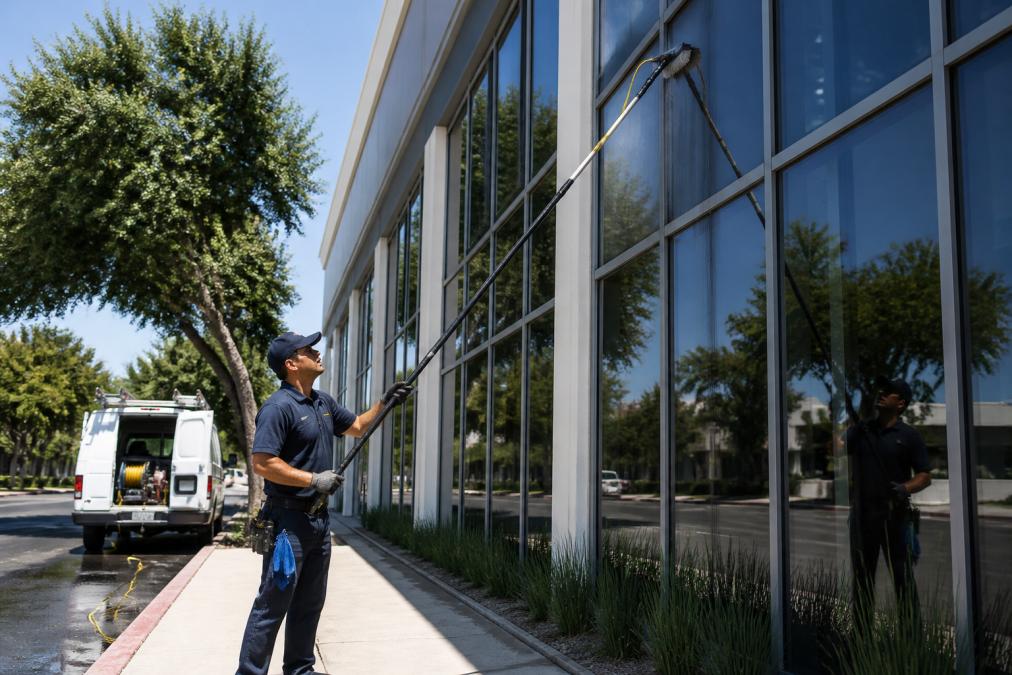
Mid-rise office buildings with curtain wall systems require quarterly cleaning at minimum; semi-annual cleaning is appropriate only in low-pollution environments. The sheer surface area of glass-dominant facades means that even moderate soiling becomes highly visible from street level.
Curtain wall systems require particular attention because framing and gaskets trap debris and moisture, creating conditions for mold growth and seal degradation. Professional window washing at the right frequency keeps these systems functioning as designed.
Interior vs. Exterior Cleaning Intervals
Exterior glass in most commercial environments needs cleaning two to four times more frequently than interior surfaces. Interior windows in climate-controlled office environments often need only quarterly or semi-annual attention, while the same building’s exterior may require monthly service. The exception is high-occupancy interiors where glass partitions accumulate fingerprints and HVAC particulate rapidly.
Factors Affecting Your Window Cleaning Schedule
No two buildings soil at the same rate. These environmental and material factors will push your actual service interval shorter or longer.
Weather, Environment, and Hard Water Stains
Geography is one of the biggest variables in determining cleaning frequency. Buildings in coastal environments face salt air that deposits chloride compounds on glass surfaces. Left uncleaned, these deposits corrode the glass surface and surrounding metal frames.
Hard water stains are a particular issue in Southern California, where municipal water has elevated mineral content. When water evaporates on glass, it leaves behind calcium and magnesium deposits that become progressively harder to remove and attract future soiling more aggressively.
Spring brings pollen. Summer brings UV exposure that bakes surface contaminants into glass. Fall and winter bring rain that often leaves glass dirtier than before as it carries airborne particulate down the facade.
Do not assume that rain cleans your windows. Rainwater in most urban environments carries dissolved pollutants and deposits them directly onto glass surfaces, often accelerating the need for professional cleaning.
Glass Degradation, Chemical Etching, and Mineral Deposits
Glass degradation is a real and permanent risk when commercial windows go without adequate maintenance. Chemical etching occurs when acidic or alkaline substances remain in contact with glass long enough to alter the surface structure at a microscopic level. Common culprits include acid rain, fertilizer overspray, construction runoff, and mineral deposits. Once etching occurs, the glass surface cannot be restored by standard cleaning methods.
According to the Glass Association of North America’s guidance on glass performance, unaddressed surface contamination is one of the leading causes of premature glass failure in commercial installations. Deionized water systems used by professional window cleaning services leave no residue when they evaporate, reducing mineral deposit buildup between service visits.
Signs Your Commercial Windows Need Immediate Attention
These indicators warrant an unscheduled service call:
- White haze or clouding on the glass surface indicates mineral deposit buildup requiring professional glass restoration.
- Water streaking that doesn’t clear after rain signals surface contamination has altered the glass’s hydrophobic properties.
- Visible corrosion on window frames or sills accelerates when cleaning is deferred.
- Fogging or condensation between panes indicates window seal failure.
- Dark streaking from sill runoff requires prompt professional attention.
- Visible biological growth indicates moisture retention requiring attention.
OSHA Window Cleaning Safety Standards and Compliance
Safety compliance is non-negotiable in commercial window cleaning. According to OSHA’s standards for window cleaning and elevated work, commercial window cleaning operations are subject to regulations governing fall protection, personal protective equipment, and the use of aerial lifts and rope access systems.

Key compliance areas include:
- Fall protection systems. OSHA requires fall protection for any work at heights of four feet or more, typically meaning anchor systems, safety harnesses, and lanyards rated for the specific load and drop distance.
- Aerial lift certification. Technicians operating boom lifts or scissor lifts must be trained and certified per OSHA 1910.67.
- Rope access systems. Suspended scaffold and rope descent systems are governed by OSHA 1910.27, which specifies anchor strength, equipment inspection, and two-person minimum requirements.
- Personal protective equipment. Appropriate PPE includes non-slip footwear, gloves, and eye protection when working with cleaning agents.
The Simply Superior Window Cleaning team holds monthly safety meetings and puts every technician through rigorous training before they work on any commercial property.
When evaluating commercial window cleaning providers, ask directly about their fall protection training, OSHA compliance record, and equipment inspection protocols. A provider that cannot answer these questions specifically is a liability risk for your property.
Budgeting, ROI, and the Case for Preventative Maintenance
Many facility managers approach commercial window cleaning as discretionary spending. This is the wrong framing. The ROI calculation has two components: avoided cost of glass restoration or replacement, and the revenue or tenant retention impact of building appearance.
Glass replacement for commercial curtain wall panels is a significant capital expense. Routine professional window cleaning at the correct frequency is the lowest-cost option by a wide margin and the only one that prevents the problem rather than addressing it after the fact.
Building appearance directly influences tenant satisfaction and lease renewal rates. According to BOMA International’s research on building operations and tenant experience, building exterior condition is consistently cited by commercial tenants as a factor in lease renewal decisions.
Treat commercial window cleaning as a line item in the preventative maintenance budget rather than the discretionary cleaning budget. Contact Simply Superior Window Cleaning for a virtual quote tailored to your property, with no obligation and no requirement for an in-person visit.
How to Build and Manage a Commercial Window Cleaning Schedule
Step-by-Step: Setting Up Your Maintenance Plan
Step 1: Audit your glass inventory. Document every window, glass partition, skylight, and glass facade element on your property. Note the type, orientation, and access requirements.
Step 2: Classify each surface by soil rate. Use the frequency chart above as your starting point. Adjust based on environmental factors: coastal proximity, construction activity, HVAC exhaust locations, and irrigation overspray.
Step 3: Assign service intervals. Most commercial properties end up with two or three distinct intervals: high-frequency for street-level glass, standard frequency for general office exteriors, and lower frequency for protected or interior-only surfaces.
Step 4: Schedule interior and exterior cleaning separately. Coordinate interior cleaning with building occupancy to minimize disruption.
Step 5: Build in post-event triggers. Define events that trigger unscheduled cleaning: major storms, construction activity, vandalism, or warning signs listed earlier.
Step 6: Document and review annually. Track actual soil rates against initial estimates and adjust service intervals based on real-world performance.
Integrating Schedules with Facility Management Software
Commercial window cleaning schedules work best when integrated into the broader facility management workflow. Most facility management platforms support custom preventative maintenance task scheduling. Window cleaning can be entered as a recurring work order with defined intervals, assigned vendor contacts, and completion documentation requirements.
Software integration ensures that window cleaning is tracked alongside HVAC, elevator, and life safety maintenance rather than falling through the cracks. Missed service cycles generate alerts rather than going unnoticed until glass deteriorates visibly.
According to IFMA’s guidance on preventative maintenance programs for commercial facilities, facilities with documented preventative maintenance schedules consistently outperform reactive-maintenance facilities on both cost and asset longevity metrics.
| Maintenance Approach | Glass Longevity Impact | Cost Profile | Risk Level |
|---|---|---|---|
| Scheduled preventative cleaning | Maximized | Predictable, lowest long-term | Low |
| Reactive cleaning (as-needed) | Moderate degradation over time | Variable, higher long-term | Medium |
| Deferred / infrequent cleaning | Significant degradation, etching risk | Lowest short-term, highest long-term | High |
| No scheduled maintenance | Permanent glass damage likely | Lowest short-term, replacement cost | Very high |
Facility managers who defer commercial window cleaning schedules consistently end up paying more over the life of a building. Glass degradation, chemical etching, and seal failure are expensive problems with straightforward preventative solutions.
Simply Superior Window Cleaning offers flexible maintenance contracts for commercial properties throughout Ventura and North LA Counties, with virtual quote options that eliminate the need for an in-person assessment. Our technicians are trained to handle buildings up to four stories with the safety protocols and equipment to do it correctly. Schedule a Free Quote and let us build a maintenance plan that protects your property and your budget.
Frequently Asked Questions
How often should commercial windows be cleaned?
Most commercial buildings benefit from cleaning every one to three months for exteriors, though the right interval depends on building type, location, and foot traffic. Storefront retail properties in high-traffic areas often need bi-weekly or monthly service. Office buildings in cleaner suburban environments may only need quarterly or semi-annual exterior cleaning. Interior glass typically needs less frequent attention. A professional assessment of your specific property gives you the most accurate service interval recommendation.
What factors influence the frequency of commercial window cleaning?
Several factors affect how often your windows need professional attention: proximity to roads or construction sites, coastal salt air exposure, local weather patterns, building height, and the type of glass installed. Hard water stains and mineral deposits from irrigation systems accelerate glass degradation if left untreated. Buildings near the coast in areas like Ventura County generally require more frequent service than inland properties due to salt spray and airborne debris that can cause chemical etching over time.
What are the benefits of a recurring commercial window cleaning contract?
A scheduled maintenance contract locks in consistent service intervals, which protects glass integrity and prevents costly restoration work caused by chemical etching or mineral deposit buildup. It also simplifies facility management by removing the need to book ad hoc appointments. Regular cleaning preserves curb appeal, supports tenant satisfaction, and can extend the lifespan of window seals. Many providers offer priority scheduling and consistent technician assignments under contract, which improves results over time.
What is the difference between interior and exterior window cleaning frequency?
Exterior glass faces direct exposure to weather, pollution, hard water overspray, and airborne debris, so it typically needs cleaning two to four times more often than interior glass. Exterior surfaces on busy storefronts may need monthly or bi-weekly service, while interiors in the same building often only need quarterly attention. Interior cleaning frequency rises in high-traffic lobbies, restaurants, or healthcare facilities where fingerprints, grease, and humidity accumulate faster than in standard office environments.
This article was written using GrandRanker