Table of Contents
- Quick Comparison: 5 Mild Soaps for Solar Panel Cleaning
- What Makes a Soap Safe for Photovoltaic Panels
- 1. Solar Panel Max Cleaner: The Purpose-Built Option
- 2. Winsol Solar Brite: Best for Large Residential Arrays
- 3. 303 Multi-Surface Cleaner: The Retail Standby
- 4. Dawn Dish Soap: The Budget Pick That Works When Diluted
- 5. Distilled Water With a Drop of Soap: The Zero-Residue Method
- How to Clean Solar Panels Without Damaging Them
- Frequently Asked Questions
Last Updated: September 27, 2026
Quick Comparison: 5 Mild Soaps for Solar Panel Cleaning
The best mild soaps for solar panel cleaning balance three things: a pH neutral formula, no abrasive additives, and a clean rinse that leaves nothing behind on the glass. This guide from Simply Superior Window Cleaning breaks down five options that meet those standards, from purpose-built concentrates to the distilled water method technicians use on sensitive arrays.
Below, we’ll show you exactly what separates a safe soap from one that quietly voids your warranty, plus the dilution ratios that keep photovoltaic glass streak-free.
| Product | Type | Best For | Key Feature |
|---|---|---|---|
| Solar Panel Max Cleaner | Purpose-built liquid | Dedicated solar care | pH-balanced, residue-free |
| Winsol Solar Brite | Concentrate | Large residential arrays | Anti-static, biodegradable |
| 303 Multi-Surface Cleaner | Retail spray | Multi-purpose use | Non-toxic, no abrasives |
| Dawn Dish Soap | Dish detergent | Budget cleaning | Works when heavily diluted |
| Distilled Water + Soap Drop | DIY mix | Zero-residue rinsing | No minerals, no spotting |
What Makes a Soap Safe for Photovoltaic Panels
A soap is safe for photovoltaic panels when it is pH neutral, free of abrasives, and rinses clean without leaving a film. Tempered glass is tough, but the anti-reflective coating on top of it and the frame seals around it are not, and the wrong chemistry causes damage you cannot see until output drops.
pH Neutral Formulas and Dilution Ratios
Most manufacturers specify a pH neutral cleaner because alkaline or acidic formulas can etch glass over repeated use. A common approach is mixing one or two drops of mild soap per gallon of water. More soap does not clean better; it just leaves more residue. A concentrate label will usually give a ratio in ounces per gallon, and it pays to measure rather than eyeball, because doubling the dose does not double the cleaning power.
Ingredients to Avoid vs. Ingredients That Are Safe
This is the part most guides skip. The list below is the quick-reference version worth taping inside your bucket lid.
| Avoid | Why | Safe alternative |
|---|---|---|
| Ammonia-based glass sprays | Can degrade anti-reflective coatings and frame seals | pH neutral soap or distilled water |
| Chlorine bleach | Corrosive to seals and metal mounting hardware | Oxygen-based or plain mild soap |
| Abrasive powders and scouring pads | Micro-scratches scatter light and cut output | Soft-bristle brush or microfiber |
| Acidic descalers (vinegar, citrus concentrates) | Etch glass and attack coatings over time | Distilled water final rinse |
| Solvent or petroleum-based degreasers | Leave films and can soften sealants | Diluted mild dish soap |
| Dish soaps with added lotions or degreasers | Leave a film that attracts dust | Plain, dye-free, fragrance-free mild soap |
Why Abrasive Materials and Corrosive Additives Void Warranties
Warranty terms typically exclude damage from abrasive materials, corrosive chemicals, or harsh detergents. Powder cleansers, scouring pads, and ammonia-based glass sprays all fall into that category. If a claim adjuster finds scratch marks or coating damage, the repair bill lands on you. Keep the label or spec sheet for whatever you use, and note the date you cleaned. If a warranty question ever comes up, a dated record of a pH neutral product is far easier to defend than a vague memory of “some dish soap.”
U.S. Department of Energy guidance on solar panel maintenance
1. Solar Panel Max Cleaner: The Purpose-Built Option
Solar Panel Max Cleaner is the safest starting point for anyone who wants a formula designed for solar glass rather than adapted from another job. It ships as a pH-balanced liquid with residue-free drying technology, and it works on all standard solar glass types.
2. Winsol Solar Brite: Best for Large Residential Arrays
Winsol Solar Brite earns its place for one reason: it is a concentrate. One bottle mixes into enough solution for a full large residential array, which makes it the practical pick for frequent maintenance.
3. 303 Multi-Surface Cleaner: The Retail Standby
303 Multi-Surface Cleaner is the option to grab when you need something today. It is non-toxic, biodegradable, and free of harsh chemicals or abrasives, and it handles both organic dirt and mineral grime.
4. Dawn Dish Soap: The Budget Pick That Works When Diluted
Dawn Dish Soap works on solar panels when you dilute it properly. A couple of drops in a gallon of water cuts through grime for a fraction of the cost of specialty cleaners, which is why so many homeowners keep a bottle in the garage.
5. Distilled Water With a Drop of Soap: The Zero-Residue Method
Distilled water with a single drop of mild soap is the zero-residue method professional technicians favor for routine maintenance. Distilled water contains no minerals, so it cannot leave hard water spots or calcium deposits as it dries.
Check your local water hardness before you mix anything. Hard water leaves mineral deposits even when your soap is perfect, so a final rinse with distilled or deionized water solves a problem no soap can.
How to Clean Solar Panels Without Damaging Them
Cleaning solar panels without damaging them comes down to five rules: work early, use soft tools, dilute correctly, rinse fully, and never scrub dry glass. Follow them and you protect both the panel surface and your warranty. The two things most guides leave out are what your water is doing to the glass and where your runoff ends up.
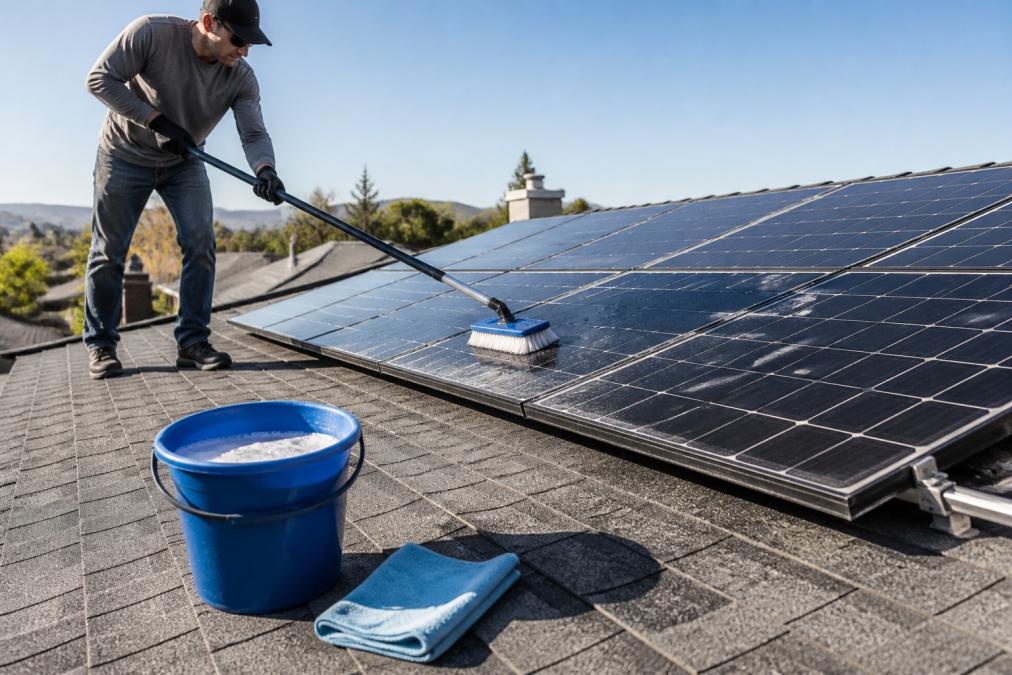
Here is the process, start to finish:
- Shut the system down if your inverter manual calls for it, then work in early morning when glass is cool. Thermal shock from cold water on hot glass can crack a panel.
- Rinse loose debris first with a garden hose. Pollen accumulation and dust act like sandpaper if you scrub before rinsing.
- Mix your solution at one or two drops of mild soap per gallon, or per the concentrate’s label.
- Wash with a soft-bristle brush on an extension pole. Skip abrasive materials entirely.
- Rinse top to bottom so dirty water never crosses clean glass.
- Dry with a microfiber cloth or squeegee to prevent spotting.
Water Hardness: The Variable No Soap Can Fix
If your tap water is hard, the minerals in it will leave spots on the glass no matter how perfect your soap is. Hard water spots are calcium and magnesium deposits, and once they bake on in the sun they bond to the surface and require a descaling step to remove. You can look up your utility’s water quality report, which is published annually, to see your hardness in grains per gallon or milligrams per liter.
Plant-Safe Runoff: What Ends Up in Your Garden
Never clean panels while they are hot or in full midday sun. Cold water on hot tempered glass causes thermal shock, and the cracked panel is not covered under warranty.
A few more solar panel cleaning best practices worth building into your routine: clean two to four times a year, more often if you live near farmland, open dirt, or heavy tree cover. Watch for bird droppings, which bake onto glass and block light in a small but stubborn spot. And keep an eye on environmental runoff, since soapy water leaving your roof ends up in the soil and storm drains below.
EPA guidance on outdoor water use and runoff
Frequently Asked Questions
What type of soap is best for cleaning solar panels?
A pH-neutral, biodegradable soap with no abrasives is the safest choice for photovoltaic glass. Purpose-built options like Solar Panel Max Cleaner or Winsol Solar Brite are formulated for tempered glass and aluminum frames, so they rinse clean without leaving residue that blocks sunlight. If you use a general cleaner, check that it contains no ammonia, no harsh acids, and no grit, since those can scratch the surface or degrade the frame seals over time.
Can I use Dawn dish soap to wash my solar panels?
Yes, when heavily diluted. A few drops of Dawn in a gallon of water cuts through bird droppings and pollen without harming tempered glass. The risk is concentration: too much soap leaves a film that causes streaking and reduces power output. Always follow with a clean-water rinse cycle, and never let soapy water dry on the panel in direct sun. For routine maintenance, plain distilled water is safer.
Does using the wrong soap void my solar panel warranty?
It can. Most manufacturer warranties exclude damage from abrasive materials, corrosive chemicals, or improper cleaning methods. A soap that scratches the anti-reflective coating or leaves mineral deposits may give the manufacturer grounds to deny a claim. Before cleaning, check your panel manual for approved solutions. When in doubt, pH-neutral soap or deionized water is the lowest-risk choice for keeping your warranty intact.
How often should I clean my solar panels for maximum efficiency?
Most homes need cleaning two to four times a year, but pollen accumulation and bird droppings can justify more frequent attention in spring and fall. A visible layer of dust or a drop in power output on your monitoring app signals it is time. In dry, dusty regions or near agricultural land, a seasonal cleaning schedule of every two to three months keeps energy efficiency steady and prevents mineral deposits from bonding to the glass.
Is it safe to use a pressure washer on solar panels?
No. Pressure washers force water behind the frame seals and can crack tempered glass through thermal shock, especially if you spray a hot panel with cold water. The high-pressure stream also strips the anti-reflective coating. Use a garden hose with moderate flow, a soft-bristle brush, and a squeegee instead. If your panels are heavily soiled or mounted on a steep roof, residential solar panel cleaning services have the right equipment and roof safety gear to do it without damage.
Cleaning solar panels safely is less about the soap and more about the discipline around it: the right dilution, a full rinse, and a healthy respect for a wet roof. If you want that handled by trained technicians who do it every week, Simply Superior Window Cleaning offers cost-effective solar panel cleaning, flexible maintenance schedules, and virtual quotes you can request from your phone. Schedule a free quote and keep your array producing at full output.