
Last Updated: October 25, 2026
Quick Summary
Commercial window cleaning equipment and techniques have evolved to safely handle multi-story buildings and large-scale properties, with water-fed poles, squeegees, safety harnesses, and specialized platforms serving distinct purposes based on building height and access requirements.
- Water-fed pole systems extend 20-60 feet and allow technicians to reach high windows from ground level without ladders.
- Building height determines equipment needs: single-story uses basic tools, two-story introduces extension ladders or water-fed poles, three to four-story requires harnesses and platforms with legally required fall protection.
- Proper squeegee technique maintains a 45-degree blade angle for initial passes and 30 degrees for finishing strokes with steady, even pressure.
- Safety harnesses must connect to secure anchor points and include shock absorbers to reduce fall impact forces.
- Professional teams check weather forecasts and postpone jobs when wind speeds exceed 20 miles per hour or conditions become unsafe.
Table of Contents
- Understanding Commercial Window Cleaning Equipment
- Water-Fed Pole Window Cleaning Systems
- Commercial Window Cleaning Tools for Different Building Heights
- Mastering the Commercial Window Squeegee Technique
- Commercial Window Cleaning Safety Equipment and Protocols
- Efficiency Strategies for Large-Scale Window Cleaning
- Scheduling Your Professional Commercial Window Cleaning Service
- Frequently Asked Questions
Understanding Commercial Window Cleaning Equipment
Commercial window cleaning equipment and techniques have evolved significantly to handle the demands of multi-story buildings and large-scale properties. The right equipment makes the difference between a time-consuming, risky job and an efficient, safe operation. At Simply Superior Window Cleaning, we understand that selecting the proper tools is foundational to delivering pristine results.
Commercial window cleaning equipment falls into several categories based on building height, window type, and access requirements. Water-fed poles, squeegees, cleaning solutions, safety harnesses, and specialized platforms each serve distinct purposes. Understanding what each tool does helps you make informed decisions about your cleaning strategy.
The fundamental principle behind commercial window cleaning equipment is that it must balance efficiency with safety. A squeegee that works beautifully on a one-story storefront won’t meet your needs for a four-story office complex. Similarly, a water-fed pole system that excels at reaching high windows requires different technique than traditional hand-squeegee methods. This guide walks you through the essential equipment, proven techniques, and safety protocols that professional teams rely on.
Water-Fed Pole Window Cleaning Systems
Water-fed pole systems represent a significant advancement in commercial window cleaning equipment, particularly for buildings up to four stories. These systems use purified water delivered through a pole with a brush head, eliminating the need for traditional ladders on many jobs. The pole extends 20-60 feet depending on the model, allowing technicians to reach high windows from ground level.
A water-fed pole system consists of several components working together. The pump pressurizes purified water stored in a tank, typically mounted on a vehicle or cart. Hoses deliver this water through an extendable pole to a brush head at the tip.
The key advantage of water-fed pole systems is safety. Technicians remain on the ground, eliminating fall hazards associated with ladders and scaffolding. This approach also covers more area per hour than traditional methods on taller buildings. For commercial properties, water-fed poles reduce insurance liability and worker compensation claims.
Installation and maintenance of water-fed systems require understanding water purification. Most systems use deionized water or reverse osmosis water to prevent mineral spotting. This purification step adds cost but delivers superior final results.
Commercial Window Cleaning Tools for Different Building Heights
Building height fundamentally determines which commercial window cleaning equipment and techniques you’ll use. Single-story buildings allow hand tools and basic ladders. Two-story properties introduce fall risks that demand safety equipment. Three- and four-story commercial buildings require water-fed poles, harnesses, or platform access.
For single-story commercial buildings, your commercial window cleaning equipment toolkit remains relatively simple. A squeegee, microfiber cloths, bucket, and cleaning solution handle most work. A six-foot ladder reaches second-story windows safely. This equipment set is affordable and sufficient for storefronts, single-level office buildings, and retail spaces.
Two-story buildings introduce complexity. Windows on the second floor become harder to reach safely with a ladder alone. This is where commercial window cleaning equipment decisions become critical. You can use an extension ladder with stabilizer bars, reducing tip risk. Alternatively, water-fed poles eliminate ladder work entirely.
Three- and four-story commercial buildings demand specialized commercial window cleaning equipment. Water-fed poles become essential for upper-floor access. Technicians working at height require safety harnesses, anchor points, and often platform or lift access. At this height, fall protection isn’t optional, it’s legally required under occupational safety standards.
Commercial window cleaning equipment needs vary significantly based on how tall your building is.
| Building Height | Equipment Used | Key Consideration |
|---|---|---|
| Single-story | Squeegee, cloths, bucket, cleaning solution, six-foot ladder | Affordable and sufficient for most business owners |
| Two-story | Extension ladder with stabilizer bars or water-fed poles | Water-fed poles eliminate ladder work and fall hazards |
| Three to four-story | Water-fed poles, safety harnesses, anchor points, platforms or lifts | Fall protection legally required under occupational safety standards |
Mastering the Commercial Window Squeegee Technique
The squeegee remains the primary tool for final window finishing despite modern innovations in commercial window cleaning equipment. Proper squeegee technique separates professional results from amateur attempts. Mastering this technique requires understanding blade angle, pressure, and stroke patterns.
A commercial window squeegee consists of a handle and a replaceable rubber blade. The blade width typically ranges from 10 to 24 inches for commercial work. The blade angle, the angle between the blade and the glass, directly affects performance.
Pressure application matters significantly. Too little pressure leaves water behind, creating streaks when the water dries. Too much pressure causes the blade to skip or chatter, leaving lines across the glass. The sweet spot involves steady, even pressure that maintains consistent blade contact without forcing the blade into the glass.
Stroke patterns affect efficiency and results. Discover how to get streak-free windows with hard water to overcome common challenges like mineral deposits. After completing horizontal passes, many professionals make a final vertical pass at the edges to catch any remaining water. OSHA guidelines on window cleaning safety emphasize proper technique as part of comprehensive safety practices.
Water-fed pole systems change squeegee technique because they eliminate the need for traditional hand-squeegee finishing on upper-story windows. However, ground-level work and detail areas still benefit from hand-squeegee finishing. Understanding both techniques makes you versatile across different building types and commercial window cleaning equipment setups.
Commercial Window Cleaning Safety Equipment and Protocols
Safety equipment separates professional operations from risky DIY attempts. Proper commercial window cleaning safety equipment protects technicians from falls, chemical exposure, and environmental hazards.
Fall protection forms the foundation of commercial window cleaning safety equipment for any work above six feet. A safety harness distributes fall forces across the body, preventing injury if a technician loses balance or slips. Harnesses connect to anchor points, secure attachment locations on the building structure. Modern harnesses include shock absorbers that slow falls and reduce impact forces. Technicians working on commercial properties must be trained in harness inspection, proper wearing, and anchor point identification.
Personal protective equipment beyond harnesses includes helmets, gloves, and eye protection. A hard hat protects against overhead hazards and falling objects. Work gloves provide grip in wet conditions and protect hands from sharp edges.
Chemical safety requires proper handling of cleaning solutions. Proper ventilation prevents inhalation of fumes. EPA guidance on chemical safety in commercial cleaning provides detailed requirements for handling and storing cleaning products.
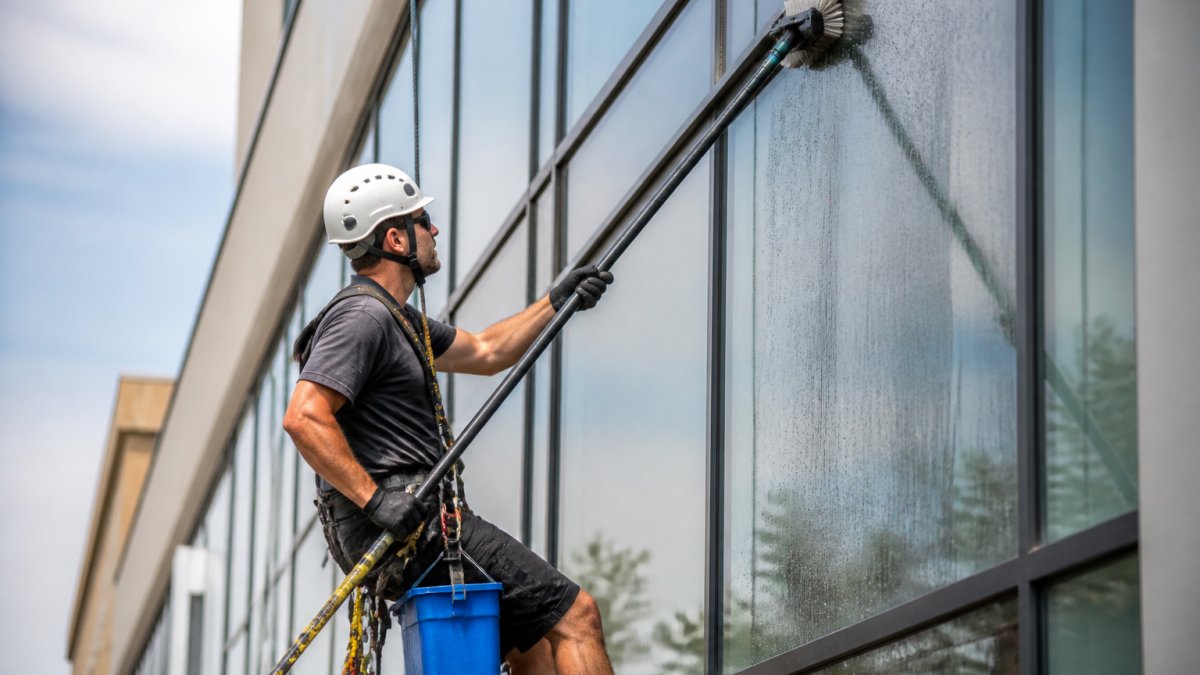
Weather monitoring represents an often-overlooked safety protocol. Wind speeds above 20 miles per hour create hazardous conditions for elevated work. Rain or ice makes surfaces slippery and increases fall risk.
Regular equipment inspection prevents failures that could cause injuries. Squeegee blades should be examined for nicks or deterioration that affects performance. ANSI standards for fall protection equipment outline inspection requirements that professional teams follow to ensure equipment reliability.
Efficiency Strategies for Large-Scale Window Cleaning
Efficiency in commercial window cleaning equipment operation directly impacts profitability and customer satisfaction. Large-scale jobs covering multiple stories or extensive square footage require strategic planning to minimize time while maintaining quality. Experienced teams develop systematic approaches that maximize output without cutting corners on safety or results.
Route planning forms the foundation of efficiency. Before beginning work, technicians should map the building’s layout, identify water access points, and plan equipment positioning. Starting at one corner and working systematically around the building prevents backtracking.
Batch processing techniques improve efficiency with commercial window cleaning equipment. Rather than completing each window individually, professionals often pre-wet multiple windows, then squeegee them in sequence. This approach keeps the solution wet and workable longer, improving cleaning effectiveness and reducing time per window.
Team coordination multiplies efficiency. One technician might operate the water-fed pole while another handles squeegee finishing and detail work. Larger teams can assign specific roles: equipment management, safety monitoring, and quality checking. Clear communication ensures smooth workflow and prevents duplicated effort.
Equipment maintenance scheduling prevents downtime that disrupts efficiency. A water-fed pump that fails mid-job forces rescheduling and disappoints clients. Regular maintenance, cleaning filters, checking seals, testing pressure, catches problems before they cause failures.
Scheduling Your Professional Commercial Window Cleaning Service
Determining when to hire professional commercial window cleaning services depends on building type, environmental factors, and business image priorities. Most commercial properties benefit from quarterly or semi-annual cleaning, though high-traffic areas or buildings in dusty environments may need more frequent attention.
When selecting a commercial window cleaning service, evaluate their equipment capabilities and safety practices. Learn how to choose a reliable commercial window cleaner to ensure you’re working with a qualified provider. Ask about their experience with buildings similar to yours, experience with your building height and window type matters significantly. best practices for hiring commercial service providers outlines evaluation criteria that help ensure you’re working with a reliable partner.
commercial window cleaning safety tips(page:1) provide detailed guidance on what professional teams should implement. Before committing to a service, discuss their safety protocols and ask for references from similar commercial properties. A reputable service welcomes these conversations and provides evidence of their commitment to safety and quality.
Virtual quote options simplify the hiring process. Rather than requiring multiple in-person visits, digital assessment allows you to receive accurate pricing and service recommendations quickly. This efficiency respects your time while ensuring the service provider understands your specific needs.
Professional commercial window cleaning equipment and techniques represent years of industry evolution focused on safety, efficiency, and results. Selecting the right equipment for your building type, maintaining rigorous safety protocols, and scheduling regular service protects your investment and maintains your property’s appearance. Simply Superior Window Cleaning combines industry-leading equipment with trained technicians who prioritize your peace of mind.
Frequently Asked Questions
What equipment do commercial window cleaners use?
Professional commercial window cleaners use water-fed poles (typically 20-60 feet), squeegees, microfiber cloths, pressure washers, safety harnesses, and specialized cleaning solutions. Equipment selection depends on building height, window type, and surface accessibility. Larger buildings often require rope access systems or lift equipment. The right tools ensure both efficiency and safety while protecting building surfaces from damage.
How often should commercial windows be cleaned?
Frequency depends on building location, weather conditions, and use. Most commercial properties benefit from quarterly or semi-annual cleaning. Buildings near highways, in coastal areas, or with high foot traffic may need monthly service. Ground-level storefronts often require more frequent cleaning than upper-floor windows. A professional assessment can determine the optimal schedule for your specific property.
What safety equipment is needed for commercial window cleaning?
Essential safety equipment includes OSHA-compliant harnesses, helmets, non-slip footwear, and eye protection. For water-fed pole work, workers need proper training and fall protection systems. Rope access requires specialized rigging equipment and certification. All technicians should use gloves to protect against chemicals and sharp edges. Regular safety inspections and monthly safety meetings help maintain compliance.
What is the best technique for cleaning commercial windows without streaks?
The commercial window squeegee technique involves applying cleaning solution, then using a squeegee at a consistent angle (typically 45 degrees) with smooth, overlapping strokes. Proper technique requires starting at the top corner and working downward, wiping the squeegee blade between passes. Microfiber cloths dry any remaining moisture. Water-fed pole systems reduce streaking by using purified water rinses. Technique mastery takes practice but significantly improves results and reduces rework.
Are commercial windows different from residential windows?
Yes. Commercial windows are typically larger, use different framing materials (aluminum versus vinyl), and often feature specialized coatings or tinting. They may include reflective glass, low-emissivity coatings, or safety films requiring specific cleaning approaches. Commercial buildings present unique challenges like building height, weather exposure, and accessibility constraints. Professional cleaning for commercial properties demands specialized equipment and trained technicians familiar with these differences.
Is professional commercial window cleaning worth the cost?
Professional cleaning protects your investment by preventing damage from mineral deposits and environmental contaminants that can etch glass permanently. Clean windows improve building appearance, which affects tenant satisfaction and property value. For multi-story buildings, professional service eliminates safety risks of DIY cleaning. Most property managers find the cost justified by improved aesthetics, reduced liability, and long-term property protection.