
Table of Contents
- Gutter Cleaning vs Gutter Guards: A Quick Comparison
- What Is the Average Cost of Gutter Cleaning?
- Gutter Guard Systems: Types and Materials
- How Often to Clean Gutters in California’s Climate
- Preventing Water Damage to Home Foundations
- Fire Safety and Gutter Guards in Wildfire Zones
- Long-Term ROI: Cleaning Costs vs Guard Installation
- Frequently Asked Questions
Last Updated: September 17, 2026
Gutter Cleaning vs Gutter Guards: A Quick Comparison
For California homeowners, the gutter cleaning vs gutter guards decision comes down to recurring labor versus a one-time installation. Cleaning removes debris that has already accumulated; guards stop most of it from settling in the channel in the first place. This guide covers the real costs, the material options, and the fire and water risks that make this choice more consequential here than in most states.
Winner: Professional cleaning for most homes with light tree cover and a modest budget. Choose professionally installed micro-mesh guards if you have heavy pine or eucalyptus debris and want to cut seasonal cleaning frequency.
| Factor | Gutter Cleaning | Gutter Guards |
|---|---|---|
| Upfront cost | Low, per visit | High, per linear foot |
| Ongoing cost | Recurring each season | Minimal after install |
| Debris protection | Removes buildup | Prevents most buildup |
| DIY friendly | Somewhat | Varies by system |
| Best for | Light debris, tight budgets | Heavy debris, long-term savings |
What Is the Average Cost of Gutter Cleaning?
The average cost of gutter cleaning depends on home size, roof pitch, and how many stories the crew has to reach. A single-story ranch with few trees sits at the low end, while a two-story home surrounded by pines pushes toward the high end because of labor rates and setup time.
Gutter Guard Systems: Types and Materials
Gutter guard systems fall into four main categories, and each handles debris differently. The right pick hinges on what actually lands on your roof: leaves, pine needles, or fine grit.
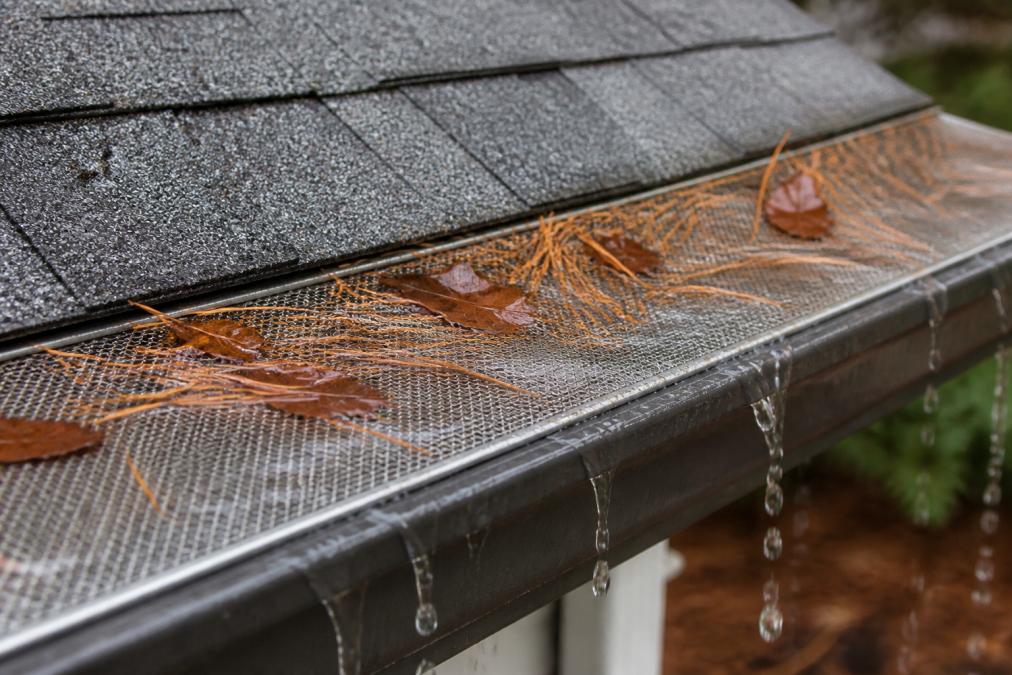
- Mesh screen guards: Stainless steel micro-mesh blocks the smallest debris, including pine needles and sand. Best for heavy tree cover.
- Reverse curve guards: Water curls over a curved surface into the gutter while leaves slide off. Effective for large leaves, weaker on fine debris.
- Foam inserts: Porous foam sits inside the channel and traps debris on top. Cheap and easy, but prone to clogging over time.
- Brush guards: Bristles fill the gutter and let water through. Simple to install, but they collect debris and need their own cleaning.
How Often to Clean Gutters in California’s Climate
How often to clean gutters here depends on your tree cover more than the calendar. Most homes need cleaning at least twice a year, once in late fall after leaves drop and once in spring. Homes under pines, eucalyptus, or oaks often need three or four visits because those trees shed year-round.
Preventing Water Damage to Home Foundations
Preventing water damage to home foundations starts with keeping water moving away from the house. A clogged gutter dumps hundreds of gallons directly at the base of your foundation during a storm, and that water finds every crack.
Fire Safety and Gutter Guards in Wildfire Zones
Fire safety and debris accumulation are linked in ways many homeowners miss. Dry leaves and pine needles sitting in a gutter are fuel, and an ember landing in that material can ignite the roof edge. This is the section where generic national guides fall short, because the rules and the risk profile here are different from most of the country.
Why gutters are an ignition point
Homes in the wildland-urban interface (WUI) face the highest risk. Ember showers from a nearby fire can travel well ahead of the flame front, and gutters packed with dry debris are a common ignition point. A gutter full of cured pine needles or eucalyptus litter is essentially a fuse running along the most vulnerable part of the roof, the edge, where the roof deck meets the fascia and where wind-driven embers collect.
What the codes actually require
If your home sits in a WUI-designated area, your local jurisdiction likely enforces ignition-resistant construction standards, and those standards reach the roof edge. The relevant framework is the wildland-urban interface chapter of the state building code, which local fire authorities adopt and sometimes tighten. Two practical points follow from it:
- Roof and edge assemblies in these zones are held to ignition-resistant or Class A standards, and gutter components are part of that assembly. A combustible plastic or foam insert sitting in the channel works against the intent of those requirements.
- Debris management is treated as a defensible-space obligation, not just a maintenance preference. Keeping the roof edge and gutter clear is part of the same ember-resistance strategy as clearing brush and screening vents.
Which guard materials hold up
Material choice is the whole game in a fire zone:
- Stainless steel micro-mesh with a metal frame is the strongest option. It will not burn, it keeps most embers and fine debris out of the channel, and it holds its shape under heat.
- Powder-coated aluminum guards are non-combustible and lighter, but the coating can degrade over time and the wider openings let more fine debris through.
- Plastic and foam inserts are the weakest choice here. They can melt, sag, or degrade under heat, and a foam insert that traps dry debris is the opposite of what you want at the roof edge.
A guard that keeps debris out of the channel still leaves debris sitting on top of the mesh. In a fire zone, that surface layer needs clearing too, an ember can ignite material resting on the guard just as easily as material inside the gutter.
The maintenance reality in a fire zone
Guards reduce how often debris reaches the channel, but they do not remove the need to inspect and clear the roof edge. In high-hazard areas, plan on checking the guard surface and the roof edge before and during fire season, and after any wind event that drops needles or leaves. Pair that with the defensible-space work around the structure, clearing brush, screening vents, and keeping the roof and gutters free of accumulated fuel.
Long-Term ROI: Cleaning Costs vs Guard Installation
The long-term return on investment favors guards only when your cleaning frequency is high enough to offset the upfront spend. The mistake most homeowners make is comparing a single cleaning invoice to a full installation quote. The honest comparison is total cost of ownership over a set horizon, usually five to ten years.
How to run the math on your own home
Start with three numbers you can get from any local quote:
- Your per-visit cleaning cost. This scales with stories, roof pitch, gutter linear footage, and debris load. A single-story ranch with light tree cover sits at the low end; a two-story home under pines sits at the high end.
- Your annual cleaning frequency. One to two visits for light cover, three to four for pine, eucalyptus, or oak.
- Your gutter linear footage. This is the unit guards are priced in, so it drives the installation side of the equation.
What actually swings the payback period
A few variables move the answer more than anything else:
- Cleaning frequency. At one visit a year, cleaning almost always wins. At three or four, guards typically pay back within a few years.
- Debris type. Fine debris like pine needles and roof granules is the hardest to keep out and the most likely to force repeat cleanings, which pushes the math toward guards.
- Guard lifespan. All-metal micro-mesh with a rigid frame outlasts plastic or foam inserts by a wide margin, so the amortized annual cost drops the longer the system holds up.
- DIY vs professional install. A DIY kit lowers upfront cost but shifts risk onto you, a poorly seated guard lets debris slip past the edge or traps water, which erases the savings.
The maintenance guards still require
Guards are not a maintenance-free product, and any ROI estimate that treats them as one is wrong. Fine grit, shingle granules, and small seed pods still work through most screens and settle in the channel. Plan on periodic flushing, often every one to three years depending on debris load, plus occasional surface clearing of the mesh itself. That residual cost is real and belongs in your comparison.
Guards win on ROI when you currently clean three or more times a year, when your debris is fine rather than leafy, and when you install a metal system that will last. They lose when you clean once a year, when you buy a cheap insert that clogs, or when a bad installation creates new problems.
Where the local angle changes the answer
Two factors specific to this market push the ROI calculation in ways a generic guide misses. First, the dry-to-wet cycle: months without rain let debris compact and harden in the channel, so the first winter storm is when clogs do their damage. That pattern raises the cost of a missed cleaning, which strengthens the case for guards on heavily treed properties.
Frequently Asked Questions
Do I need to clean gutters if I have gutter guards?
Yes, but far less often. Gutter guards block leaves and large debris, yet fine particles like pine needles, sand, and roof grit still accumulate on the mesh surface and inside the trough. In California’s dry, windy climate, dust and ash settle on top of guards and can reduce water flow. Most manufacturers recommend an annual inspection and occasional light cleaning, especially before the rainy season.
What is the average cost of professional gutter cleaning?
Professional gutter cleaning typically runs $100 to $500 per visit, depending on home height, gutter length, and debris volume. In California, two-story homes with heavy tree cover tend to fall at the higher end. Many homeowners schedule cleaning twice a year, which adds up over time. Requesting a quote from a local provider is the most accurate way to budget for your specific property.
How often should gutters be cleaned in fire-prone areas?
In wildfire-prone zones, clean gutters at least twice a year and after any nearby fire or heavy wind event. Dry leaves and pine needles in gutters are a fire hazard, especially in the wildland-urban interface. Some California fire agencies recommend quarterly checks during peak fire season. Gutter guards reduce debris buildup but do not eliminate the need for inspections.
Do gutter guards prevent water damage during heavy rain?
Gutter guards help water flow freely by keeping gutters clear, which reduces overflow that can damage foundations and siding. However, they cannot compensate for undersized gutters, clogged downspouts, or poor roof pitch. Pairing guards with regular downspout flushing and a professional inspection gives the best protection against water damage to home foundations.
How much do gutter guards cost for a 2,500 square foot home?
Gutter guard costs vary widely by material and installation method. DIY micro-mesh options range from $2.40 to $35 per foot at retail, while professionally installed systems require a project-based quote. For a 2,500 square foot home with roughly 200 linear feet of gutter, professional installation is a significant upfront investment, but it can reduce long-term cleaning expenses.